


The Fresh-Wallet Bets Against the Crypto Bill Just Doubled to $3 Million
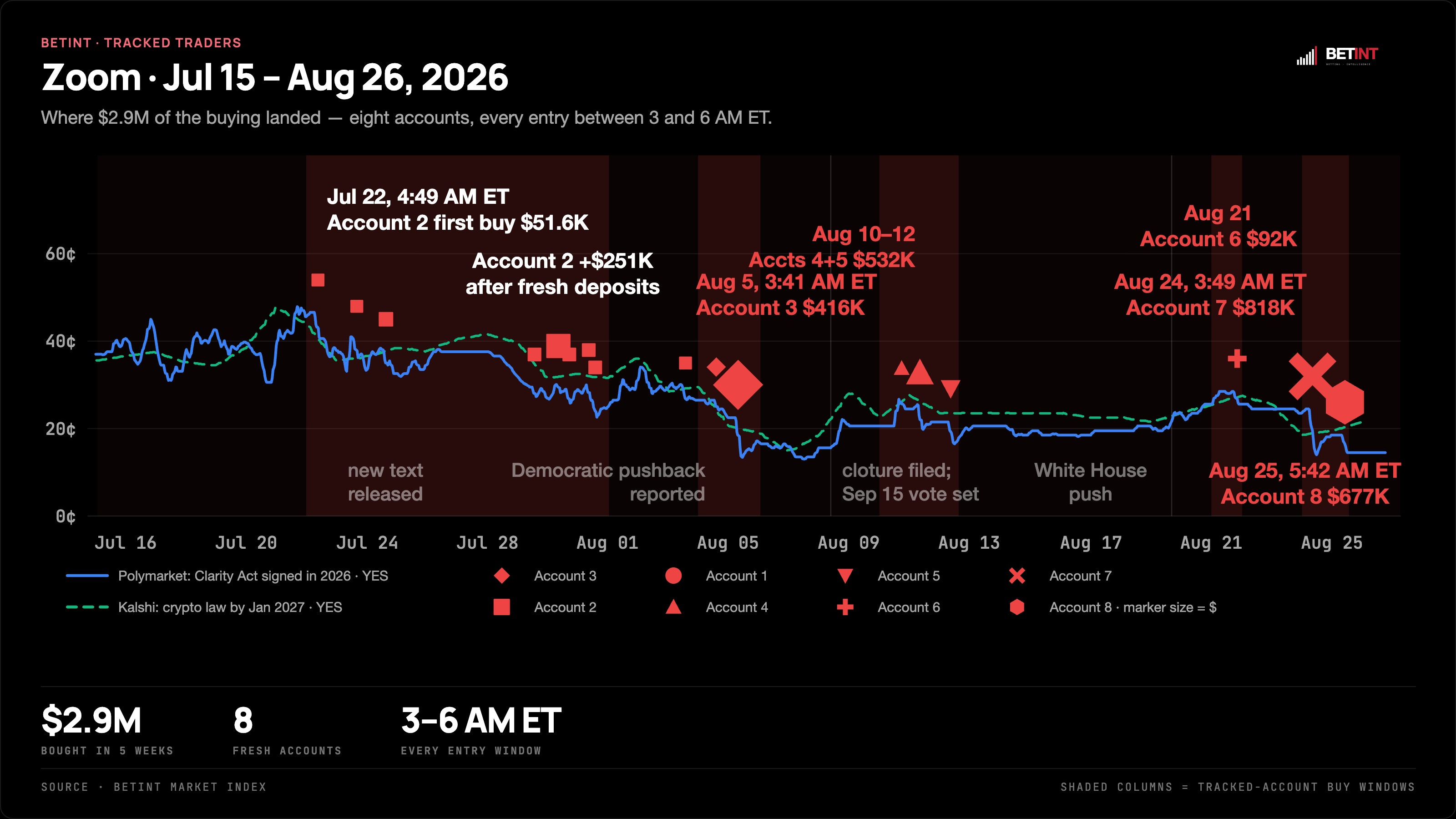
Two weeks ago we documented five brand-new Polymarket accounts betting $1.4 million that the CLARITY Act dies. Three more have arrived since, funded from the same exchange wallets, and the two largest purchases in the market’s history landed before dawn.
On August 24, a brand-new Polymarket account bet $818,000 that the CLARITY Act, the crypto bill facing a make-or-break Senate vote on September 15, does not become law this year. The account was just minutes old. The money had arrived moments earlier from an offshore exchange, and the whole trade was completed before sunrise in New York. The wallet hasn’t traded since.
On August 14 BETINT published an investigation into five accounts just like this one: fresh wallets, funded with hundreds of thousands of dollars from non-US crypto exchanges, betting one way on one market, mostly before dawn, never selling. We ended that piece by saying the story was still being written and we would be tracking every one of those wallets using our software, BETINT.ai.
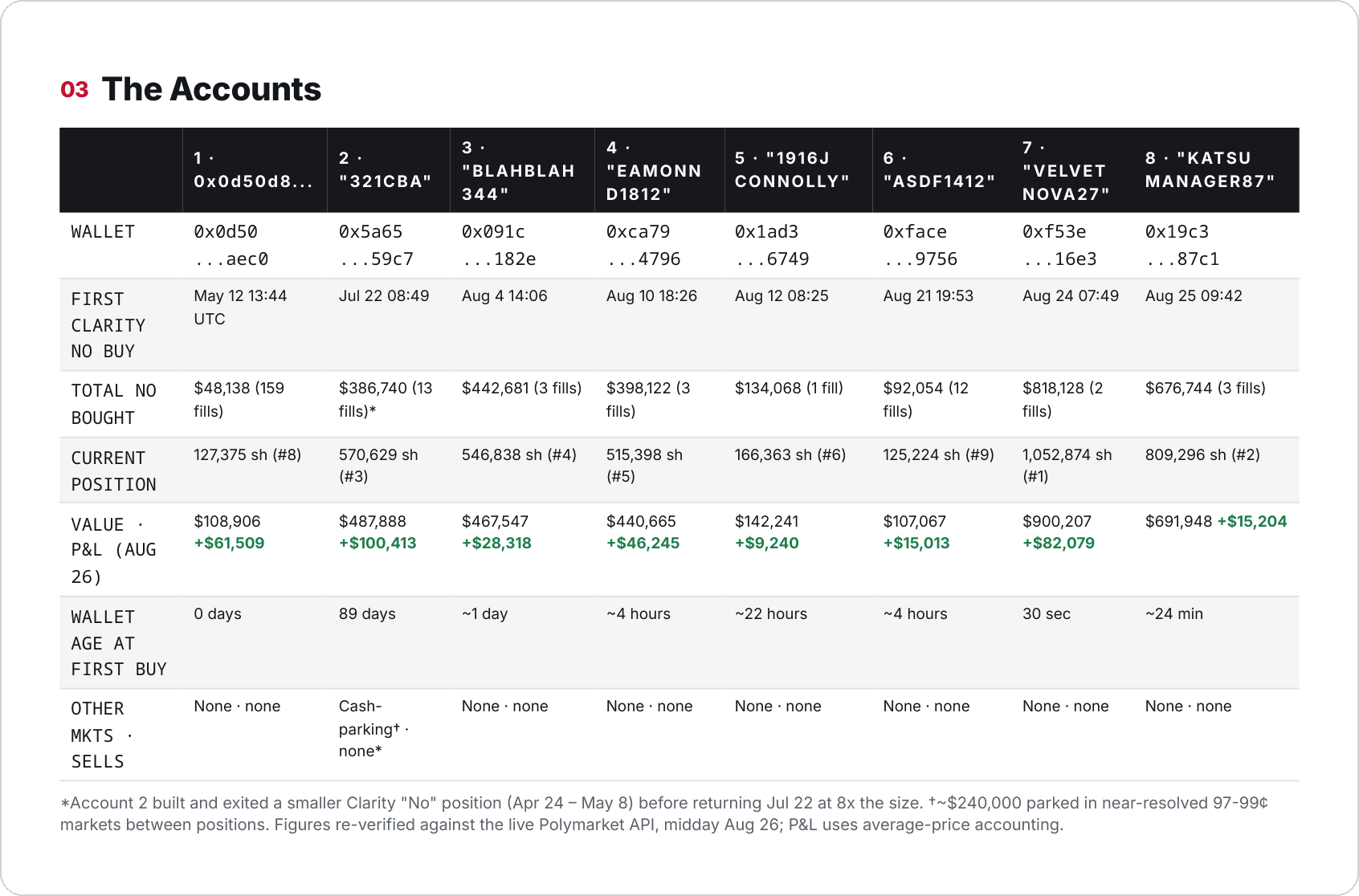
Since then, three more accounts have entered our view with another $1.6 million wagered on “No.” We’re now tracking eight accounts holding roughly $3.0 million at cost, which works out to eight of the nine largest “No” positions in the entire market. Not one share has been sold and seven of the eight accounts have never traded anything else, signaling to us analysts a convincing level of confidence.
As we stated in part 1 of our investigation, nothing in the public record tells us who is behind any of these accounts. We are not accusing anyone of insider trading, and we’re not claiming one person is running eight accounts. What we can show you, transaction by transaction, is where the money came from, how the wallets have behaved, and when they moved the market.
Where we left off
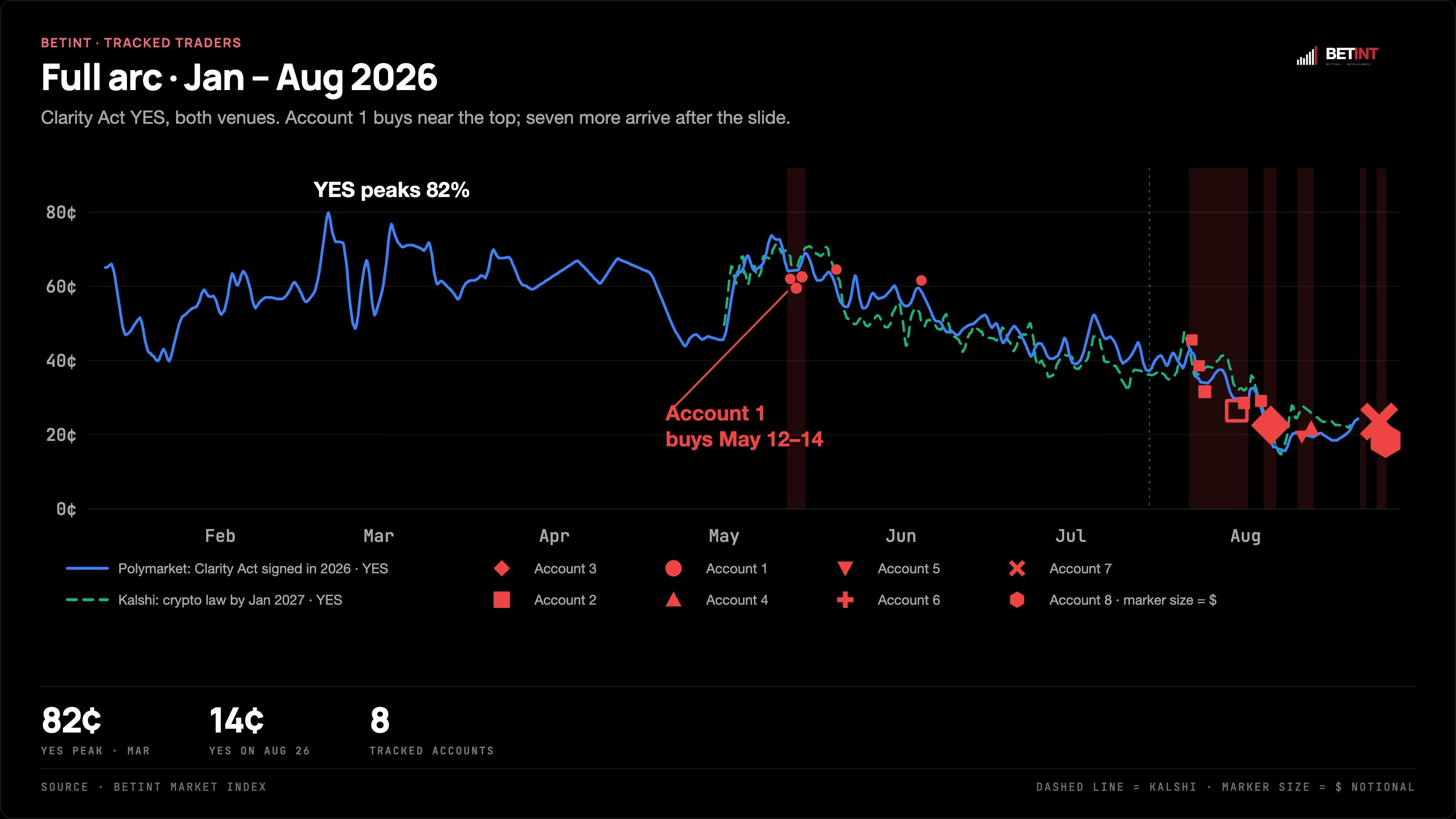
If you didn’t read part 1, here’s the short version (the first piece has the full detail): between May and mid-August, five accounts built about $1.4 million of “No” on this market.
Every one traced back to a withdrawal from Binance or Bybit, most through freshly created pass-through wallets used exactly once. One went from creation to a six-figure bet inside four hours. The largest purchases printed between 3:41 and 4:25 AM Eastern, on different dates. And in what may be the most important note, there were multiple instances where the money moved hours before news that hurt the bill became public.
When we published, the fifth account was sitting on $366,000 it had not spent, and we wrote that if that money moved, we would see it.
That money still hasn’t moved. What did happen, however, is that new money showed up, three times, through the same doors.
First, the bill rallied
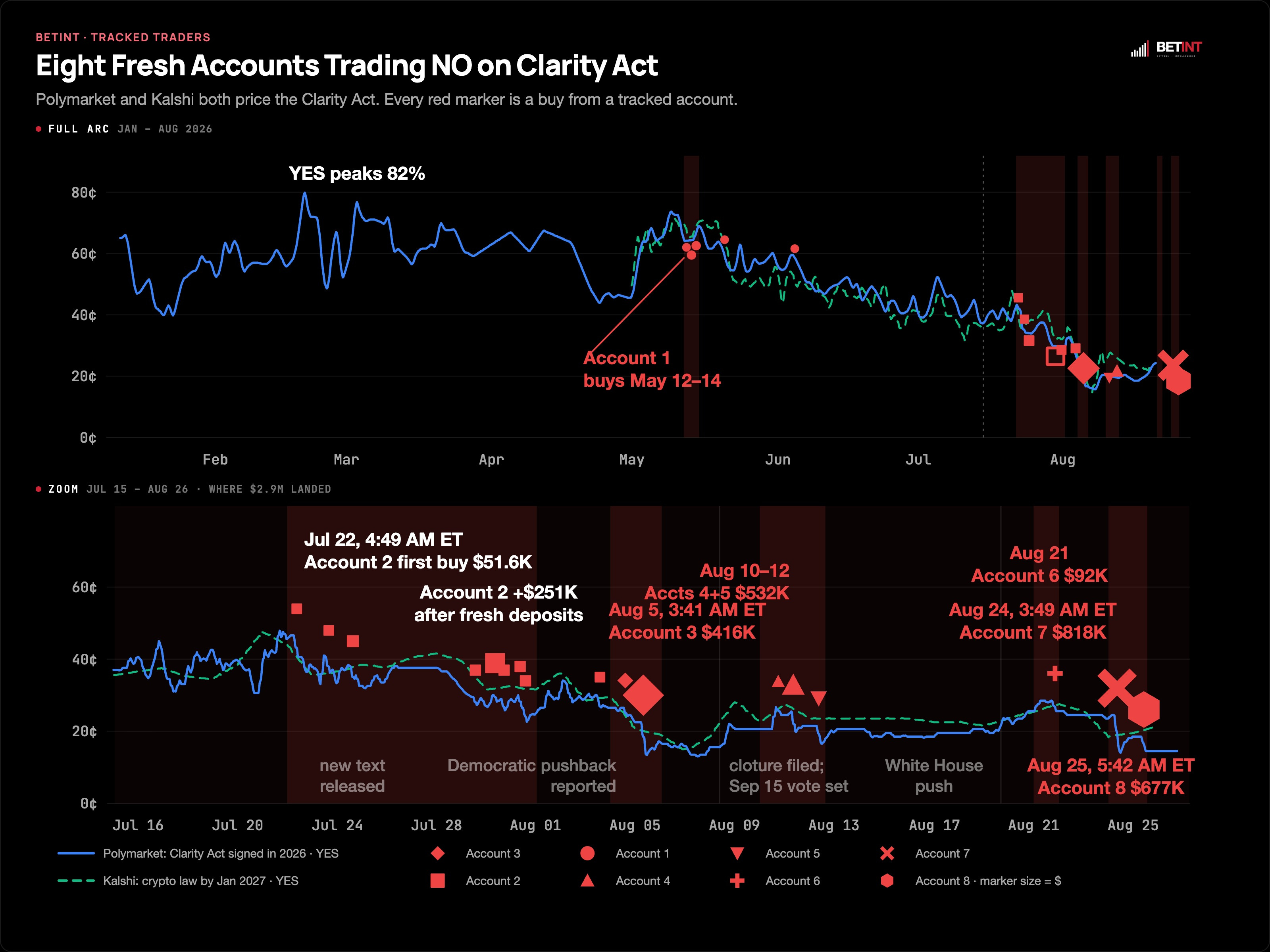
The timing matters here, because the new accounts didn’t buy into a falling market. They bought into a rising one.
The recess turned out to be eventful. On August 14, the OCC granted preliminary approval to a bank charter for World Liberty Financial, the Trump-family crypto venture at the center of the ethics fight that stalled the bill all summer.
On August 19, the White House hosted the industry’s chief executives, and the President urged Congress to pass “a fair version” of the bill.
Bitcoin surged, and Polymarket’s “Yes” price climbed from 18.5 cents to 25.5 over three days, its best stretch since June.
If you were holding $1.4 million of “No,” that was the worst week since the positions opened. None of the five accounts reacted. No sells, no adds, nothing. And then the new wallets started arriving.
August 21: back to the Binance channel
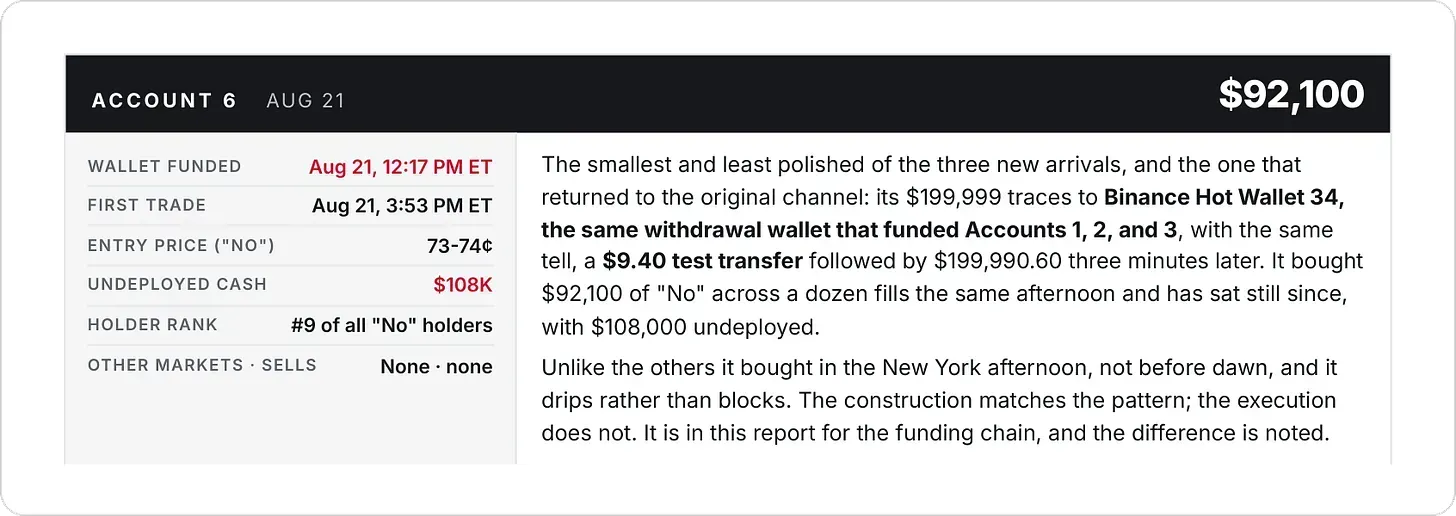
The sixth account is the smallest of the new three. Just after noon Eastern on August 21, a brand-new wallet received $199,999 traced to Binance Hot Wallet 34, the withdrawal wallet that also funded the first three accounts in our earlier piece, across what is now more than three months.
One thing to hold onto every time a shared hot wallet comes up in this story, starting now: these hot wallets are exchange plumbing. Hot Wallet 34 processes withdrawals for millions of Binance customers. Money arriving from it tells you the account was funded off Binance but it does not link one account to another directly.
The funding carried a similar human fingerprint we found in May: a small test transfer first, $9.40 this time, with the real money following a few minutes behind. That is a human operator; someone checking the pipe before sending the full amount.
It bought $92,100 of “No” that same afternoon, in a dozen fills, hours after the Bitcoin rally peaked. It has $108,000 still unspent.
This wallet did have some variety in it’s behavior relative to the other wallets. It bought into the market midday Eastern time - not before dawn like the other traders. It also dripped its buying in over a dozen trades rather than sweeping the book in one massive trade.
August 24: $818K the biggest position in the market
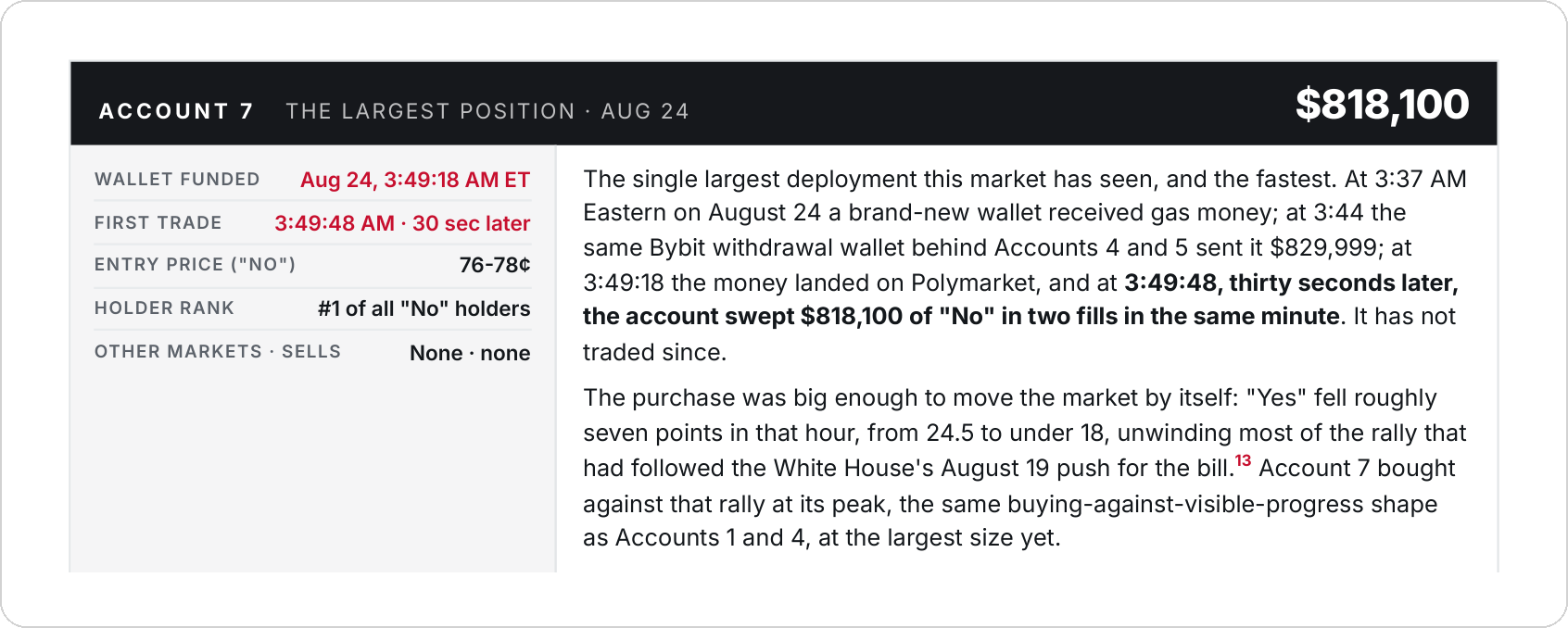
The seventh account is the new largest whale.
At 3:37 ET on August 24th, a brand-new wallet was opened. Minutes later, $829,999 arrived from a Bybit withdrawal wallet we recognized, one that had also funded the two newest accounts in our first piece. The money reached Polymarket at 3:49, and 30 seconds after it landed the account had bought $818,100 of “No” in two fills.
From empty wallet to the largest position in the market took about twelve minutes, and there was seemingly no hesitation anywhere in it. No pause to look at prices, no testing the market with a small order first.
The purchase was big enough to move the market by itself.
“Yes” fell roughly seven points in that hour, from 24.5 cents to under 18, and there was no headline or senator’s statement that hour to explain it. The rally that had been building since the White House meeting got unwound by this account’s trade.
The timing is also interesting, because it was the best odds the bill had to pass all month. The first piece documented two accounts buying against visibly good news for the bill, and this is the same behavior at an even bigger scale.
August 25: it happened again the next morning
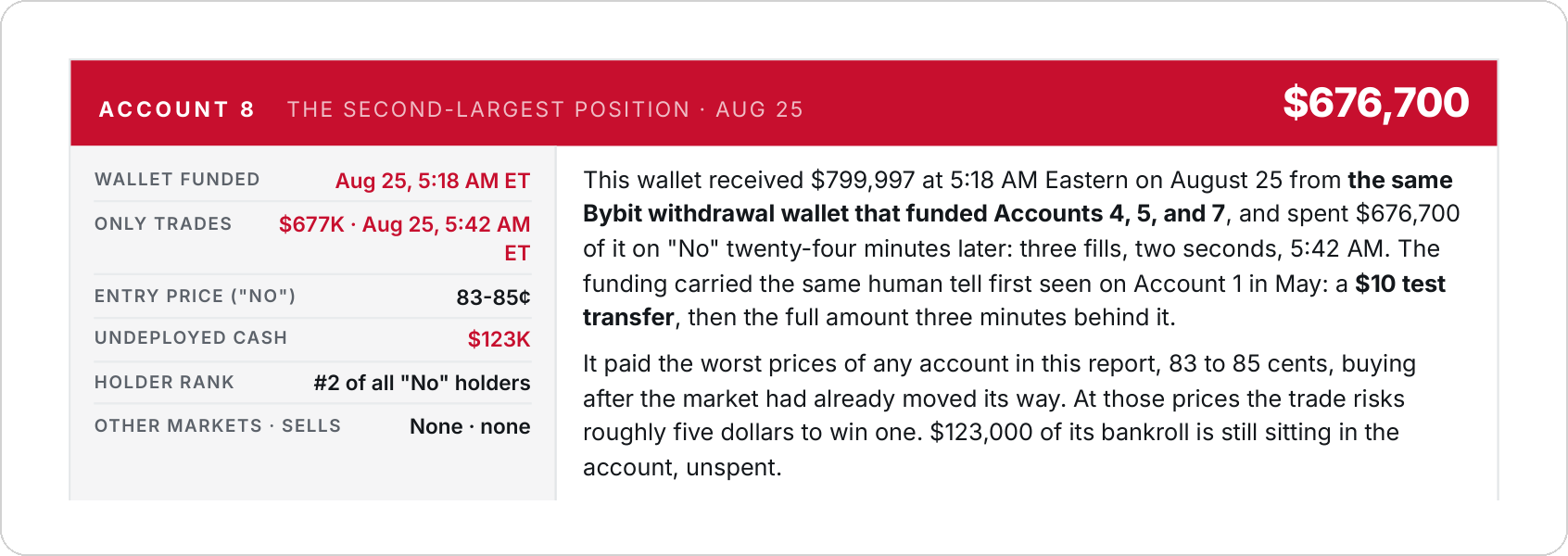
A day later it ran again, almost step for step. Before dawn on August 25, another fresh wallet went through the same motions: fee money first, then a $10.00 test transfer, then $799,998 from that Bybit withdrawal wallet again.
Within the hour the money was on Polymarket, and at 5:42 AM the account bought $676,700 of “No”, three fills so fast they printed inside two seconds.
That made it the second-largest holder in the market, behind only the $800K+ account from the day before. It paid the worst prices of anyone in this story, 83 to 85 cents on the dollar, buying after the market had already moved its way. At those prices you’re risking roughly five dollars to win one. It has $123,000 still sitting unspent.
Its purchase pushed “Yes” from 18.5 toward 15. So between these two mornings, the market’s entire late-August repricing traces back to two orders.
One more detail carried over from the first piece, because it kept happening. The four Bybit-funded chains each leave almost exactly one dollar behind per hop: $500,000.20 became $499,999.20; $499,999.20 became $499,998.20; $829,999.20 became $829,998.20; $799,998.40 became $799,997.40. That looks like the same withdrawal and bridging mechanics being used four times. In fairness, it’s also something an exchange’s fee structure could produce for any customer, so we treat it as texture, not proof.
What the shared wallets do and don’t tell us
The shared wallets are the part of this case most likely to be over-read, so here is the full picture and its limits in the same breath.
Four of the eight accounts, spanning May to late August, drew their money through one Binance withdrawal wallet. The other four, spanning fifteen days, drew theirs through one Bybit withdrawal wallet. All eight used the same bridging service, moved round amounts, spent their money almost as soon as they had it, and the manual test-transfer tell appears on four of the eight chains.
We’ve flagged it at each step and it bears repeating in full: exchange withdrawal wallets are shared infrastructure, the pipes an exchange uses to pay out everyone. Two accounts drawing from the same one proves only that they used the same exchange around the same time. That was true in the first piece and it’s still true with eight. It is NOT evidence of cluster trading or coordinated positioning, and we are not presenting it as such.
What is fair to say is that several ordinary things line up at once: same exchanges, same bridge, same cadence, same tells, same one-dollar decrements, same one-way bet on the same market, eight times over four months. Each item alone is unremarkable. The accumulation is much more interesting.
There is no direct on-chain transfer linking any two of the eight wallets, no shared intermediary between the Binance and Bybit sides, and our own clustering engine, which requires harder evidence than a shared exchange before it connects accounts, assigns no cluster here. The identities are recoverable only through exchange customer records, which would take a legal process to reach.
Five of the eight have now printed their single biggest purchase between 3:41 and 4:25 AM Eastern, on five different dates spanning almost a month. The newest account landed just outside it at 5:42 AM, still pre-dawn in New York.
That stretch of clock carries elevated volume generally because it’s mid-morning in Europe. But it carries nine of the nineteen large fills. Paired with two exchanges that don’t serve US customers, it could be a hint.
And the first five accounts haven’t moved at all. Through the White House rally, through the drawdown, through the recovery, zero trades across all five since August 12. The only thing that changed is their mark: at today’s price of 85.5 cents, every one of the eight positions is in profit, about $358,000 cumulative in the green at the time of writing.
Why someone might bet $3 million on “No”
So what would make someone comfortable wagering this much on “No”? We can’t establish who these accounts belong to or whether they’re connected, and we’ve been careful not to guess. But we can give informed speculation.
Start with what “inside information” would even mean here. A bill is not an earnings report. There’s no single number sitting in a data room until a release date.
Whether the CLARITY Act becomes law is being decided in public, slowly, by a few hundred people whose staff, colleagues, donors, and lobbyists talk constantly.
Someone can be extremely well informed about a bill’s chances without possessing anything close to a secret, and in Washington the line between “well connected” and “inside” is blurred and mostly legal.
“No” was never a fringe position. “Yes” did peak at 82% chance back in March but spent the whole summer sliding.
Betting against Congress finishing something is, historically, a safe default. What stands out is the size and freshness of the wallets.
But the most informed speculation I have that I find most interesting: hedging.
Imagine someone with a lot riding on the CLARITY Act passing.
A crypto business that becomes far more valuable under the new rules, a fund heavy in tokens that would rally on passage, an investor whose whole book is positioned for regulatory clarity. For that person, a large “No” bet isn’t a prediction at all. It’s insurance.
If the bill passes, they lose the wager and don’t mind, because everything else they own just went up - probably by a lot more than $3M. If it dies, the payout cushions a much bigger loss. Paying 80 cents on the dollar for “No” looks reckless if the bet is your whole position. As the offset to a large “Yes”-shaped portfolio, it could be entirely rational.
The hedging read would also explain the behavior we keep documenting and can’t otherwise account for: no reaction to a 12-point adverse move, no selling into profit, no risk management of any kind.
Traders tend to manage positions. Hedgers may be more confident putting down theur bet on and leaving them alone. If the hedger were a company rather than an individual, that would introduce complications of its own around how such a position gets booked, but the mechanics work the same way.
None of this is a claim about what’s actually happening. It’s the honest range: high-conviction bearishness on Congress, a hedge against the bill passing, one operator spreading exposure across fresh wallets, or something we haven’t thought of.
Every wallet here, and thousands more, are under surveillance on our systems. If any of them move before the vote, we’ll cover it.
Reporting via onchain records and BETINT’s internal systems. Our earlier coverage of the first five accounts is here. Nothing in this piece is an allegation of unlawful conduct.