



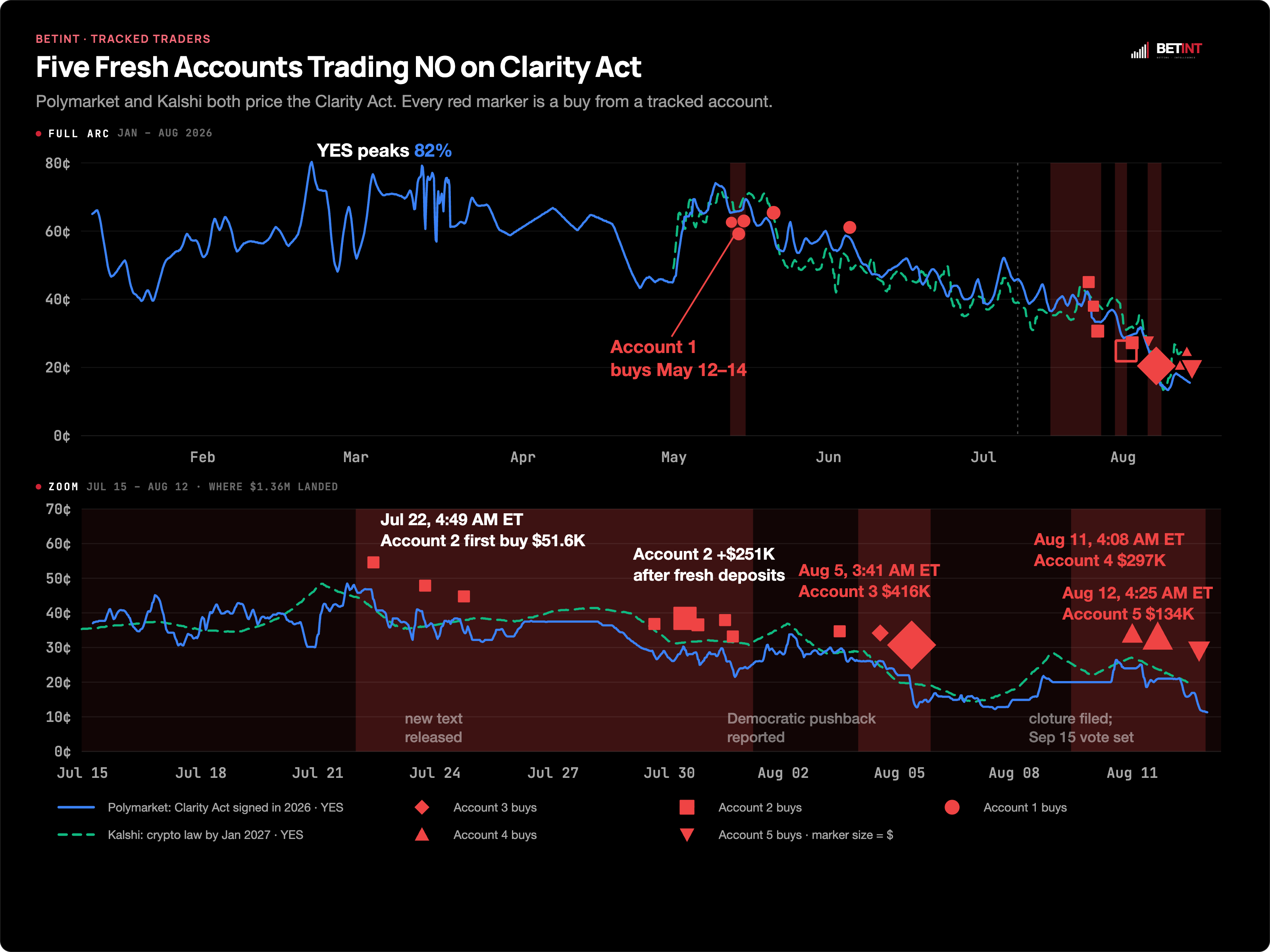
At 4:25 AM ET on August 12, a fresh account on Polymarket bet $134,000 on “No” that the CLARITY Act, the biggest crypto bill Congress has ever seriously considered, will become law this year.
We were already watching this market.
Because twenty-four hours earlier, an account that was four hours old at its first trade had done nearly the same thing at 4:08 AM, for $297,000. Both accounts had been loaded with exactly half a million dollars, withdrawn from the same offshore exchange a day apart. Neither wallet has traded any other market.
They are the fourth and fifth accounts of their kind. Since May, a series of fresh wallets funded from non-US crypto exchanges has been quietly stacking the “No” side of this market. Together they now hold five of the six largest “No” positions on Polymarket: about $1.41 million at cost. Not one of them has sold a single share. Four of the five have never touched another market.
I want to be careful right at the top about what this story is and isn’t. We spent three weeks tracing these wallets transaction by transaction, and nothing in the public record tells us who is behind any of them, or whether they are connected to each other at all. This is not an accusation of insider trading, and it is not a claim that one person is running five accounts.
What we can show you is the size, the construction, and the timing. The timing in particular kept doing something that made us keep digging: the money kept moving hours before the news.
What is The Clarity Act?
The CLARITY Act would settle, for the first time, which US regulator oversees which parts of the crypto industry. It passed the House by a wide margin in July 2025 and cleared the Senate Banking Committee 15 to 9 in May. Then it stalled. An ethics fight, centered on the Trump family’s own crypto holdings, hardened Democratic opposition through the summer, and the bill sat while the Senate’s calendar filled up. On August 8, hours before leaving for a five-week recess, Majority Leader Thune filed for a make-or-break procedural vote: September 15 at 2:15 PM, the day after the chamber returns. If the bill can’t clear that vote, it is probably dead for the year.
Prediction markets have been pricing this drama the whole way. On Polymarket, “Yes, the bill gets signed in 2026” peaked at 82 cents in February. It was 12.5 cents by August 7. Today it trades around 17.
Which means the people in this story, the ones betting “No,” are currently winning.
How to Read a Polymarket Wallet
Two pieces of background make everything below legible. First: Polymarket runs on a blockchain, so every account is a wallet whose entire history is public, when it was created, where its money came from, every trade it ever made.
There are no names attached, but the behavior is naked. Large deposits usually arrive from crypto exchanges, and exchanges pay withdrawals out of big shared company wallets, the way a bank pays everyone from the same vault.
So a funding trace can tell you which exchange the money left. It cannot, by itself, tell you whose money it was, because that vault serves millions of customers. Keep that caveat in your pocket; we’ll need it repeatedly (and will expand on this dynamic in future writing).
Now the five accounts, in the order they arrived.
May: the Smallest Bet That Was Right Early
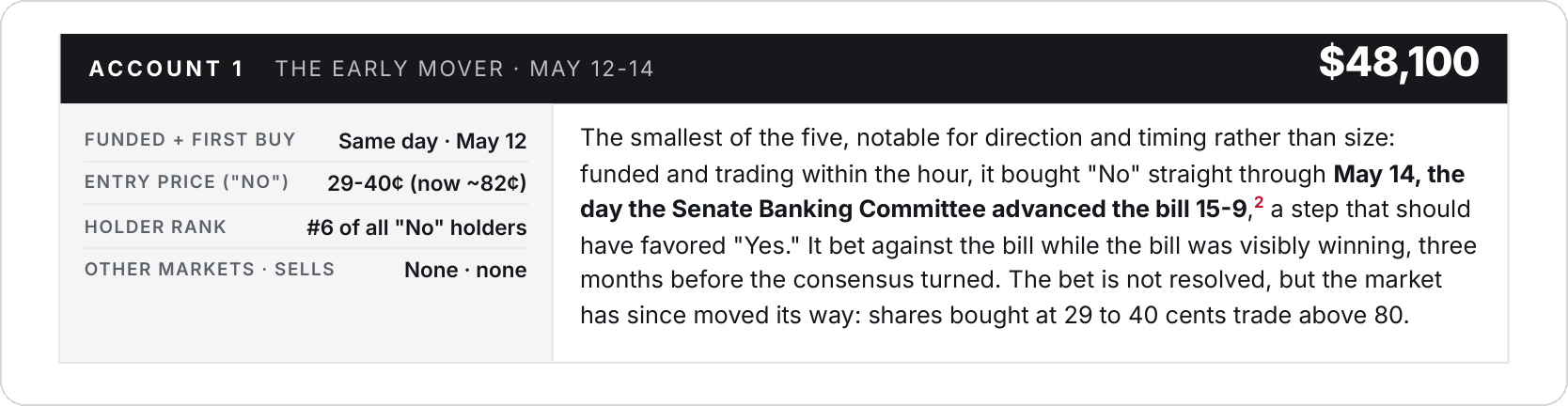
The first account is the smallest and in some ways the strangest. On May 12, a wallet was created, received $49,900 from Binance Hot Wallet 34, and started buying “No” within minutes. Actually, that’s not quite the full sequence: first it received a $10 test transfer, and then the $49,900 three minutes later. Someone checking that the pipe worked before sending the real money. That’s not a bot behavior. That’s a person.
Here’s what makes it strange. This account bought “No” at 29 to 40 cents straight through May 14, the day the Senate Banking Committee advanced the bill 15 to 9. That was a good day for the bill. The committee vote was the strongest signal all spring that the thing was moving. And this wallet spent it betting $48,100 that the bill fails, while the market visibly disagreed.
Three months later the consensus caught up to it. Those 29-cent shares now trade above 80. The bet isn’t resolved, and I want to resist the urge to grade it early, but so far the early, lonely, wrong-looking position has been directionally right.
July: The Largest Holder
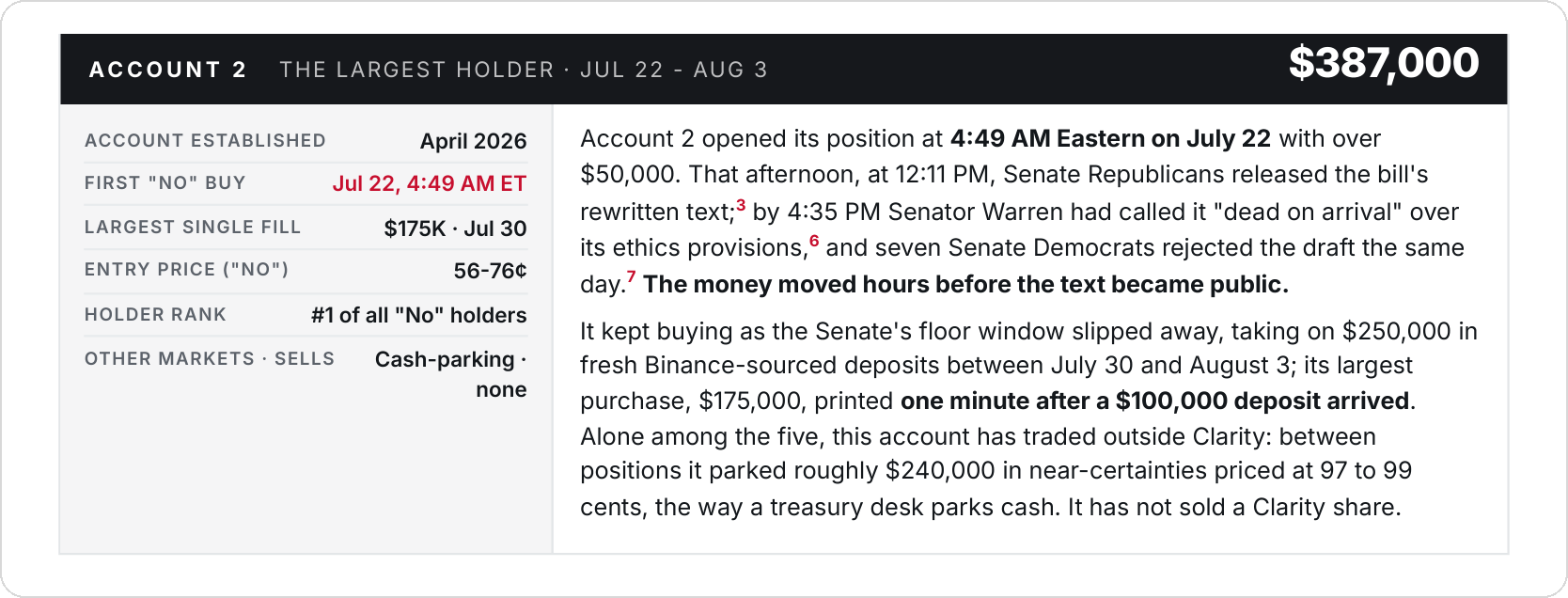
The second account is the biggest holder in the market and the only one of the five with real history. Its wallet dates to April, and it had already built and exited a smaller “No” position in the spring. On July 22 at 4:49 AM Eastern, it came back, opening with over $50,000 of “No.”
That afternoon, at 12:11 PM, Senate Republicans released the bill’s rewritten text. By 4:35 PM Senator Warren had called it “dead on arrival,” and seven Senate Democrats rejected the draft the same day. The market fell. The account kept buying for two more weeks, ending up around $387,000.
Sit with that morning for a second, because it’s the shape we kept finding: the position opened hours before the document that tanked the price became public.
It’s possible that text was circulating privately the night before; drafts do leak around Washington. Maybe it was a lucky read on a bill that plenty of smart people already thought was dying. The timestamps can’t distinguish those stories, and we won’t pretend they can. What the timestamps do say is that the money moved first and the news arrived second.
The funding is its own signal. This account draws from a personal treasury wallet that has handled roughly $100 million in stablecoins on Ethereum alone since mid-2024, pulls eight-figure sums from both Binance and Bybit, and keeps tens of millions parked in institutional-scale yield strategies.
Whoever runs it is not a hobbyist.
Eight times between April and August, money left that treasury and landed in the Polymarket account within minutes, including $100,000 on July 30 that arrived exactly one minute before the account’s single largest purchase printed. This is someone who wires money when they intend to use it.
And a small human fingerprint, the same one from May: when this account cashed out its earlier position in the spring, it sent a 10 USDC test transfer first, then $46,141 a few minutes later. That is a very human action to check the accuracy before wiring massive sums of cash.
August 4: Fresh Wallet with Massive Size
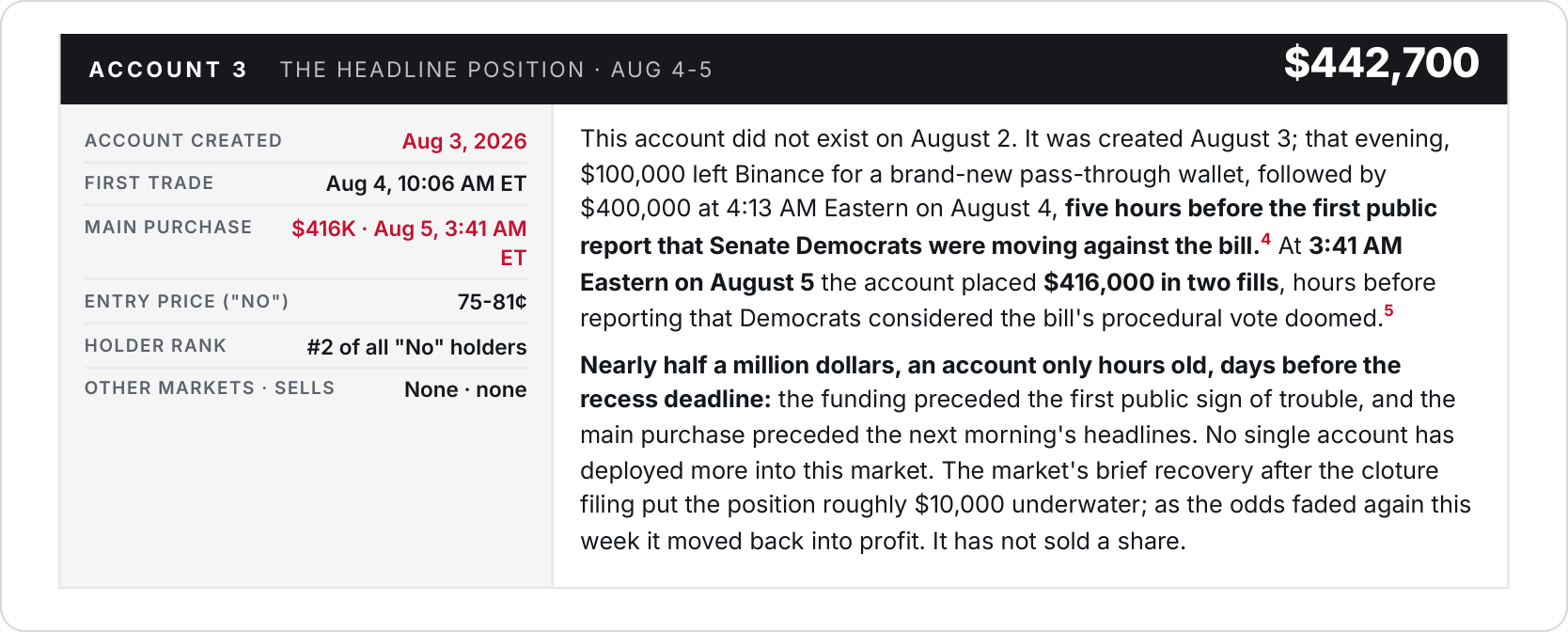
The third account is the one that made us start writing this up, and its clock is worth walking through slowly.
August 2: the account does not exist. August 3: it’s created, and that evening $100,000 leaves Binance Hot Wallet 34 for a freshly made burner wallet. August 4, 4:13 AM Eastern: $400,000 more follows. That burner has only ever made three transactions in its life: two in, one out.
At 9:30 that morning, Brendan Pedersen at Punchbowl News posted the first public sign that Senate Democratic leadership was moving to delay the bill’s vote. It’s the earliest public crack in the dam that we could find. The $500,000 had left Binance five hours before that post.
At 10:01 AM the burner forwarded the full amount into Polymarket. First trade five minutes later. And at 3:41 the next morning, August 5, the account bought $416,000 of “No” in two fills, hours before that morning’s reporting that Democrats considered the procedural vote doomed.
Within 36 hours of existing, the account had deployed $442,700 and become the second-largest “No” holder in the market. It hasn’t traded since. It has never sold. When the market briefly recovered after the cloture filing, the position went about $10,000 underwater and the account did nothing at all. It’s back in the green this week.
August 10 to 12: the Bybit Pair
Then this week the pattern repeated twice more, fast, from a different exchange, and this is the part we watched happen more or less live, because by now these wallets trip our alerts.
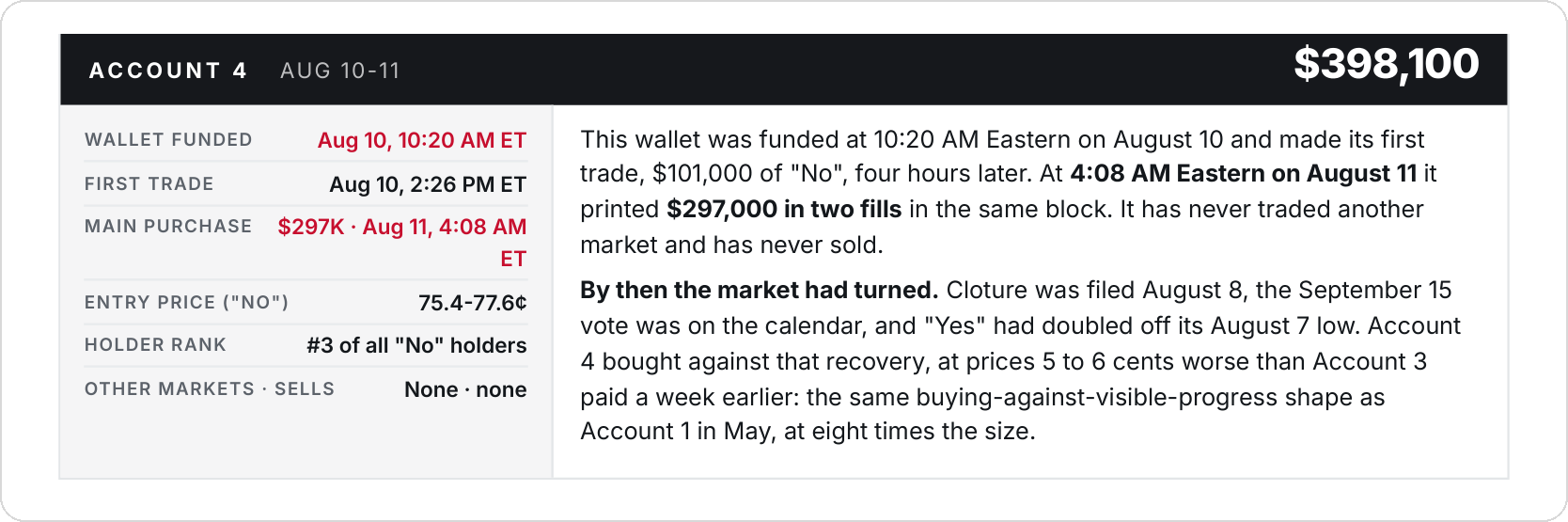
On the morning of August 10, a wallet was born on Ethereum, got a few dollars of gas money from a Bybit payout wallet, and two minutes later received $500,000.20 from a high-volume Bybit withdrawal wallet. Eight minutes after that, the full amount was on its way to Polymarket.
The wallet’s lifetime activity: two transfers, one in, one out, done. The account it funded made its first trade four hours later and printed its big one, $297,000, at 4:08 the next morning. It has never traded another market.
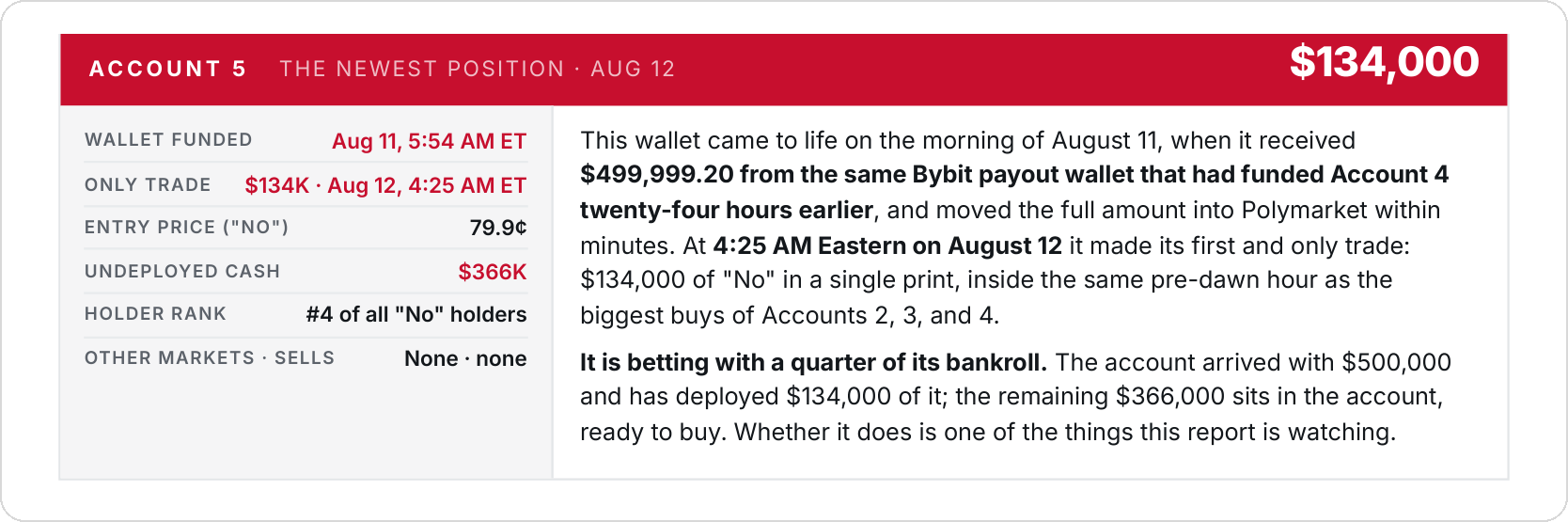
The next day showed a similar story. A new wallet, gas money at 4:52 AM, then $499,999.20 at 5:43 AM, from the same Bybit withdrawal wallet that had funded the account above, twenty-four hours earlier. Eleven minutes later the money was in Polymarket. The following pre-dawn, 4:25 AM on August 12, it bought $134,000 of “No” in a single print.
Two details here that we keep turning over. The first: the amounts. The August 10 chain ran $500,000.20 into the burner and $499,999.20 out. The August 11 chain ran $499,999.20 in and $499,998.20 out. Each hop leaves exactly one dollar behind. That’s consistent with the same withdrawal mechanics being used twice, though in fairness, an exchange’s fee structure could produce it for any two customers.
The second: the fifth account is sitting on $366,000 it hasn’t spent. It arrived with $500,000 and has deployed about a quarter of it. Which makes this a live story, not a closed one. If that money moves, we’ll see it.
The Bybit caveat gets the same treatment as the Binance one, and I mean that seriously, not as a disclaimer to skim. That withdrawal wallet pays out to many customers every hour. Two accounts drawing from it a day apart proves they used the same exchange around the same time.
The narrower coincidence, same wallet, same bridge, same one-dollar decrement, same never-used-again burners, same pre-dawn execution, is exactly that: a narrow coincidence that a busy exchange could still, in principle, produce.
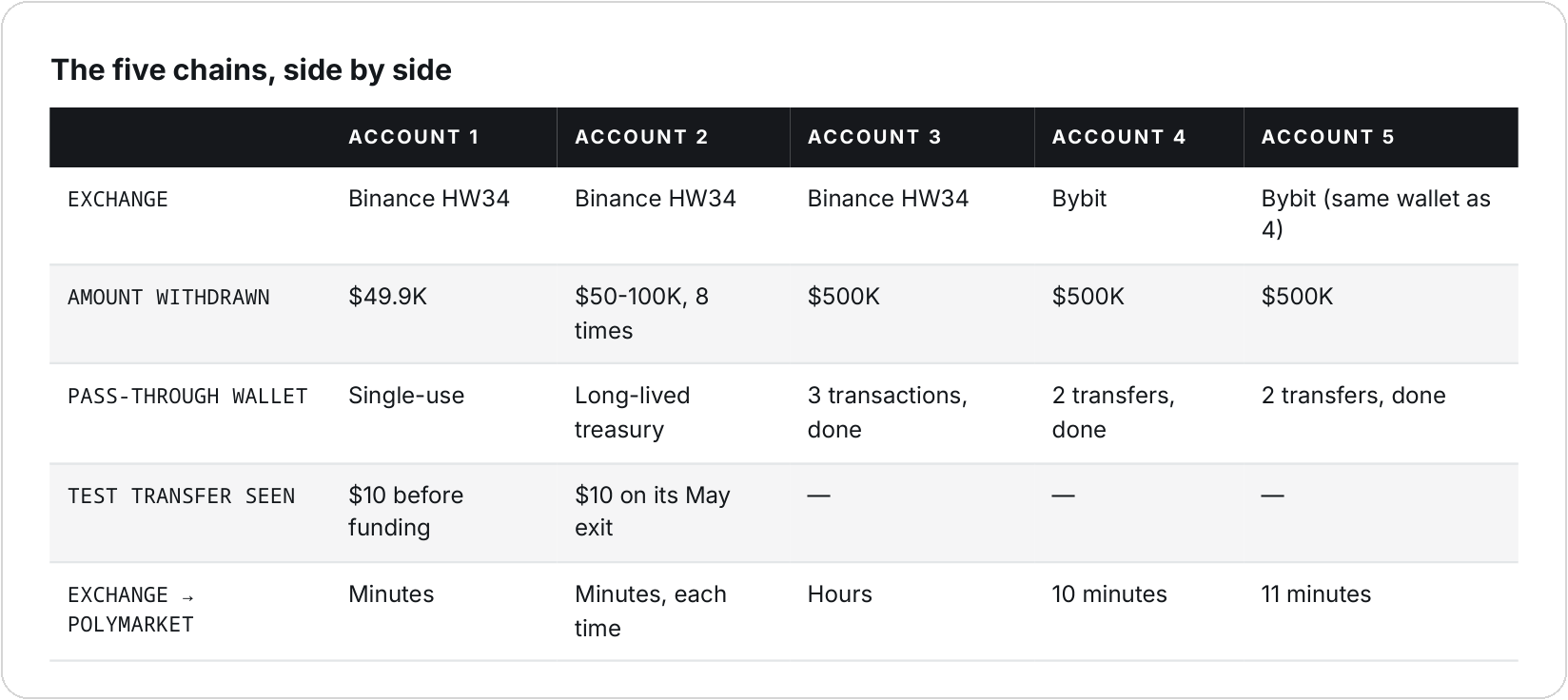
This is what the five funding chains look like next to each other:
The Rest of the Market
Pattern-hunting is cheap, and the failure mode is famous: go looking for suspicious wallets and everything starts looking suspicious. The guard against that is to screen everyone, not just the accounts that catch your eye. So we did.
The typical big holder looks nothing like them. We pulled the top 80 holders on both sides of the market and every fill from July 22 onward, more than 16,000 trades. The rest of the “No” side is ordinary. The typical big holder trades dozens or hundreds of markets.
The pre-dawn timing is the most elusive detail in the whole case, so it deserves the most skepticism. Each of the four large late accounts printed its single biggest buy between 3:41 and 4:25 AM Eastern, on four different dates.
That window does carry elevated volume generally, roughly one in eight of all fills in this market, because 8 AM UTC is mid-morning in Europe and crypto never sleeps.
But it carries 7 of the 12 large fills. And that’s the other stat worth staring at: across three weeks of trading, only twelve fills in this whole market were $25,000 or bigger, and eleven of the twelve belong to these accounts. The block-size flow in this market is these wallets. The twelfth was somebody buying “Yes.”
Read the pre-dawn window alongside the funding, two exchanges that don’t serve US customers, and you get a soft hint about what time zone the buyers live in. That’s as far as we’ll go without more information.
A Check against Kalshi
One reasonable objection to everything above: maybe this is just Polymarket being Polymarket. So we looked at Kalshi, the US-regulated exchange that runs equivalent contracts on the bill. Kalshi has no public wallets, so there’s nothing to trace there, and nothing on Kalshi connects to the accounts in this story.
What we can say is modest. Prices fell there too, and over the same stretch Kalshi’s larger trades leaned toward “No.” There’s one wrinkle in the price data worth a sentence: for part of the window, Polymarket’s odds ran a few cents below Kalshi’s before the two converged in early August. That could reflect heavy buying pressing on one venue. It could also just be two markets finding the same price at slightly different speeds.
Since the cloture filing, Kalshi’s contracts have moved toward expecting the September 15 vote to happen, and expecting the bill to lose it.
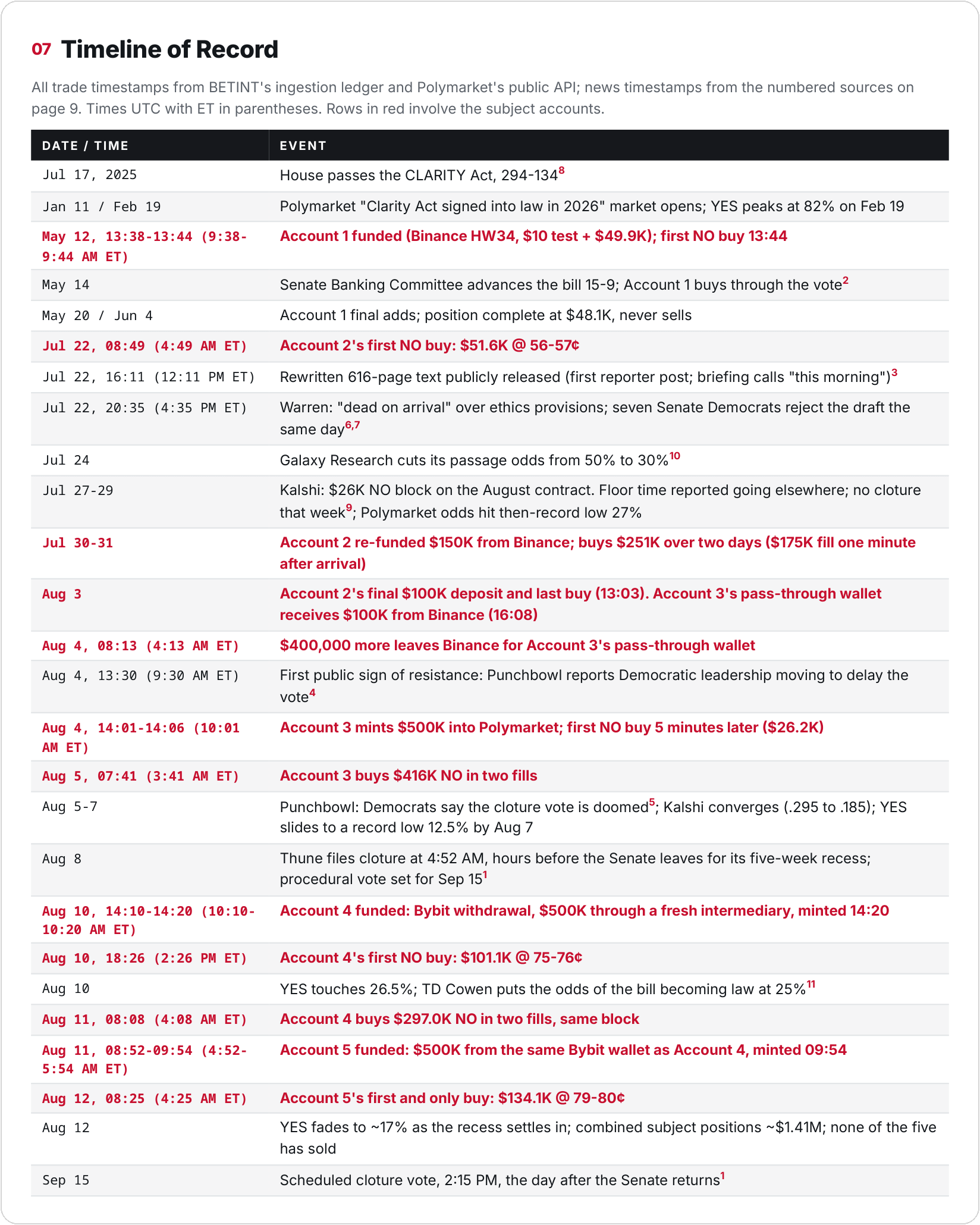
Every date and dollar figure in this piece, in one place:
The other explanations + what to watch for
The honest range of explanations for all of this runs wider than the pattern suggests at first read.
Informed positioning is on the list. So is a sophisticated hedge: imagine a fund with heavy crypto exposure that benefits if the bill passes, paying a few hundred thousand dollars for insurance against it failing.
So is plain conviction, because plenty of people with no special information thought this bill was dead by late July, and the ones in this story are, at the moment, up money on that view.
The truth might be different for each of the five accounts. Nothing in this piece establishes that they know each other even if there’s some interesting overlap in their process.
If the bill clears its vote on September 15, then the positions documented here become large, fast, wrong bets, and this piece becomes a case study in how confident-looking money can be confidently wrong.
The vote is at 2:15 PM on September 15, the day after the Senate returns. We will cover the results here on BETINT.net.
Wallet traces are from Etherscan and Polygonscan across Ethereum, Base, and Polygon; trade data from Polymarket’s public records and BETINT’s own monitoring; Kalshi figures from parallel price capture on both venues. Every funding chain above is documented transaction by transaction in the underlying BETINT brief. Nothing here is an allegation of unlawful conduct.
Fresh wallets are interesting, but I’d want to separate genuine informed conviction from coordinated positioning or attempts to move the market. The best part of prediction markets is the timestamped probability signal; the hard part is judging when the market itself may be distorted. This is a fascinating case study for that distinction.