



Bottom Line Up Front
On September 15, news reports revealed that Israel is quietly sharing intelligence with Saudi Arabia to help it defend against Houthi attacks, with U.S. Central Command acting as the go-between. The same day, Axios reported that the top military officers of Israel, Saudi Arabia and seven other regional states had met privately in Germany at a CENTCOM-hosted retreat. Six months into the war with Iran, these are the most concrete public signs yet that the two countries are working together on security.
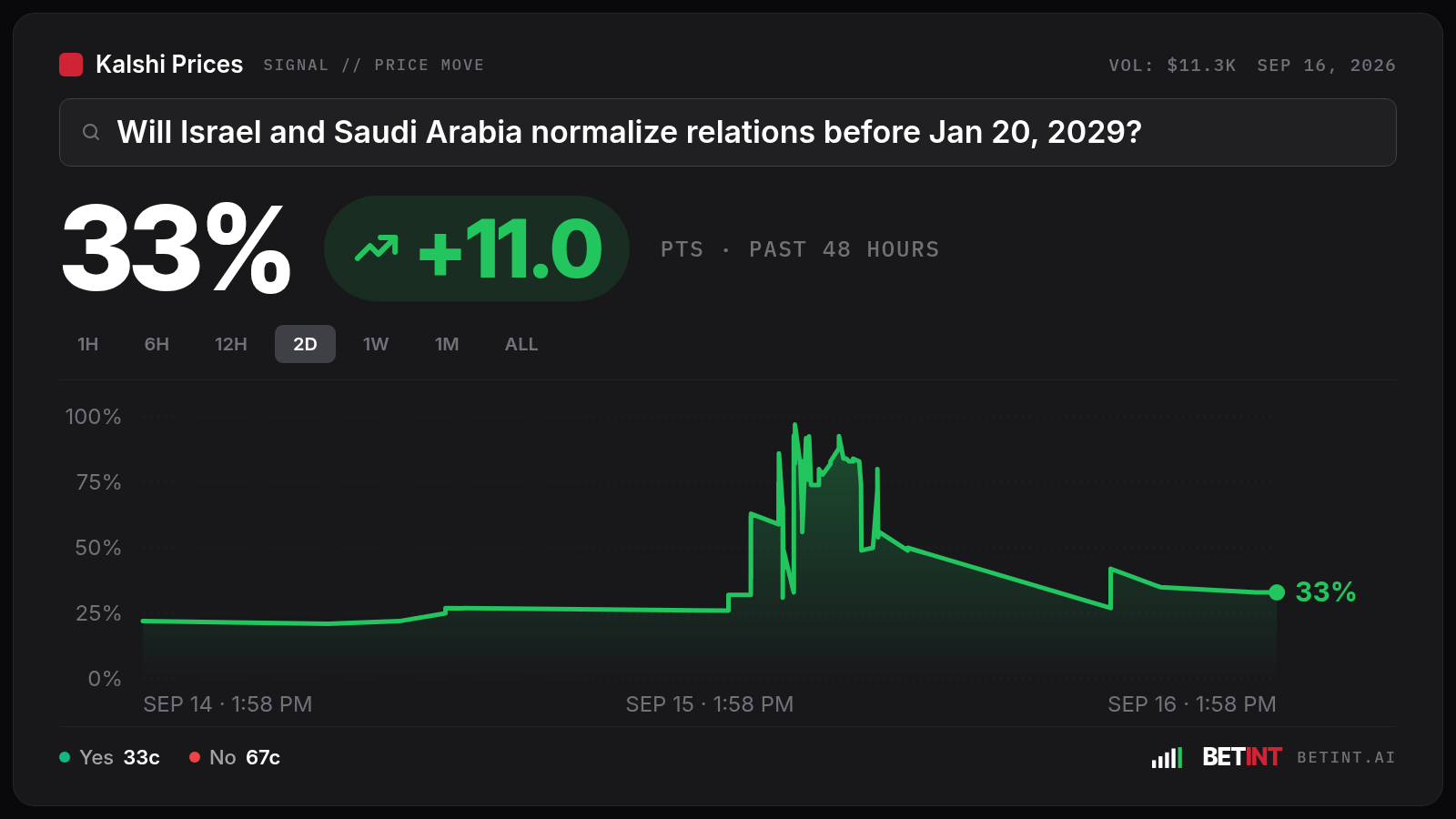
Within hours, a prediction market on Kalshi asking whether Israel and Saudi Arabia will normalize relations during Trump’s term shot from 22 percent to 97 percent. By the next afternoon it was back at 33 percent, close to where it started.
The entire jump was driven by about $11,000 of buying on a market so quiet that a few hundred dollars could move the price.
Prediction market prices are increasingly quoted by journalists and policy staff as if they measured the odds of world events. This episode shows why that only works when real money is on both sides. On a market this thin, the price tells you what the last buyer paid, not what the market thinks.
Analysis
On September 15, the Jerusalem Post and i24 News reported that Israel had provided Saudi Arabia with intelligence to help counter Houthi attacks on Saudi territory, with U.S. Central Command mediating the exchange.
Later that day Axios reported that the military chiefs of the United States, Israel, Saudi Arabia, the United Arab Emirates, Bahrain, Kuwait, Qatar, Jordan and Egypt had met privately in Germany the previous week at a retreat organized by the CENTCOM commander, Admiral Brad Cooper, to discuss the war with Iran. CENTCOM confirmed that a conference of senior leaders had taken place. A follow-up in the Jerusalem Post that afternoon quoted an anonymous source calling for the countries involved to sign the Abraham Accords together.
The reports describe a level of military cooperation between Israel and Saudi Arabia that had long been assumed but never documented. They also arrived at a moment when Houthi strikes on the kingdom and Iranian attacks on U.S. bases have made the Gulf states more dependent on the regional air defense network that Israel anchors.
The market reaction looked dramatic. Kalshi’s market asking whether Israel and Saudi Arabia will normalize relations before January 20, 2029, had spent the morning around 22% YES, even though the intelligence-sharing story had been public since early in the morning eastern time.
Then, starting at 3:42 PM ET, several quick bursts of buying over the next few hours pushed the price as high as 97%. Once the buying stopped, the price drifted back down. It ended the evening at 49% and was at 33% by early the next afternoon. On Kalshi’s chart the whole thing now looks like a single vertical line on a market that had otherwise been sliding for most of the year.
So why was the move so easy and why didn’t it last?
First, the amount of money involved was small. About $11,000 changed hands over the whole day, almost all of it from buyers, and most of it in a few bursts that each lasted seconds to a minute. This market has less than $100K volume all time, making it prone to major moves from proportional volume.
The market itself was nearly dormant. At the end of the day there were only a couple dozen standing offers to buy or sell at any price. When that little is resting on a market, one buyer willing to pay up can drag the price wherever they like, and the price will fall right back once they are done.
This is not new behavior for this market. It has jumped and collapsed before on trivial amounts, including a spike from 55 to 95 percent on New Year’s Eve.
The clearest sign that the price carried no real information is what DIDN’T move.
Kalshi lists the same question with a shorter deadline, asking whether the two countries will normalize before January 2027. That market is more than twice as large as the one that spiked, and on September 15 it traded two contracts at 5 percent. Companion markets on Israeli normalization with Syria and Qatar traded next to nothing.
Polymarket’s version of the Saudi question moved on a few hundred dollars and stayed near 8 percent. If traders had genuinely decided a Saudi deal was more likely, the nearer-dated market and the neighboring countries would have moved too, since the same diplomatic logic applies to all of them, above all an end to the war and progress on the Palestinian question that Riyadh has consistently made a precondition. Instead, one contract was pushed and then let go.
Prediction market prices now show up routinely in news coverage and policy analysis as if they were measurements of probability.
A price only earns that treatment when enough money sits on both sides to make it a real contest.
Anyone reading these prices should ask how much was traded, how much is waiting on the order book, and whether related markets moved the same way, before treating a jump as meaningful.
The September 15 spike fails every one of those tests. The intelligence-sharing arrangement and the Germany meeting are the real story, and they point to a security relationship advancing well ahead of any formal normalization.
For more analysis on the realtime signals intelligence that betting markets and exchanges create, subscribe to BETINT.net.
