


There are two ways to know who’s winning an election before anyone counts a vote. You can ask people who they’re voting for, or you can watch where people put their money.
Which one would you trust?
For most of this cycle you didn’t have to choose.
This afternoon we lined up the final polling average in all 36 Senate and governor races that have one against the betting odds on Kalshi, Polymarket and Polymarket US.
Every number in this piece is locked: market prices as of 3:15 PM ET today, and the latest polling averages published by Election Day afternoon. Nothing after that is counted.
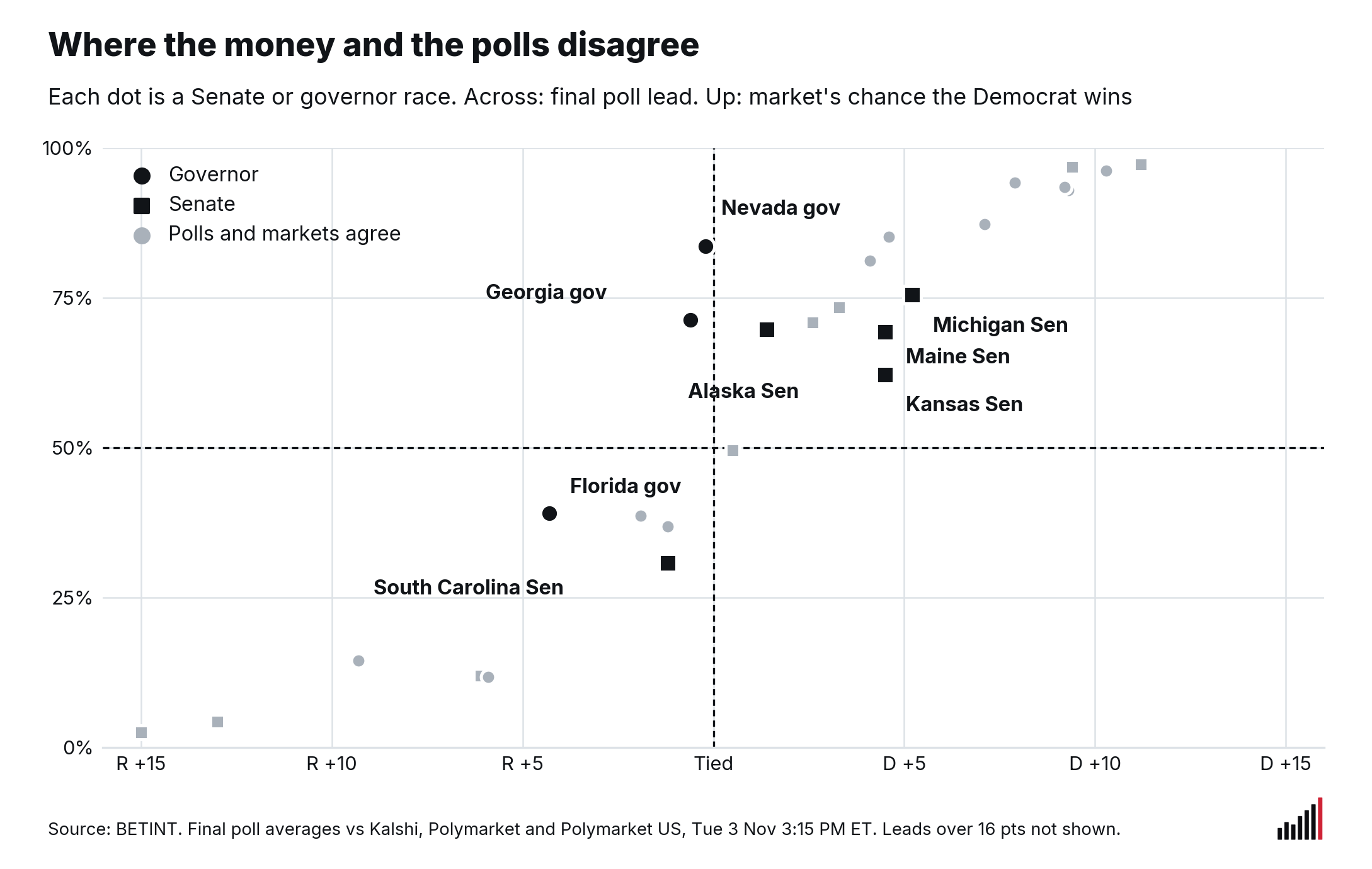
In 27 of them, the polls and the money agree on who’s ahead and by roughly how much. Iowa’s Senate race is a half-point race in the polls and a dead 50-50 in the markets. You can’t agree much harder than that.
Eight of the others are more interesting. We’ll call it the confidence gap.
The gap runs both ways.
In four races, bettors are more confident in the Democrat than the polls are.
In four others, they’re less confident. And the two groups mostly sort by office: the races where bettors like the Democrat more are mostly for governor, and the races where they like the Democrat less are all for the Senate.
A Quick Translation
Polls and markets speak different languages, so here’s the conversion.
A poll lead of under a point is really acoin flip as final polling averages miss by a few points all the time. A lead of four or five points is real, but it’s not a guarantee.
A market price is the crowd’s odds. If a candidate trades at 75%, bettors make them about a 3-1 favorite.
So when a race is tied in the polls and 5-1 in the markets, the two are reading that race very differently.
Where the Money Is Ahead of the Polls
In these races, bettors are more confident in the Democrat than the polls are.
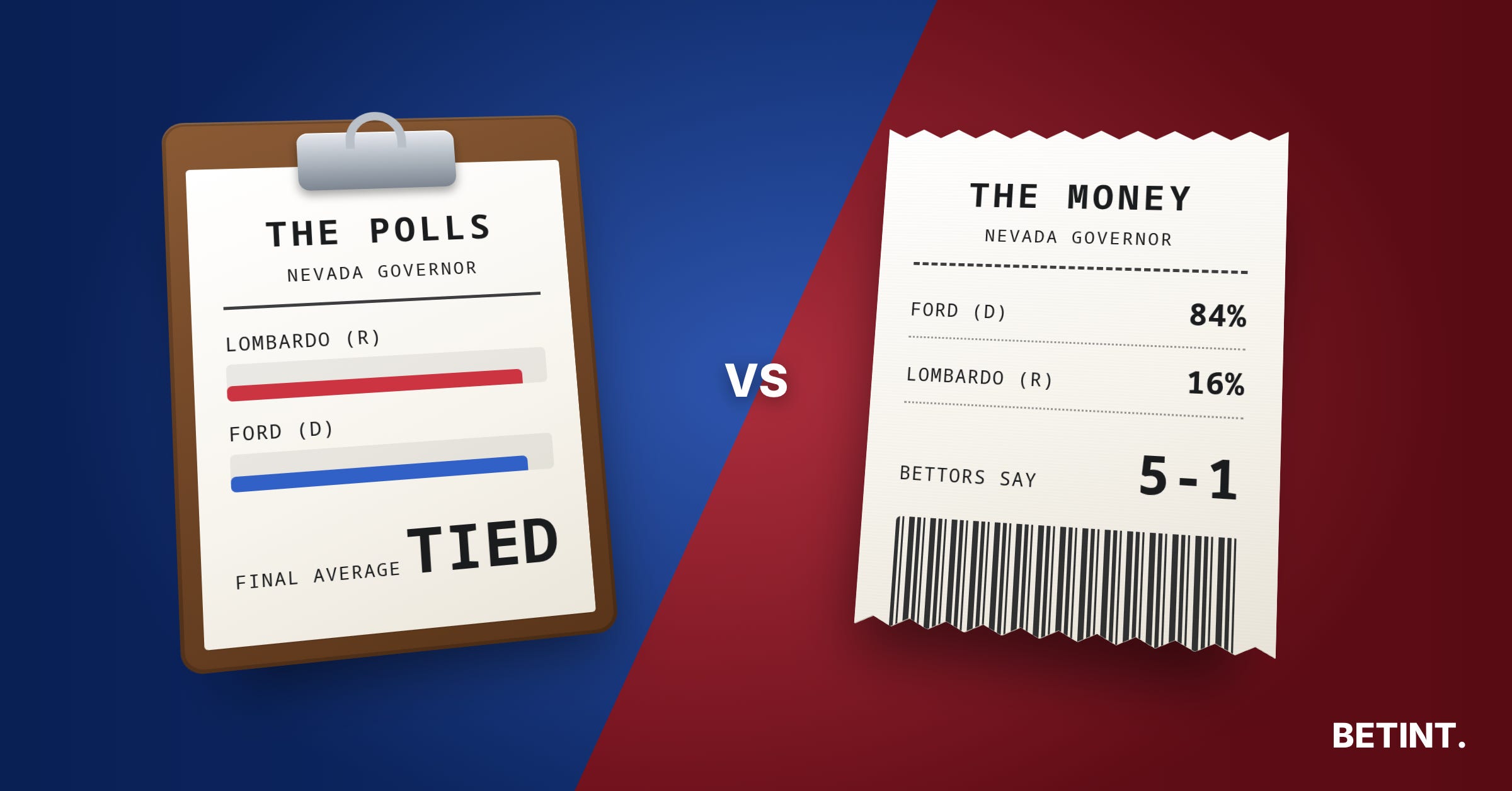
Nevada governor:
Polls: tied. Joe Lombardo (R), the sitting governor, is up just 0.2 points over Aaron Ford (D).
Markets: Ford is about a 5-1 favorite (84%).
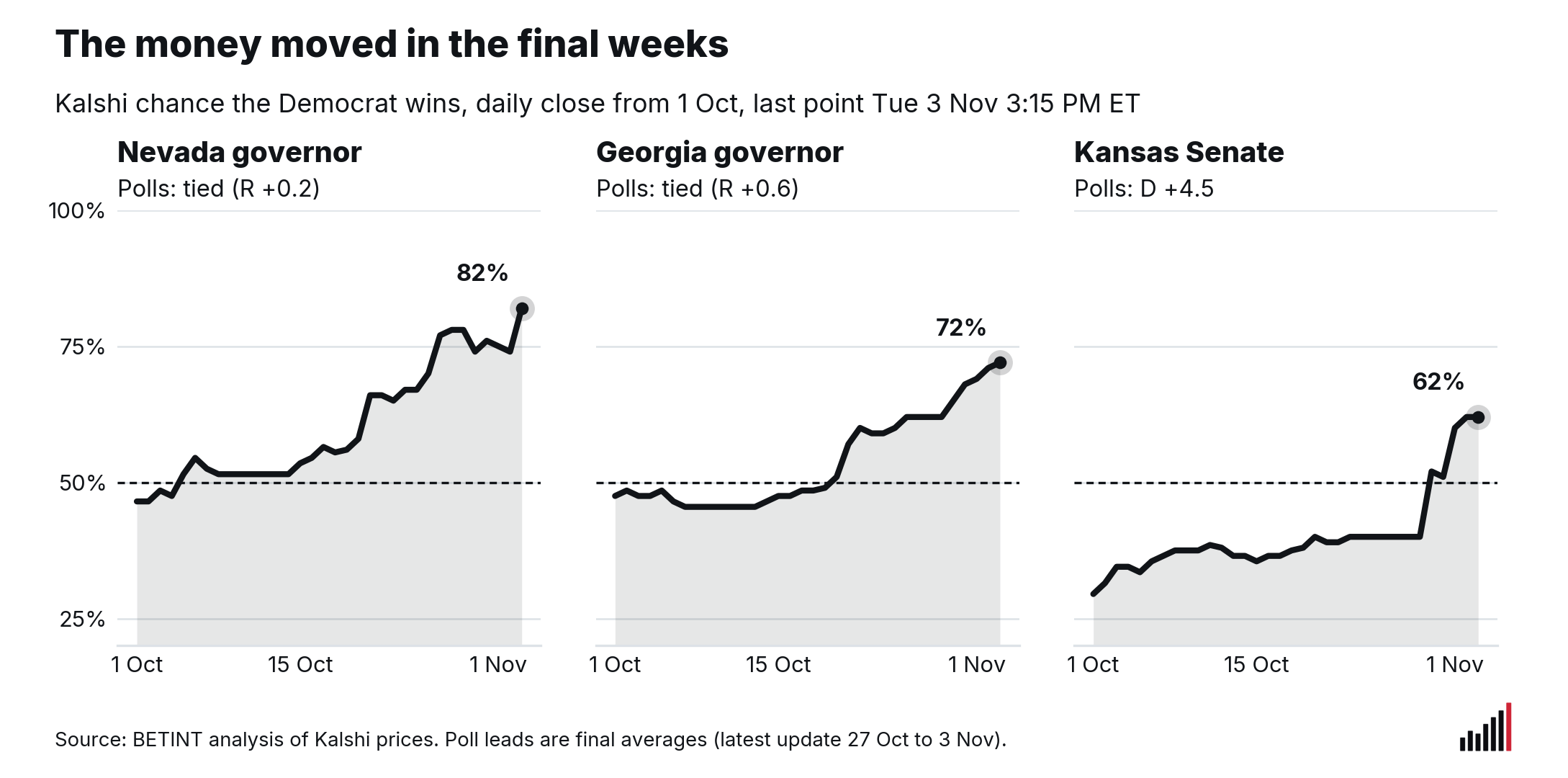
The trend: a coin flip on October 1. Ford climbed all through late October and was still rising today, from 76% at lunchtime to 84% by 3 PM.
This is the biggest gap of any race.
Georgia governor:
Polls: tied. Rick Jackson (R) is up 0.6 points over Keisha Lance Bottoms (D), and three of the five averages have it dead even.
Markets: Bottoms is about a 5-2 favorite (71%).
The trend: a month ago, she was the underdog.
Florida governor:
Polls: Byron Donalds (R) is up about 4 points over David Jolly (D).
Markets: Donalds is still the favorite, but Jolly gets about a 2-in-5 chance (39%).
The trend: in mid-October, Jolly’s chance was only 1-in-5.
Alaska Senate:
Polls: close to a toss-up. Mary Peltola (D) is up 1.4 points over Senator Dan Sullivan (R).
Markets: Peltola is better than a 2-1 favorite (70%).
One thing to keep in mind: the latest polls in Nevada and Georgia are about a week old. The markets have kept trading right up to this afternoon.
Where the Money Trails the Polls
In these races, bettors are less confident in the Democrat than the polls are.
Kansas Senate:
Polls: Adam Hamilton (D) is up 4.5 points over Senator Roger Marshall (R), and all five averages have him ahead by between 3.7 and 5 points.
Markets: Hamilton is only a little better than a 3-2 favorite (62%).
The trend: on October 29, bettors had Hamilton as the underdog (40%), even though he led in the polls. Three days later he was at 60%.
Maine Senate:
Polls: Troy Jackson (D) is up 4.5 points over Senator Susan Collins (R).
Markets: Jackson is about a 2-1 favorite (69%).
Worth knowing: Collins trailed in most polls in 2020 and won anyway.
Michigan Senate:
Polls: Abdul El-Sayed (D) is up 5.2 points over Mike Rogers (R), the biggest poll lead in this group.
Markets: El-Sayed is about a 3-1 favorite (76%). That’s a favorite, but a five-point lead usually gets more credit than that.
South Carolina Senate:
Polls: close to a toss-up. The Republican is up 1.2 points.
Markets: the Republican is about a 2-1 favorite (69%).
One thing to keep in mind: this isn’t every Senate race. In Texas and Ohio, the markets and the polls line up almost exactly.
What Each Side Is Saying
Put the two lists together and the markets and the polls are telling different stories about the same night.
If the polls are right, Nevada and Georgia are coin flips the markets have overpriced, and Democrats in Kansas, Maine and Michigan are stronger than bettors think.
If the markets are right, something moved in Nevada and Georgia after their last polls were taken, and the Senate leads in Kansas, Maine and Michigan are softer than they look. In 2016 and 2020, final polls overstated Democrats in a number of states, and bettors may be remembering that.
Tonight we find out which story holds.
Scope and sources: final polling averages from up to five sources (270toWin, Decision Desk HQ, FiftyPlusOne, RealClearPolitics and Silver Bulletin), the latest published by the afternoon of November 3, 2026. Market odds are the average of Kalshi, Polymarket and Polymarket US, weighted by trading, at 3:15 PM ET on November 3, 2026, read as a two-way race between the Democrat and the Republican. October price history is Kalshi’s daily closing price.