


A lab worker at a Russian plague institute is dead, 200 people are under observation, and Moscow says it was pneumonia.
Twelve new prediction markets are trading on what happens next, with three of them pricing a pandemic outright.
Here is what they are actually saying.
Let’s start with what we know, because it’s not much.
A 28-year-old lab worker at the Irkutsk Anti-Plague Research Institute in Siberia was hospitalized on September 29 and died two days later. Nearly 200 people who had contact with her are under now medical observation, and the hospital that treated her is under quarantine.
The governor of the region next door said she died “possibly from the plague.”
Russia’s public health agency, Rospotrebnadzor, says it was “pneumonia of unknown etiology” and that testing found nothing connected to her work. The U.S. State Department says it is monitoring the situation with the CDC, as Marco Rubios says that now is ‘a time for focus’ on this concern.
So an employee of a plague lab died of a lung infection nobody will name, and the official position is that everything is… fine.
So naturally we ask…
What do the prediction markets say about this concerning new topic?
Yes, there is a pandemic market
Three of them, in fact. They have nothing to do with plague specifically, and they were open long before anyone had heard of Irkutsk.
Polymarket has “New pandemic in 2026?” and “New pandemic before 2028?” Kalshi has “Pandemic in 2026?” All three cover any disease at all.
Here is where they sit:
A pandemic by the end of this year: about 6 percent on Polymarket, 6 to 8 percent on Kalshi.
A pandemic before 2028: about 20 percent on Polymarket.
Those are the cleanest answers to the question in the headline.
Roughly 1 in 16 odds for the next three months, and 1 in 5 for the next before the end of 2027.
They did move on these reports, though. Polymarket’s 2026 contract sat at 4.5 percent all of last week and is now around 6.
The before-2028 contract went from 17 percent to just under 20. A lab death in Siberia added a point or two to the odds of a global pandemic, and that seems to be all for now.
Then there are nine newer markets built around the Irkutsk story itself. Put all of these new plague markets side by side and they are asking four different questions.
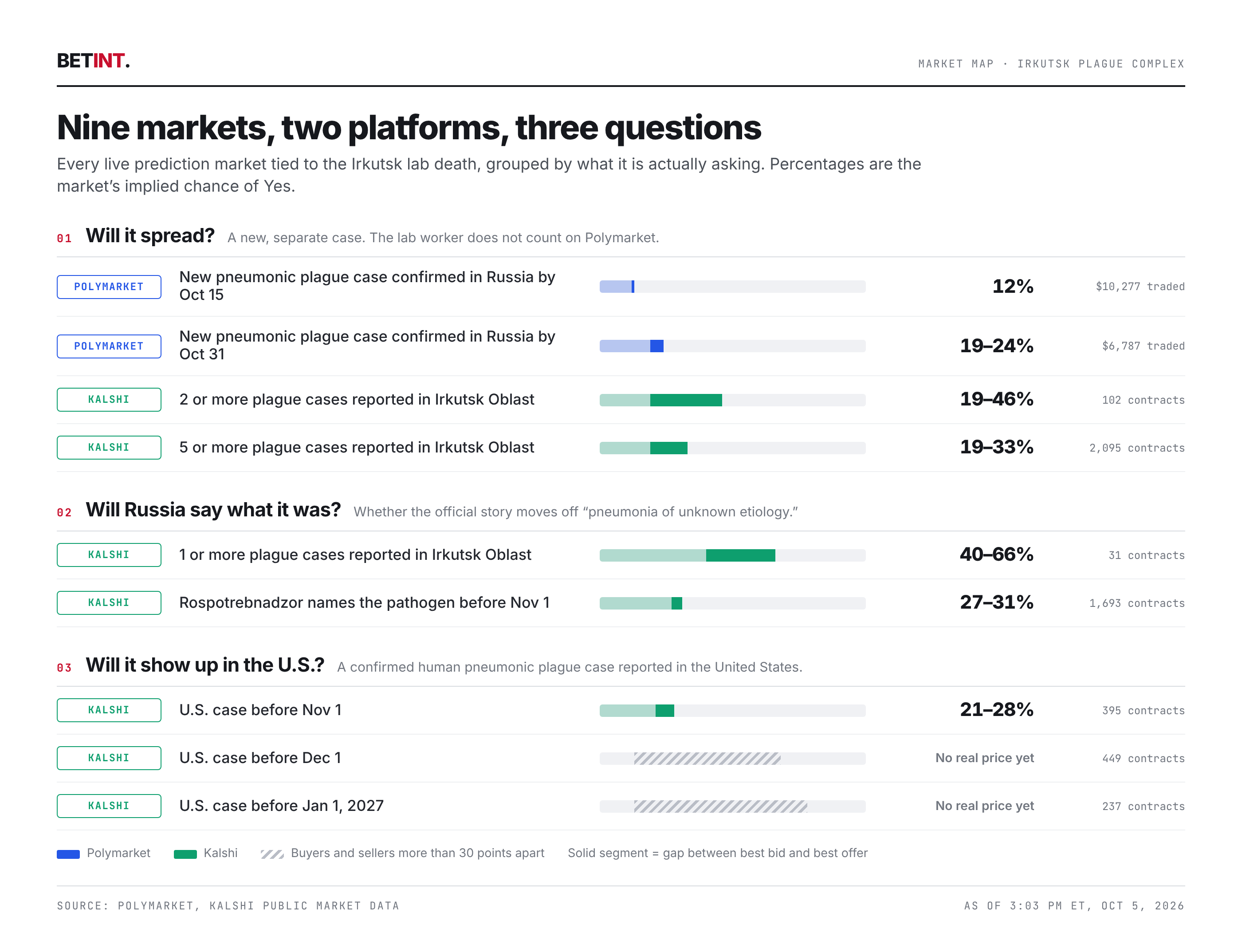
The standing pandemic markets and every live market tied to the Irkutsk death, as of Monday afternoon.
Will there be a pandemic?
The three markets above.
Will it spread?
Polymarket is asking whether a new pneumonic plague case gets confirmed in Russia. The lab worker herself is written out of the contract. Kalshi is asking whether Irkutsk reports two or more cases, or five or more.
Will Russia say what it was?
Kalshi has a market on whether Rospotrebnadzor names the pathogen before November 1, and another on whether Irkutsk reports even one plague case this month.
Will it show up here?
Kalshi is also trading whether a pneumonic plague case gets reported in the United States.
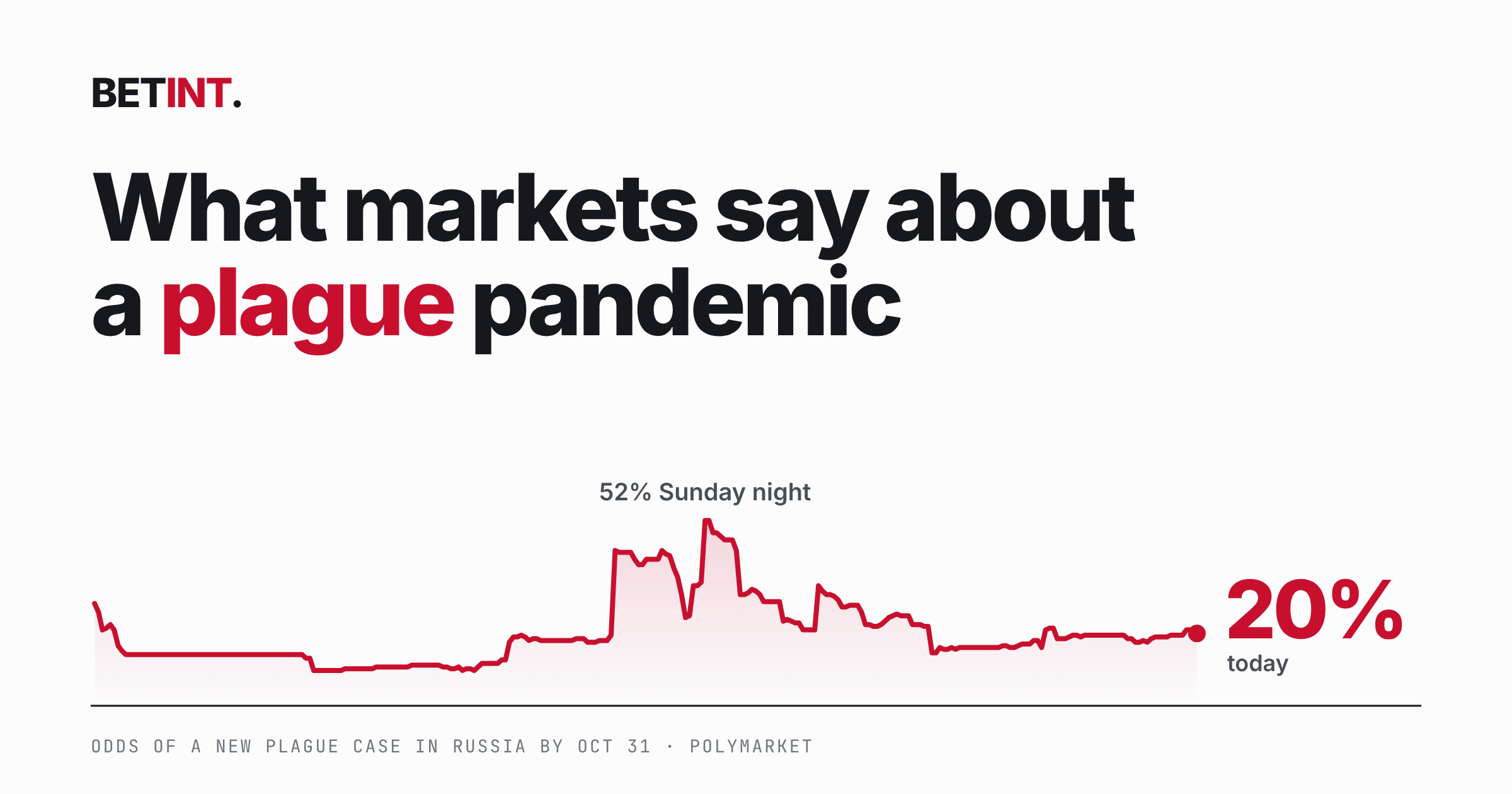
On the plague itself, the headline number is the Polymarket one. Traders are giving it roughly a 1 in 8 chance that another case is confirmed by October 15, and about 1 in 5 by the end of the month.
So the market’s answer to the pandemic question, at least for now, is probably not.
The scare lasted about half a day
It was not always that calm.
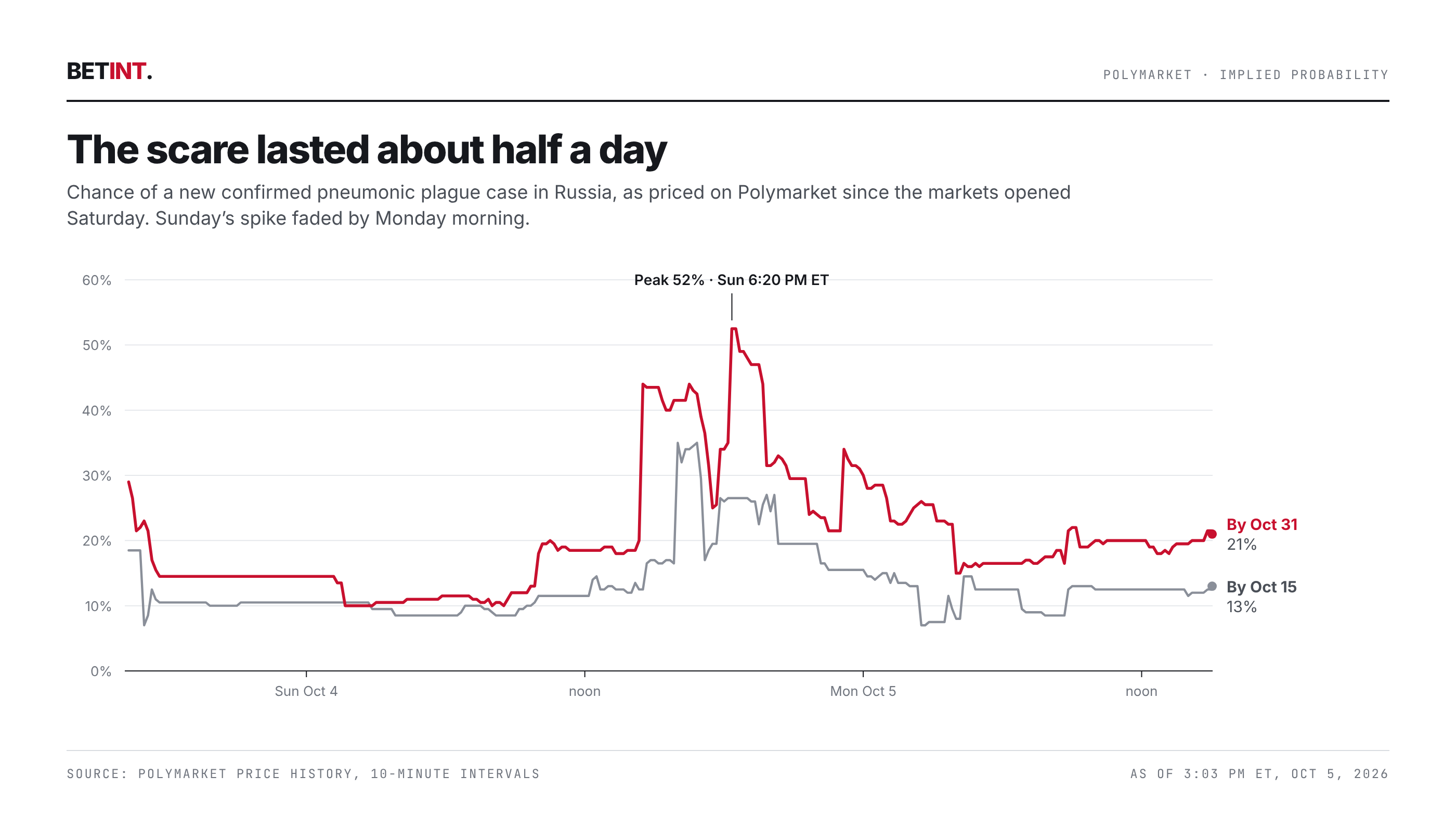
The end-of-October market, in red, briefly priced a new case as a coin flip.
For most of Saturday and Sunday morning these markets sat near 10-15 percent. Then on Sunday afternoon, as the story landed on front pages across the U.S. and Europe, the end-of-October contract ran from under 20 percent to a peak of 52 percent at 6:20 PM ET.
For a few hours on Sunday night, the market thought a second plague case in Russia was more likely than not.
By Monday morning it had fully reset.
No new reporting was confirmed in between - no new case, no new diagnosis - but the price went up on attention and fell back down on the absence of news.
Small money, leaning one way
Now for the part that should temper everything above.
This is a retail-sized market.
The big pandemic markets are liquid. More than $1.1 million has traded on Polymarket’s 2026 contract, including about $19,000 in the past day.
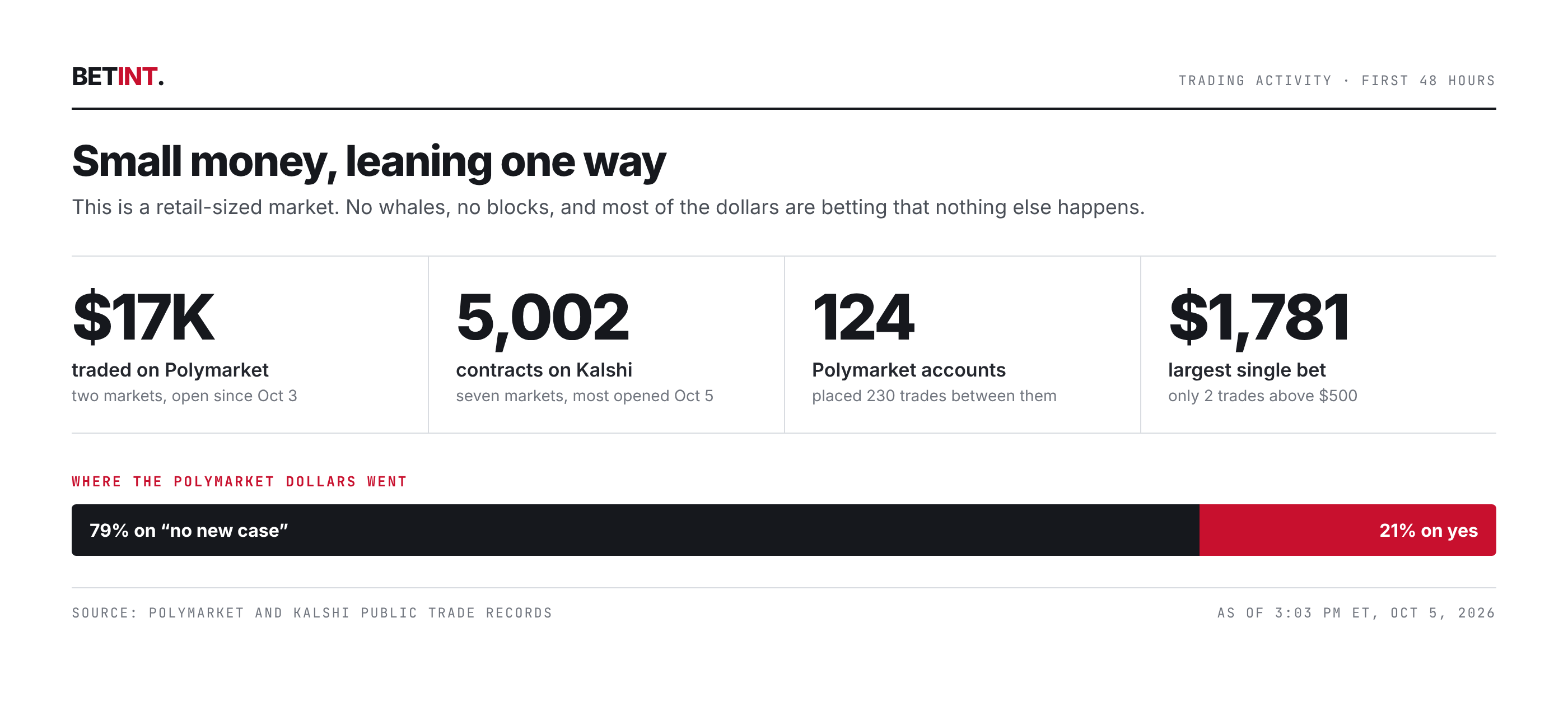
The plague markets are not. About $17,000 has traded on Polymarket’s two Russia contracts since they opened, and about 5,500 contracts on Kalshi’s seven. The old pandemic market did more business in a day than the new plague markets have done in their lives.
On the Polymarket plague contracts that is 124 accounts placing 230 trades. The single largest bet is $1,781, and only two trades are above $500.
But the direction of the money is clear. Close to 80 cents of every dollar traded on those two contracts has gone toward “no new case.” The biggest bets, almost without exception, are people buying No at 80 to 90 cents and collecting a small return if nothing happens.
At BETINT we spend most of our time looking for the opposite pattern: a large, well-timed position from someone who seems to know something. There is none of that here, although I am not sure how there could be outside of healthcare workers or deeply entrenched Russian government personnel. No whales and no blocks have surfaced.
If somebody inside the Russian health system knows what killed her, they are not expressing it on a prediction market… Yet.
My read
Here is what I think people may miss about these markets.
Most of these markets are not really pricing a disease. They are pricing a press release.
This is because every one of these contracts resolves on what an official source confirms. Not on what is provably true.
That includes the pandemic markets: on Polymarket - both pay out only if the World Health Organization declares one.
A second case that Russia never acknowledges pays out exactly the same as no second case at all. So when the market says 1 in 5, it is not saying there is a 20 percent chance of spread. It is saying there is a 20 percent chance that Rospotrebnadzor, or someone it cannot contradict, says so out loud by Halloween.
Those are very different bets.
It also explains the most interesting gap on the board. Traders give it around 30 percent that Russia names the pathogen this month. That is higher than the odds of a new case.
In other words, the market finds it more believable that Moscow eventually admits what this was than that it gets any worse.
I’m willing to bet the pathogen market is the one to watch. It is the only contract that moves on information alone, with no second patient required.
And the U.S. market? Kalshi has it between 20 and 23 percent that a pneumonic plague case is reported in America before November 1. The CDC counts an average of about seven human plague cases a year in this country, and most of them are bubonic, not pneumonic. I’d take the other side of that one at whatever odds.
That price is not a forecast. It is a few hundred contracts and a scary headline.
What prediction markets are good for here
So what do the markets actually tell us about a plague pandemic?
Three things.
The crowd is not panicking. With real money on the line, the odds of a pandemic this year moved from 4.5 percent to about 6, and the consensus is that Irkutsk stays a one-person story.
The crowd is not deep. Outside the big pandemic contracts, this is thin. Seventeen thousand dollars is an opinion poll with an entry fee, and one motivated trader could move any of the plague prices.
The crowd is betting on disclosure, not disease. The question being traded is what Russia will say, and when.
That last point is where this gets interesting for anyone who watches markets for a living. If these contracts grow, the first sign of real news will not be a headline. It will be somebody buying Yes in size at 2 in the morning Irkutsk time.
We will be watching for it.
This is not health advice and it is not trading advice. Prices are as of 3:17 PM ET on October 5, 2026 and will have moved by the time you read this. [Confirm before publishing: I hold no positions in any of the markets discussed.]