



A Kalshi account tied to the pollster behind Wedgewood Polls bet ahead of three surveys published by his previous firm, each time betting the way the poll would point, 3-9 hours before release, according to a BETINT review of the account’s trading history.
The account, which trades under the username andrewohio53, has been accused of profiting from Wedgewood’s fabricated polls. Its trading records show otherwise. Markets on the races Wedgewood polled earned the account just $53 after fees. Yet his profitable early bets came around polls from another questionable firm SoCal Strategies, a firm that pollster Lester Tellez says the founder of Wedgewood ran before Wedgewood.
The fake polls demonstrate how easily a false number can move a prediction market.
On July 21, three days after David Crowley re-entered Wisconsin’s Democratic primary for governor, Wedgewood published a survey putting him at 9%. No other poll had been released since his return.
His Kalshi price fell from 23% to 13 within 15 minutes of the poll’s release, the market traded at roughly 70 times its normal hourly pace, and about $45,000 in new money came into the contract within a day. Crowley went on to win the primary.
Kalshi has said fake polls barely move its markets. Yet this one did, against the candidate who won.
In January we described this risk in what we called The Poly-Pump Fake: a for profit misinformation operation. As we said in the piece, “Prediction markets don’t reward truth; they reward those who shape the momentum of truth.” Wisconsin is that warning playing out with a fake poll, and andrewohio53 shows the other half of it: a pollster betting on the markets his polls moved.
BETINT examined all 2,458 of the account’s public trades and compared them with private messages Tellez published on Wednesday. Tellez says he worked with the man from 2024 and raised money for his surveys. Four of the five messages that describe specific trades match the account’s activity by market and date, and a fifth partially matches. Of the seven public Kalshi accounts that traded at least two of the markets he wrote about, only andrewohio53 fits.
The Kentucky Republican primary is the clearest example. At 11:43 AM on May 16, the account bet $99 that Rep. Thomas Massie would lose. Massie was the favorite, trading at 61%. Nine hours later SoCal Strategies released a poll showing his challenger ahead by seven points, and Massie’s price fell to 46% within the hour.


Massie lost three days later. That night, according to Tellez’s screenshots, the man wrote to him: “Poll is gonna be right on.” Then: “Maybe SoCal knows a thing or two.” Three minutes later: “And I made money on it.”
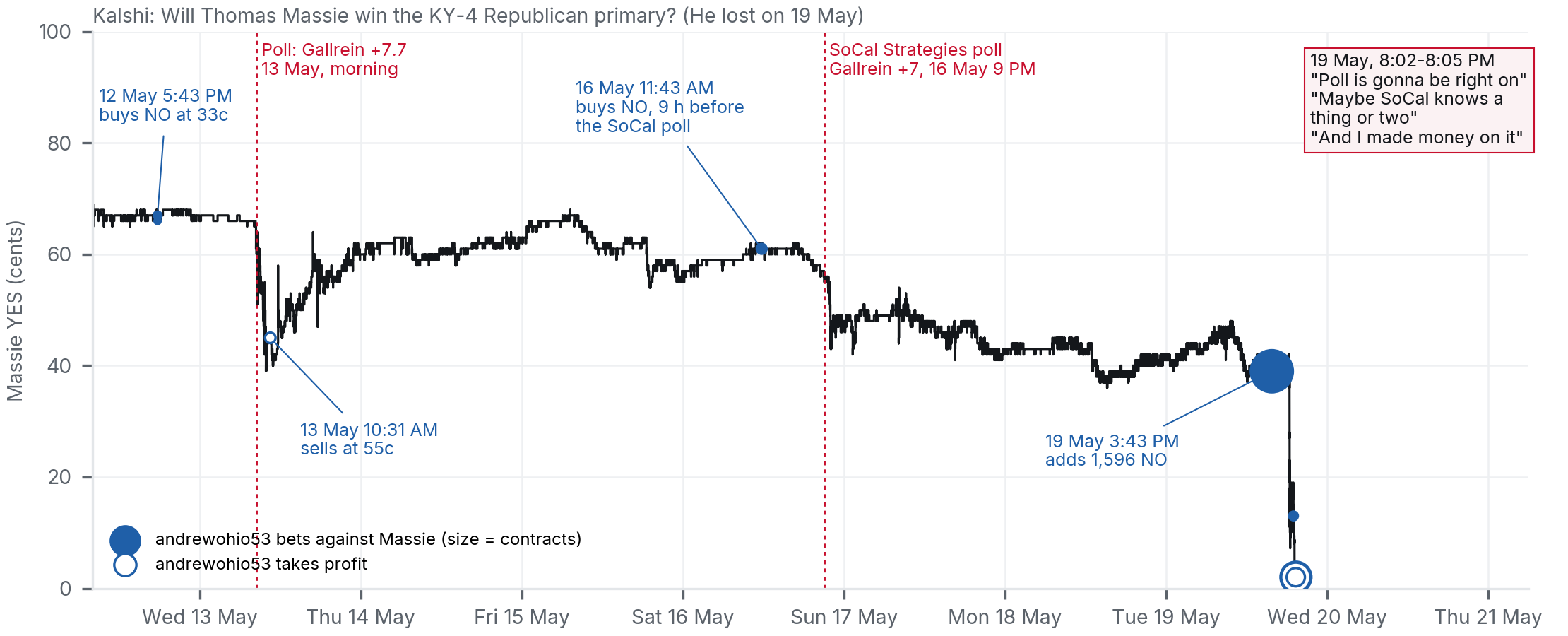
Kalshi’s Massie market, with andrewohio53’s trades and the two polls marked
Kalshi had not commented on the account as of Wednesday night. Its rules prohibit insider trading, but no rule requires a pollster to disclose bets on races he surveys. We assess that the account likely belongs to the man in Tellez’s records. Only Kalshi, which verifies its users’ identities, can confirm it.
How it came out
Wedgewood Polls appeared on X in late June 2026. Over four months it published 15 polls of Senate and governor races, and they were picked up by the New York Times’ polling database, FiftyPlusOne, VoteHub and Decision Desk HQ, and reported by outlets including Newsweek.
On Tuesday evening, after the polling newsletter FiftyPlusOne found that its respondent data did not check out, Wedgewood posted a statement calling itself “an experimental project to demonstrate the vulnerabilities” of the polling industry. It said there was “no real data behind the vast majority of our releases.”


Four hours later, an X user named @BeshearStan posted a screenshot of a Kalshi profile. “So I found Wedgewood’s Kalshi account,” the post said. “He goes by Andrew and has been insider trading using the fake polls that he was posting.” When another user asked how they knew, @BeshearStan pointed to an old “Andrew” account on X and to the profile’s focus on election bets.


The andrewohio53 profile as shared on X.
The profile showed a return of $4,764 and a Seattle Seahawks badge. The profile photo turned out to be borrowed. A reverse image search matches it to the obituary of a Virginia man who died in 2021. Kalshi’s records show it was added on May 21, two days after the Kentucky primary.
At noon on Wednesday, Tellez published a statement and a 42-page file of evidence. He wrote that he had worked since 2024 with the person he believes is behind Wedgewood, had raised $19,587 from 382 donations to pay for his polls, and had known him under several names: “Wilson Rochford” of SoCal, “Jack Sims,” “Andrew,” and a Discord account called “Michael Tracey’s Top Guy.” (That account has no known link to the journalist Michael Tracey.) The file includes screenshots of their private messages, with the date and time visible on each.


That message dump is what made it possible for BETINT analysts to test the Kalshi account’s affiliation.
The unveiled messages that confirm the trades
The Kentucky night is in Tellez’s Exhibit E.
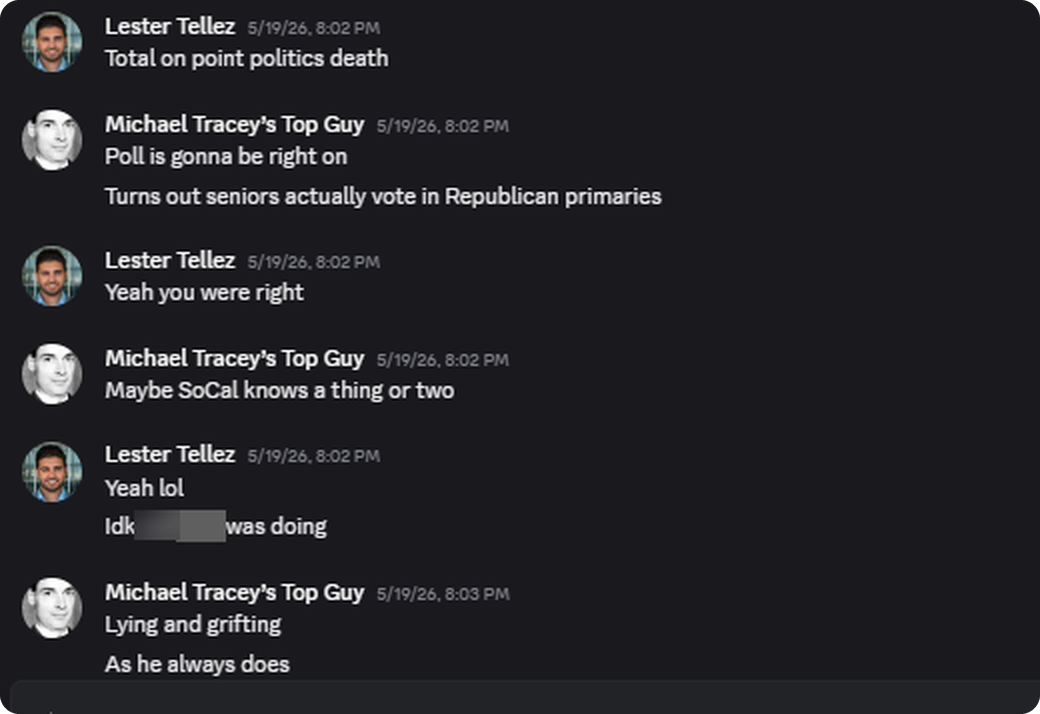
Tellez Exhibit E: messages from “Michael Tracey’s Top Guy” on the night of the Kentucky primary, May 19, 2026

Tellez Exhibit E, 8:05 PM the same evening
The trading record fills in the rest. On primary day the account added 1,596 more contracts against Massie, and it closed out at 98% as the result came in. It made $815 across the Kentucky markets, the single best race in its history.
Two days later, in Exhibit F, the same Discord account accuses another group of being “massive insider traders” for profiting when their poll moved a market. Then he says: “His share price went up to 60c when they dropped the poll. I made 3x my money.”
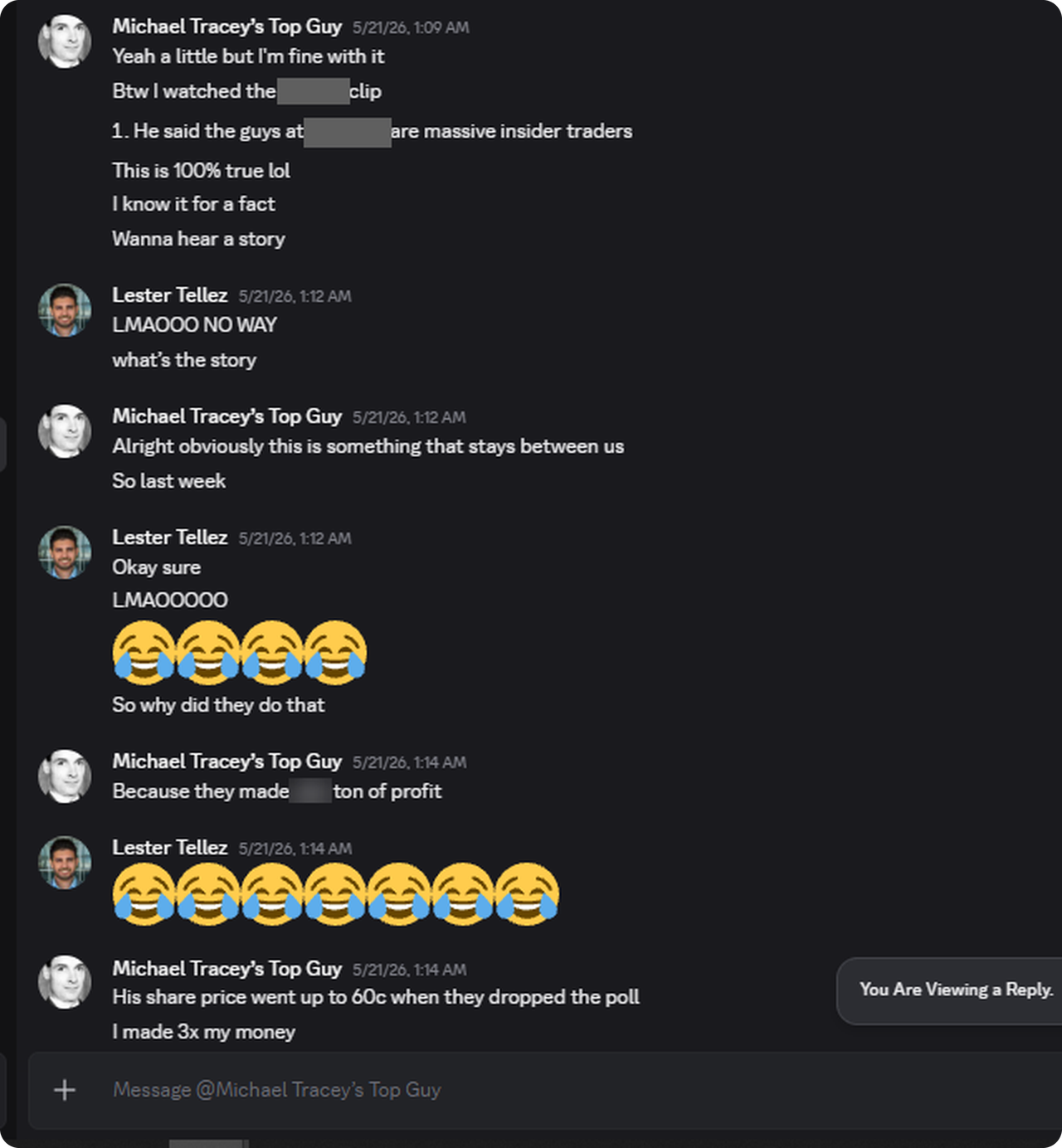
Tellez Exhibit F, May 21, 2026, 1:09 to 1:14 AM. Names redacted by Tellez
The timing fits a different firm’s Kentucky survey, released on the morning of May 13. The account had bet against Massie the evening before and sold that morning, after the poll knocked Massie’s price down. It made 1.6 times its money, not three.
We went through every message in Tellez’s file that makes a claim a trading record could check. They are below. Where he names a market and a night, the account traded that market that night. Where we can check which side he was on, the side matches too. Where he names an amount, he overstates it.
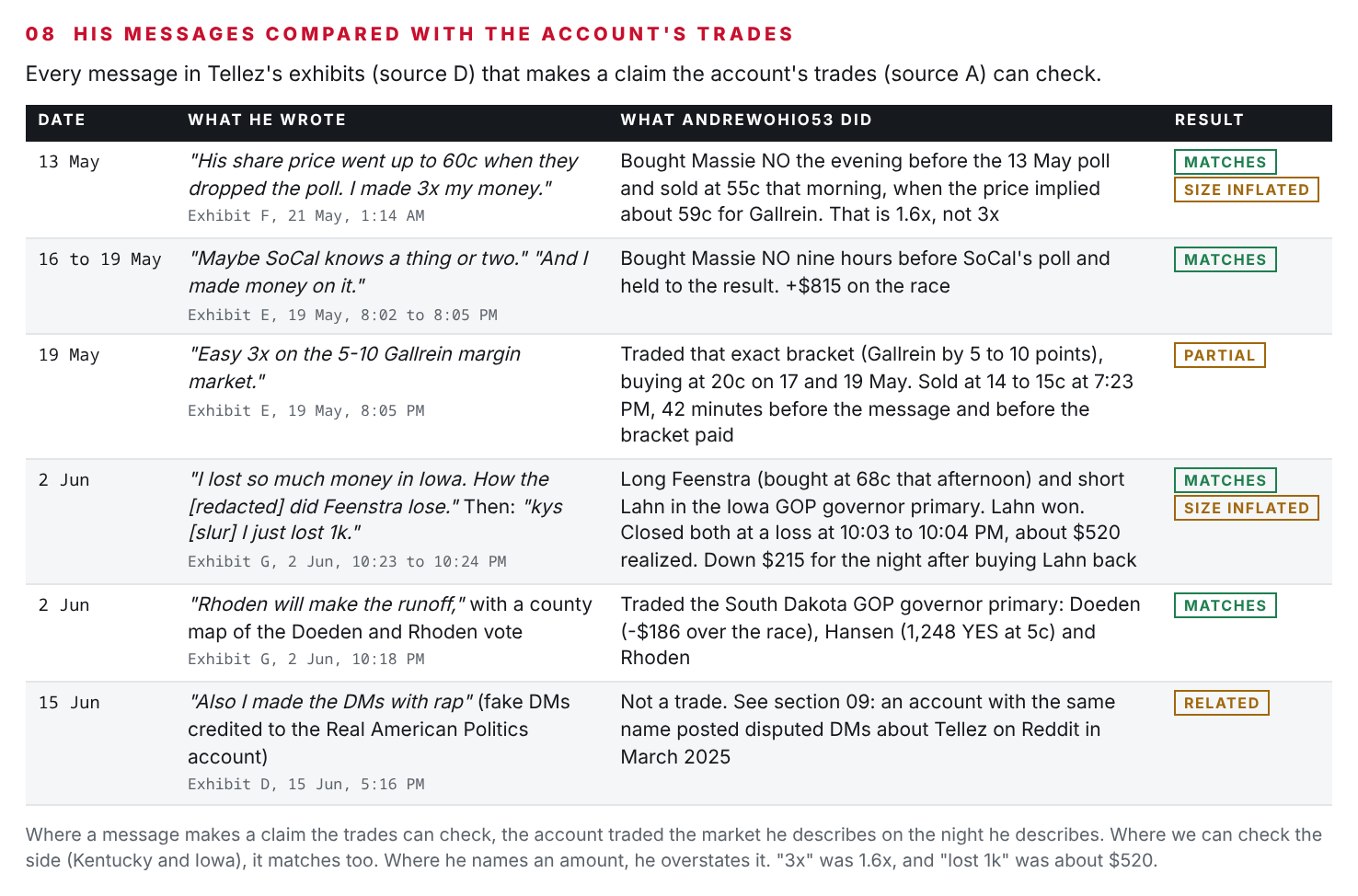
Every testable message in Tellez’s exhibits, set against andrewohio53’s trades
The June 2 messages matter most for narrowing it down, because they are about losing. “I lost so much money in Iowa,” he wrote after the Iowa governor primary, then told Tellez to kill himself, with a slur attached, because “I just lost 1k.” That night andrewohio53 lost about $520 in the same market, betting on Feenstra, the candidate he names.
Kalshi lets traders make their profiles public, so we checked every public account in these markets. Ninety-nine public accounts traded the narrow Kentucky margin market he called “easy 3x.”
Seventy-seven traded the Iowa primary. Seven traded both.
Only one of the seven traded the margin market on the days he described, traded the Massie market, and lost money on Iowa that night: andrewohio53.
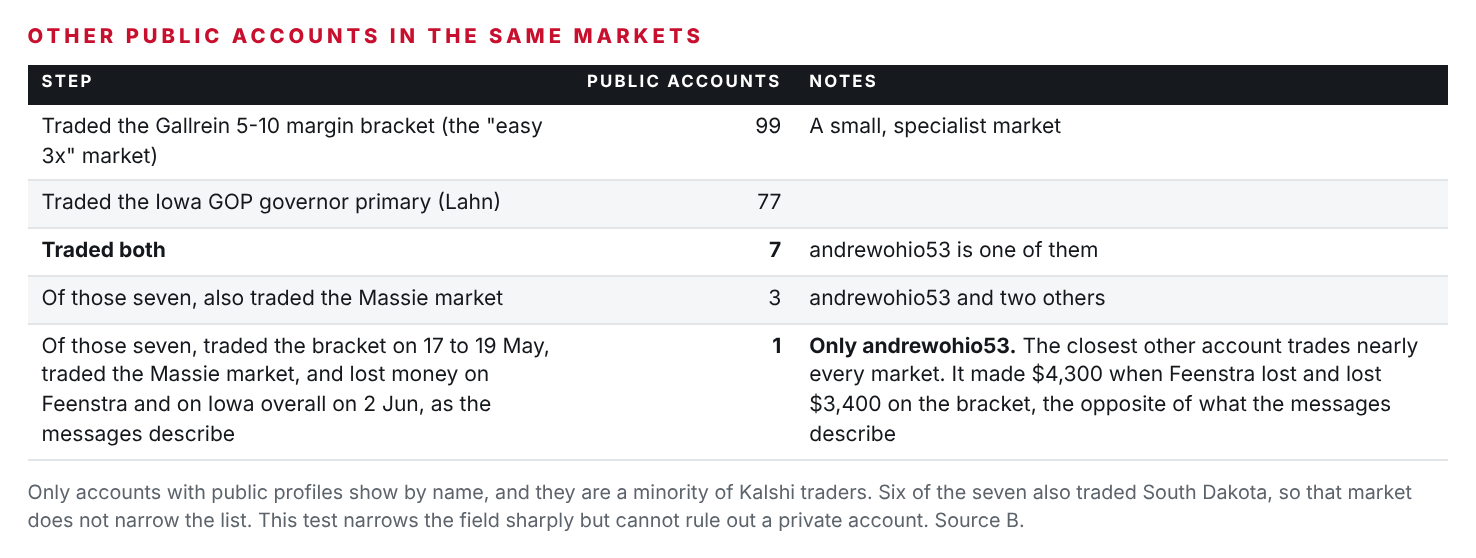
Narrowing the field: public Kalshi accounts in the markets the messages name
That test can’t rule out a private account, since most Kalshi traders don’t make their profiles public. But it narrows the field to one public account, and the timing and sides match the messages.
Three polls → three early bets
If andrewohio53 belongs to the man Tellez describes, the obvious question is what it did around SoCal’s polls.
Five SoCal polls had a Kalshi market while the account existed. It sat out two of them, the 2025 New Jersey and Virginia governor polls. It traded the other three, and each time it bet the way the poll would point before the poll was published.
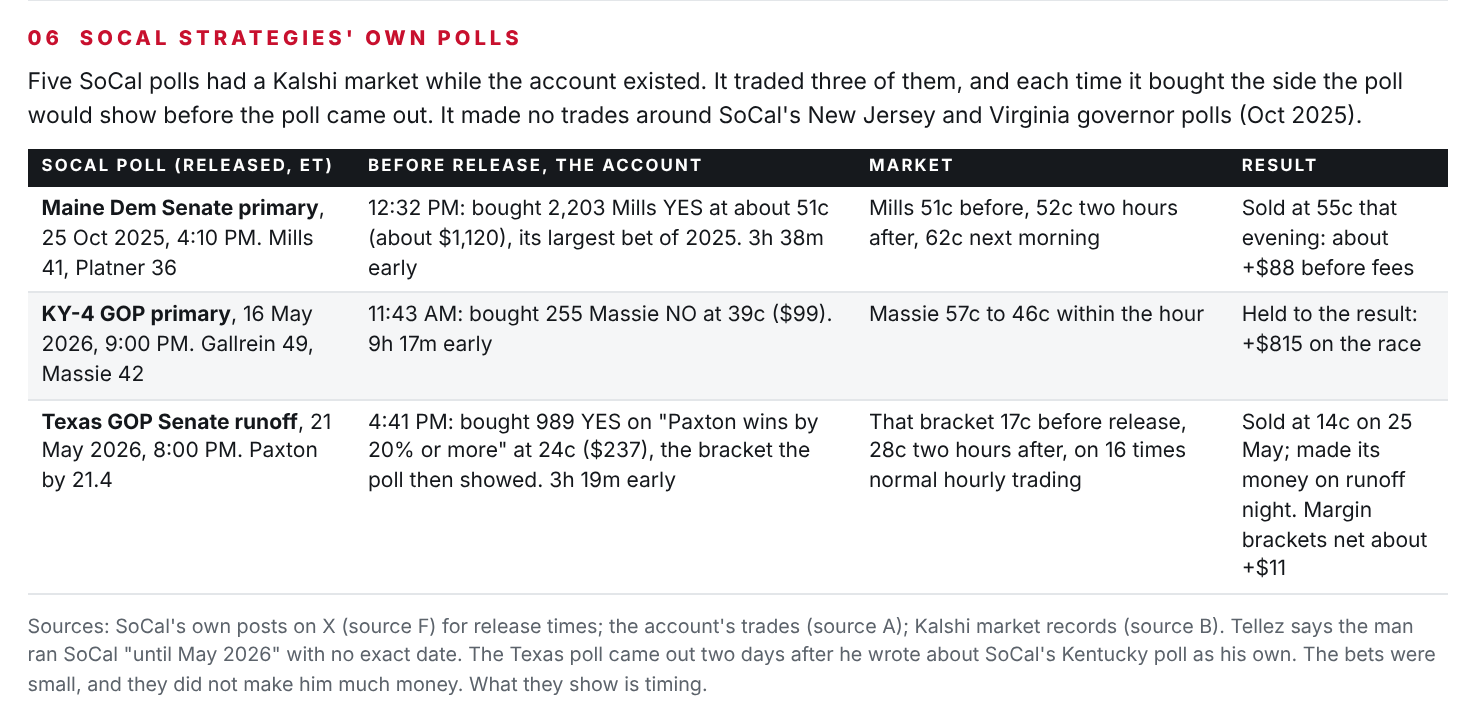
andrewohio53’s trades before each SoCal Strategies poll it traded
In Maine in October 2025, it put about $1,120 on Janet Mills three and a half hours before SoCal’s poll showed her leading. That was its largest bet of the year - In Kentucky, nine hours early.
In the Texas Senate runoff on May 21, it bought brackets on a Paxton blowout, including “Paxton wins by 20% or more,” in the three hours before SoCal’s poll put Paxton up by 21.4.
SoCal Strategies disputes part of this. It told the Washington Examiner that Jack Sims, one of the names Tellez ties to the man, “is not currently employed with SoCal Strategies and has not been for a year,” and that Andrew Prater never worked there. Tellez says the man ran SoCal until May 2026. If SoCal is right, he had left before the Kentucky and Texas polls. On the night of the Kentucky primary, though, he wrote about that poll as if it were his: “Poll is gonna be right on.”
None of these bets was large: $99, $237, about $1,120. Betting before a poll is also not, on its own, proof that someone knew what the poll would say. But a pollster betting in the hours before his firm, or his former firm, publishes, and then writing “Maybe SoCal knows a thing or two,” is exactly the conflict that prediction markets have no rule for.
What a fake number can do
Wedgewood’s polls moved real money once, clearly.
Most of Wedgewood’s 15 polls barely registered. In races with plenty of real polling, traders ignored the new name. Twelve of the 15 moved their Kalshi market by two cents or less in the first hour.
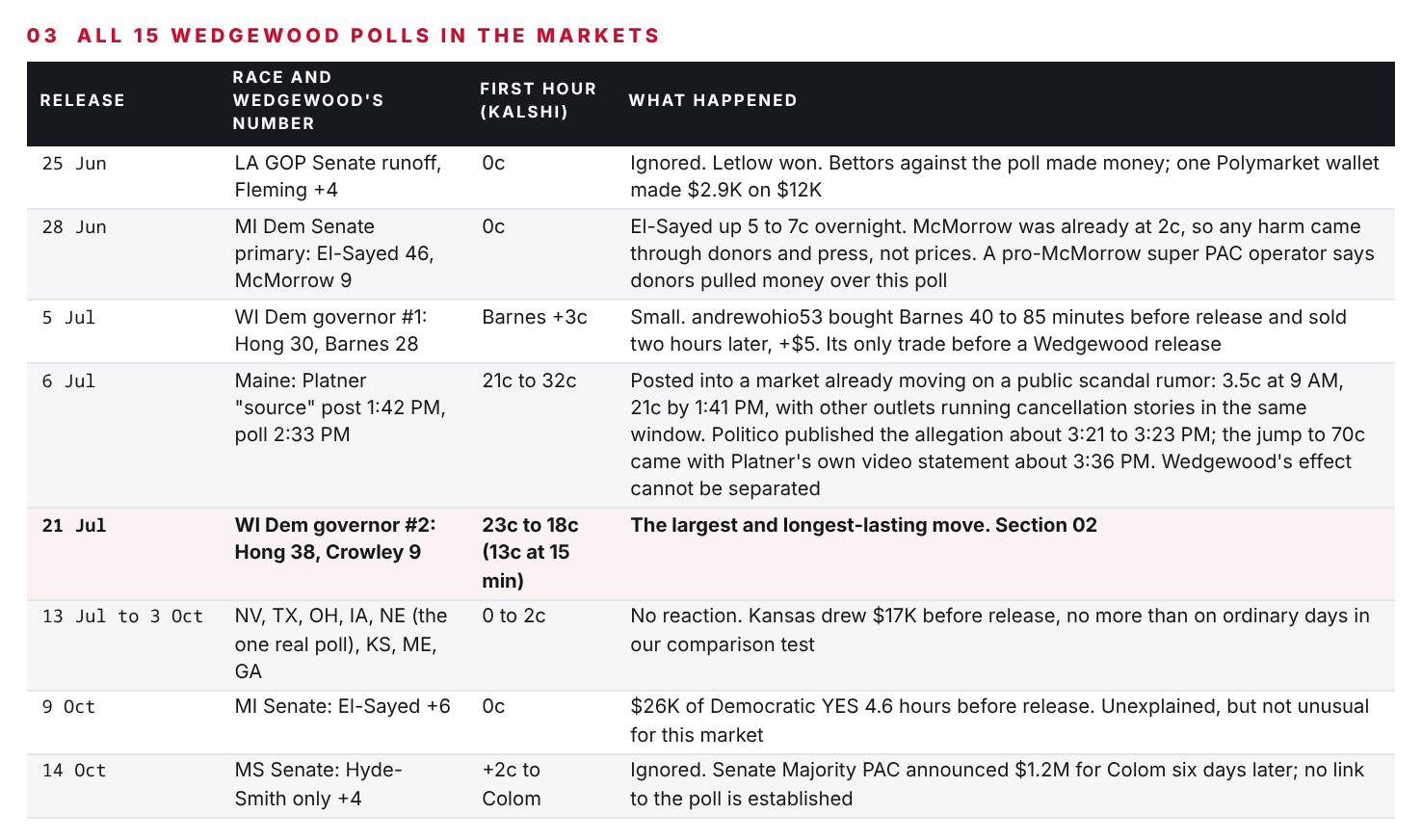
All 15 Wedgewood polls and what Kalshi did in the first hour
Wisconsin was the exception, and timing explains why. Milwaukee County Executive David Crowley had dropped out of the Democratic primary for governor, then jumped back in on July 18 with Gov. Tony Evers’ endorsement. No poll had been published since his return. Traders priced his comeback at about 23% and waited for a number.
Wedgewood gave them one on July 21. It put Crowley at 9%.
Within 15 minutes his price fell from 23% to 13%. His market traded more in the first hour than in the whole previous day, at about 70 times its normal hourly pace, and about $45,000 of new money came into it within a day. Francesca Hong’s campaign had launched a TV ad that same afternoon citing a poll labeled “NY Times” whose matchup only Wedgewood’s first Wisconsin survey had. The next day its press release cited Wedgewood by name.

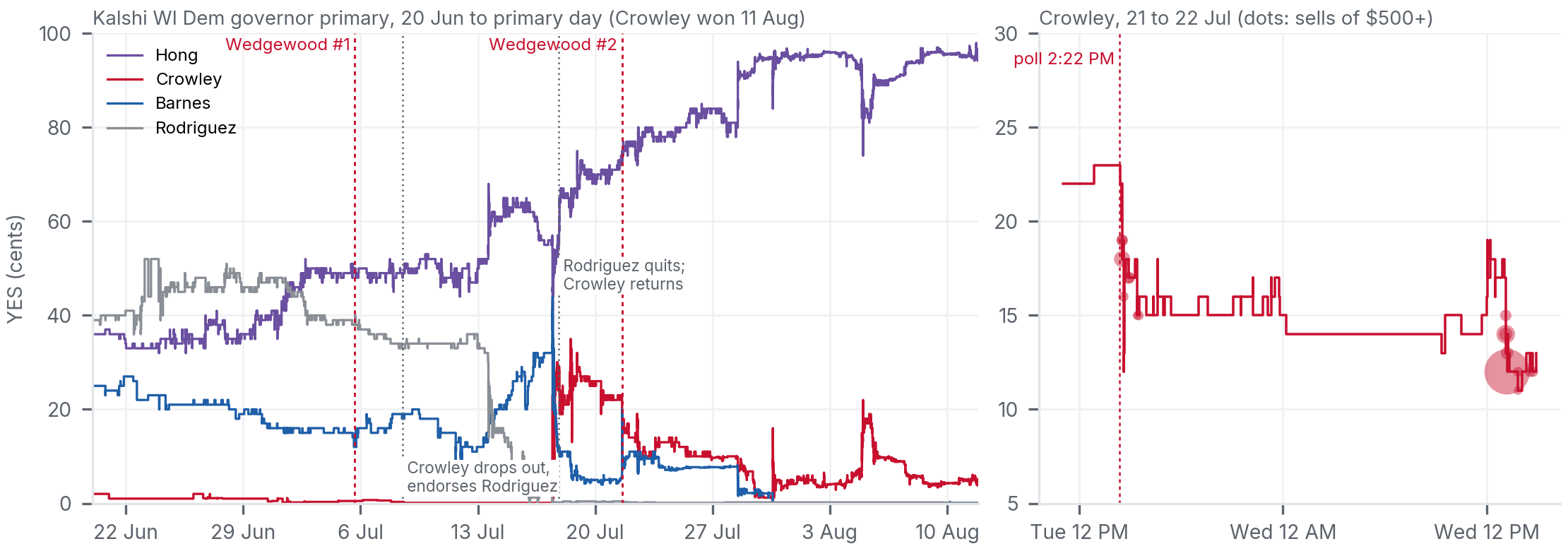
Kalshi’s Wisconsin Democratic governor primary. Right: Crowley in the hours after Wedgewood’s July 21 poll
Crowley stayed below his pre-poll price until primary day. Then he won, by about half a point.
The account tied to Wedgewood’s author barely touched this race. It bought Mandela Barnes about 85 minutes before Wedgewood’s first Wisconsin poll on July 5 and sold two days later, up $5. That is the only trade it ever made ahead of a Wedgewood release. It made no trades around the July 21 poll, and made $78 trading live on primary night. Its total across the Wisconsin race was $83 before fees.
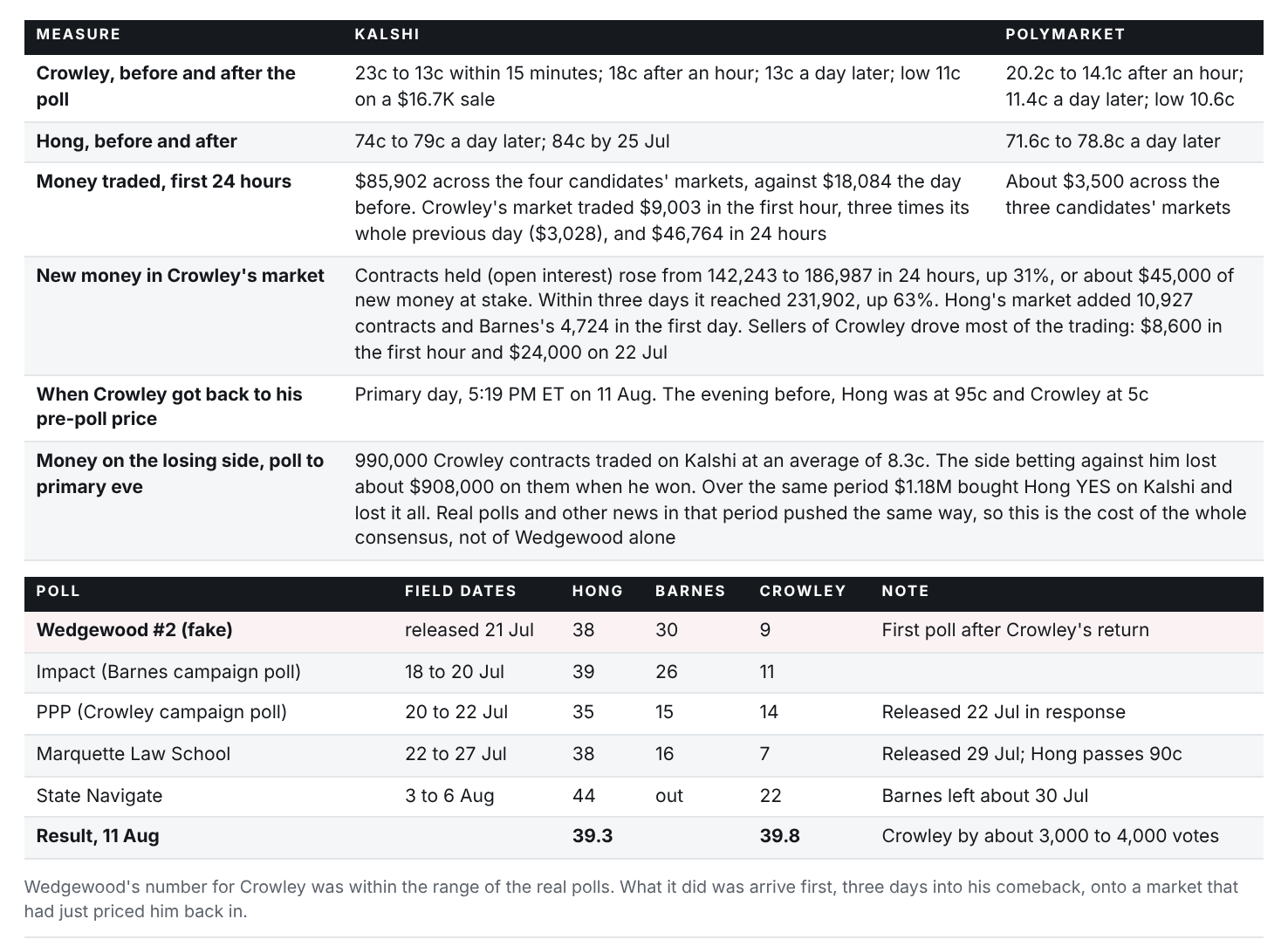
Wisconsin by the numbers: the market after the poll, and how the real polls compared
To be fair to the market, real polls released over the next week also had Crowley trailing, and they all missed too. What the fake poll did was get there first. It landed three days into his comeback, on a market that had just priced him back in and had nothing else to go on.
Kalshi has made the opposite case. In August, after a different fake pollster was exposed, the company’s spokesman told NPR that fake polls show why election markets are “a filter for misinformation.” “Traders lose money if they act on bad information,” he said. “While news outlets and campaigns touted the poll as real, the markets barely reacted at all.”
For most of Wedgewood’s polls, that held up. Wisconsin is where it broke. With no other number to go on, traders took the fake one and sold the candidate who went on to win. The same NPR story noted that Kalshi had Crowley as a long shot before his surprise win. Until the campaigns released their own polls the next day, the only poll behind that price was a fake one.
That is the pattern we laid out in The Poly-Pump Fake. We argued that the danger comes in information vacuums, where someone can “plant a rumor that ‘sticks’ simply because it is the only information available.” We expected the hard part to be trust: becoming a source a market believes takes the longest. Wedgewood made it look easy. FiftyPlusOne approved it for its averages on June 29, six days after its account appeared on X.
What Wisconsin lacked was the last step the paper described: someone positioned to cash out. The account tied to the pollster didn’t trade the July 21 poll. But nothing would have required anyone who knew the number was coming to disclose a bet on it. “Truth pays eventually,” we wrote, “but confidence pays immediately.”
The damage that didn’t show up in prices was real too.
In Michigan, Wedgewood’s late-June poll put Mallory McMorrow at 9 percent in the Senate primary. Her Kalshi price was already near 2% and barely moved. She left the race a week later. On Tuesday night, she described what the poll did to her campaign:


Where the money came from
So did andrewohio53 get rich? No.
It is a profitable politics trader: up $6,298 before fees and $4,764 after, almost all from election markets. But most of that came from ordinary primary betting across the country.
The races SoCal polled made it $735 after fees. Wedgewood’s races made it $53.
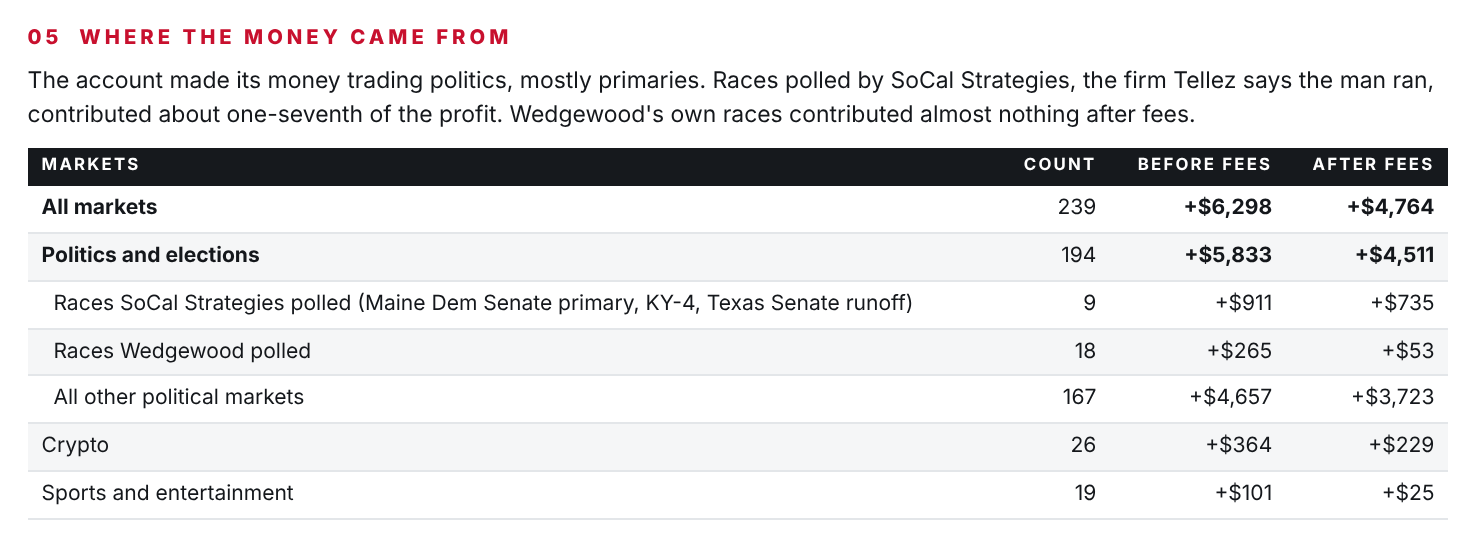
Where andrewohio53’s profit came from, before and after Kalshi’s fees
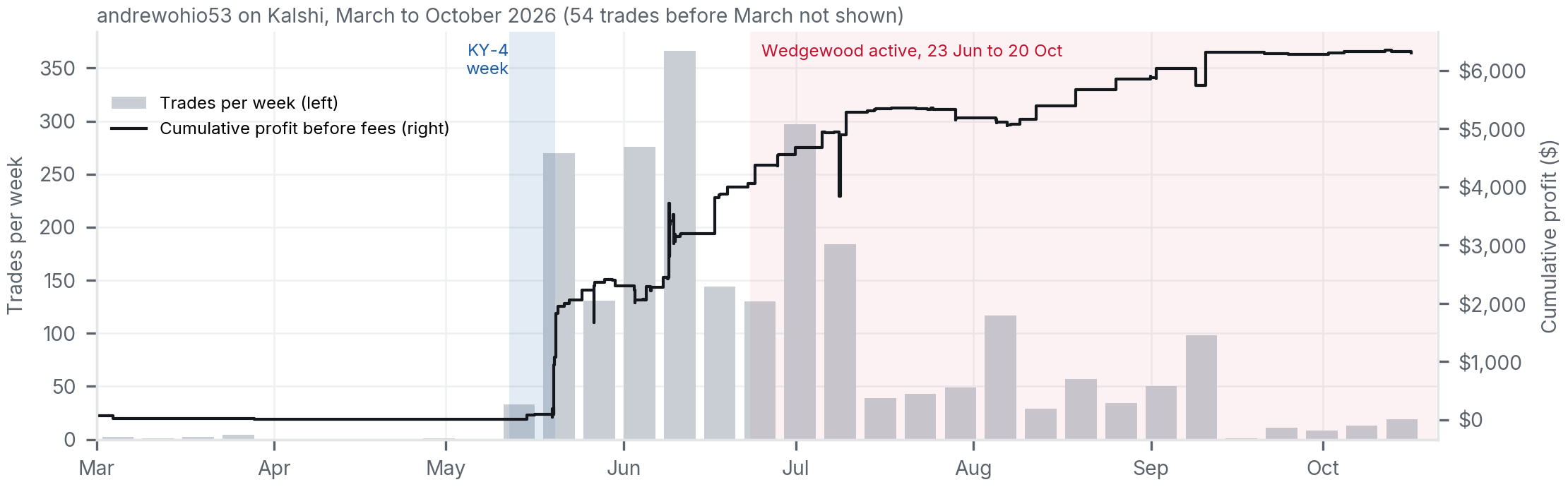
andrewohio53’s weekly trading and running profit, March to October 2026
The account barely traded for its first 15 months. It came alive in May 2026, the month of the Kentucky primary and, per Tellez, the month the man left SoCal.
Its heaviest trading ran through June and July, while Wedgewood was publishing. Its last trade was on October 16, four days before the confession. As of Wednesday night it had not traded since.
Who ran Wedgewood
The accounts conflict. Wedgewood’s own June email to FiftyPlusOne, published on Tuesday, named two people: Jack Sims, who signed it, and a “co-pollster,” Andrew Prater, described as active in Ohio Democratic politics. On Tuesday night the man using the Prater name gave a live interview on a Discord server. He said he ran Wedgewood’s companion X account, that Sims made the polls, and that he only learned they were fake on October 19. VoteHub’s head of data science, Zachary Donnini, said Wedgewood’s head pollster had told him he was a Boston University student who used to work at SoCal Strategies. The Washington Examiner found no students by either name in Boston University’s directory.
Tellez says there was one man behind every name. He has a grievance, and we have only seen redacted copies of his records. But every claim in them that we could test against market data held up.
Our evidence connects the Kalshi account to the man who wrote the messages in Tellez’s file. It does not tell us his legal name, and we are not attaching one. Kalshi knows who holds the account, because it verifies identity before anyone can trade.
What happens now
Kalshi had not commented publicly on the account as of Wednesday night. It has looked before: after Median Strategies, Kalshi checked its author’s account and found no bets on his races, NPR reported, citing two people with knowledge of his trades. Kalshi’s rules prohibit insider trading, and it told NPR it has barred campaign staffers from betting on their own races. Whether a pollster’s own numbers, before he publishes them, count as inside information is a question for Kalshi and its regulator. No rule we know of requires a pollster to disclose bets on races he polls.
Faking a poll is cheap. FiftyPlusOne paid $900 for 600 real interviews to test Wedgewood’s data, and making the numbers up costs nothing. Wedgewood is also the second fake pollster this year. In August, Median Strategies was exposed for fabricating polls in the Los Angeles mayor’s race, Nevada and the same Wisconsin primary. Its 21-year-old author called it a social experiment, much the same explanation Wedgewood gave.
The fallout so far has landed on the polls, not the markets. Decision Desk HQ and the Silver Bulletin pulled Wedgewood from their averages. The New York Times added an editors’ note and covered the fallout. The FCC chairman, Brendan Carr, warned broadcasters about airing “fake polls.”
Stock markets solved a version of this problem long ago, with rules about who can trade before an earnings release and surveillance around the release itself. Election markets move on polls now. Nothing stops the people who write the polls from trading on them, and nothing stops someone from inventing a poll to move a price.
BETINT has an open case on Wedgewood. We are watching andrewohio53, the X accounts involved, and the 13 races Wedgewood polled that are still trading through Election Day. If the account moves or more information emerges in this story, we’ll report it here on BETINT.net.
Trade data comes from Kalshi’s and Polymarket’s public records and andrewohio53’s public Kalshi profile, which lists every trade. Messages are from Lester Tellez’s October 21 statement and exhibits, which we have read only in redacted form. Other sources are posts on X, FiftyPlusOne’s reporting, the Washington Examiner, NPR, and other published coverage. Times are Eastern. That andrewohio53 belongs to the man described in Tellez’s records is BETINT’s assessment, and Kalshi has not confirmed it. Nothing in this piece alleges that anyone broke the law. The full brief, BI-20261021-WDG, has the method and every source.