


Last week, someone put $499,800 on Greg Abbott to win another term as governor of Texas. We covered the trade with CNN, and the obvious question was who had that much confidence in Abbott a week before an election.
But the way they placed the bet tells us something even without a name.
This was a block trade, a deal negotiated privately between two parties who qualify to trade in a part of Kalshi reserved for institutions and the very wealthy. Someone had agreed to take the other side before the rest of us ever saw it. By Thursday, another $500,000 had gone onto Abbott the same way.
For now, that looks like a familiar story. Someone with a lot of money thinks a candidate will win and is willing to back it. But what happens when hedge funds and major corporations start putting up more money than the rest of the crowd combined? Their bets could tell us as much about what they stand to lose as who they expect to win.
If a candidate’s policies could hurt a fund’s investments, a contract that pays out if that candidate wins could help offset those losses. The fund doesn’t need to think the candidate is likely to win. It needs a reason to protect itself if they do. That’s a different reason to bet.
I think we’re heading toward a lot more of that. The Abbott trades don’t prove it’s happening yet, but they show that the machinery is there, and that big money is starting to use it for elections. Once funds begin buying protection against the policies they fear, what exactly will we be looking at when we check who’s ahead in the odds?
Wait, What’s a Block Trade?
When most of us bet on prediction markets, we buy from whoever is offering the best price on the public order book, or leave an offer and wait for someone to take it. A large enough bet can chew through those offers and move the price.
With a block trade, the two sides negotiate the whole deal first.
A block trade is when two qualified participants agree on a size and a price between themselves, report it to Kalshi within 15 minutes, and Kalshi posts the trade publicly with no names attached.
Think less “tapping buy on your phone” and more two funds calling each other to swap a big position at a number they’ve already shaken on. It’s old school, in a way.
The part that matters is who gets to participate. Kalshi’s rules require both sides to qualify as Eligible Contract Participants, a legal category that includes financial institutions and some wealthy individuals. This is big-money territory.
This is the kind of trading built for hedge funds, professional trading firms and other financial institutions. Very wealthy individuals can qualify too, so a block doesn’t tell us automatically that a hedge fund placed it, but it does tell us that the buyer was qualified to trade alongside them.
Election Blocks: Brazil, Then Texas
Of the election blocks we’re looking at, Brazil came first. Those contracts have already paid out.
The last big poll before the runoff had Flávio Bolsonaro and Lula basically tied. The market didn’t believe it and had Flávio as roughly a 3-1 favorite. A block buyer took the Lula to win side, paid a little over the going price for it at 26%, sat underwater through a rough Saturday, and then collected $750K on Sunday night.
Was it insider information? Nothing indicates that at all. It looks like big, patient money that trusted the polls more than the crowd and got it right.
Then came Texas.
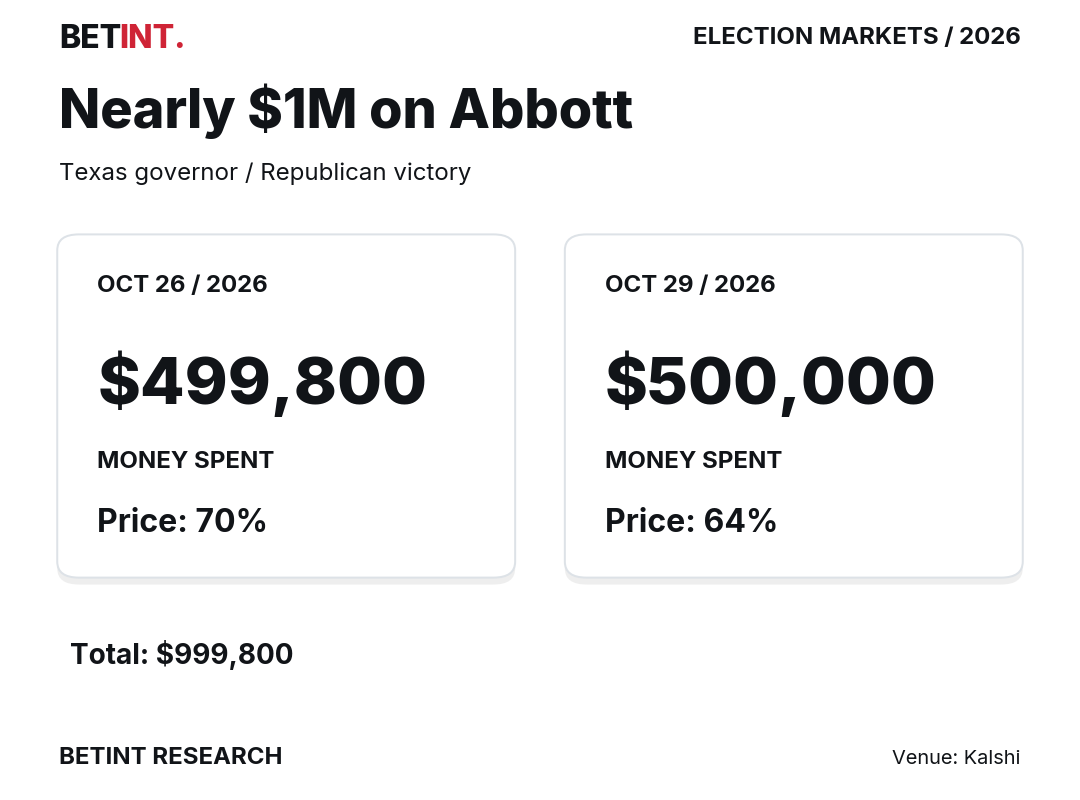
Abbott’s odds of being re-elected had been sliding for a week and a half, from 77% down to 68%, when the first block bought him at 70%.
That is somebody paying a premium to buy the dip, and doing it with a single ticket nearly twice the size of that race’s daily volume.
A $100K bet on Republicans to maintain control of the Senate followed five minutes later on Kalshi.
Then on Thursday the second Abbott block arrived at 64%, cheaper than the first, and the market barely budged.
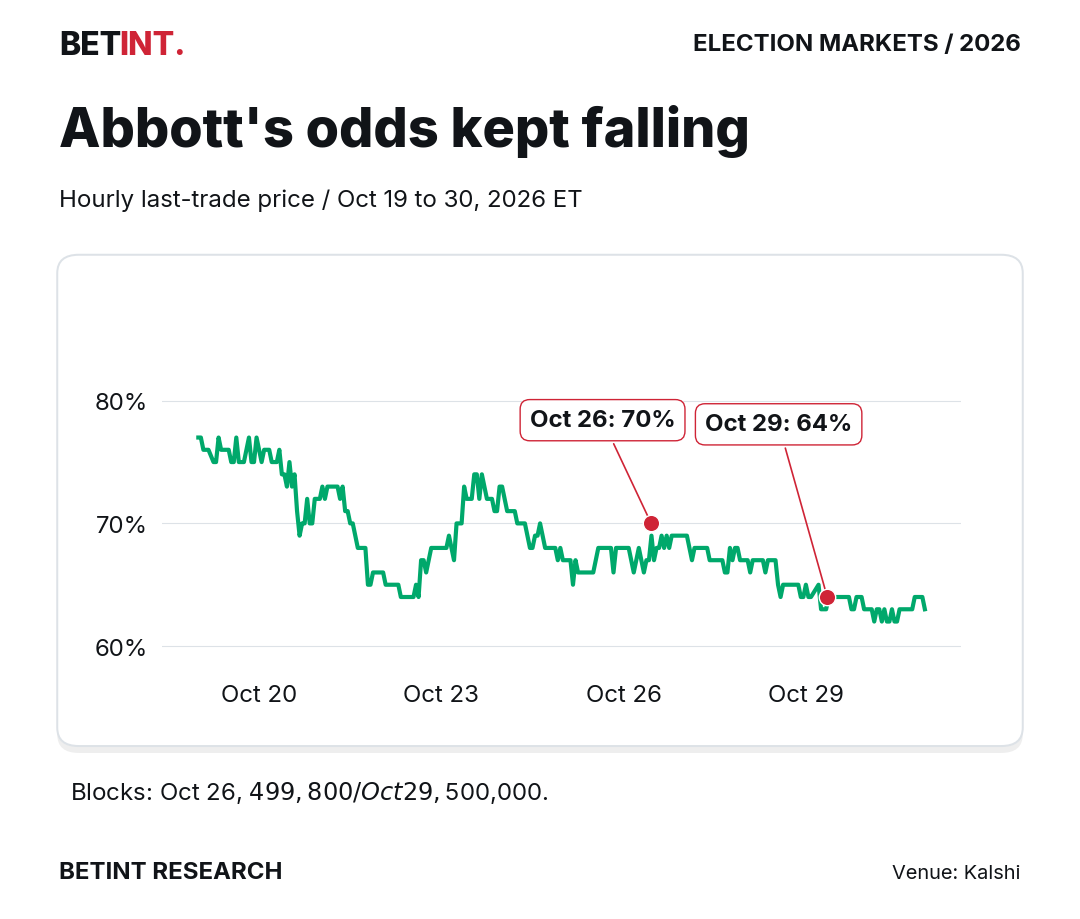
So was it the same buyer?
Kalshi doesn’t publish names, so I can’t claim that. But the Abbott trades are in the same market, on the same side, both roughly half a million dollars, three days apart, with the second coming at a cheaper price. If I had to take a guess, I’d say one buyer adding to a position.
The Senate bet five minutes after the first Abbott trade makes me wonder whether that was part of the same plan too.
We covered these trades with CNN, and Marshall Cohen put it about as plainly as you can:

What I told CNN about that first trade still holds: “They’re going out on a limb. Yes, it’s likely. But it’s not a near-certain outcome.”
For a sense of scale, the Texas Senate race between Talarico and Paxton is the most heavily bet Senate race in the country, with $28.2M traded over the last six weeks across Kalshi and both Polymarkets. We found no Kalshi block trades in that race.
Hedge or Bet?
Kalshi had an institutional block-trading business before these election bets showed up.
The first block Kalshi ever did, back in April, was about... carbon.
Greenlight Commodities, a Houston broker, put together a trade on California’s carbon auction between an environmental hedge fund and Jump Trading, and Bloomberg labeled it Kalshi’s first block trade.
After that came LSU’s side hedging a coaching bonus and Mattress Mack hedging a furniture promotion on the Astros. By August, Cantor Fitzgerald had opened block trading to its institutional clients, with Susquehanna pricing the trades. (To be clear, nothing ties any of those firms to these election block trades.)
Those deals show what hedging can look like: taking a position that helps offset a loss somewhere else. If you own a beach house, you buy hurricane coverage, and you’re thrilled if you never use it. A hedge can be a bet on the event or outcome you don’t want to see happen.
The election blocks look very different.
They landed in busy markets full of regular bettors where they were a small slice of the action. If you were protecting a portfolio that does well under Republicans, you’d consider buying Democrats, not paying a premium for more Abbott.
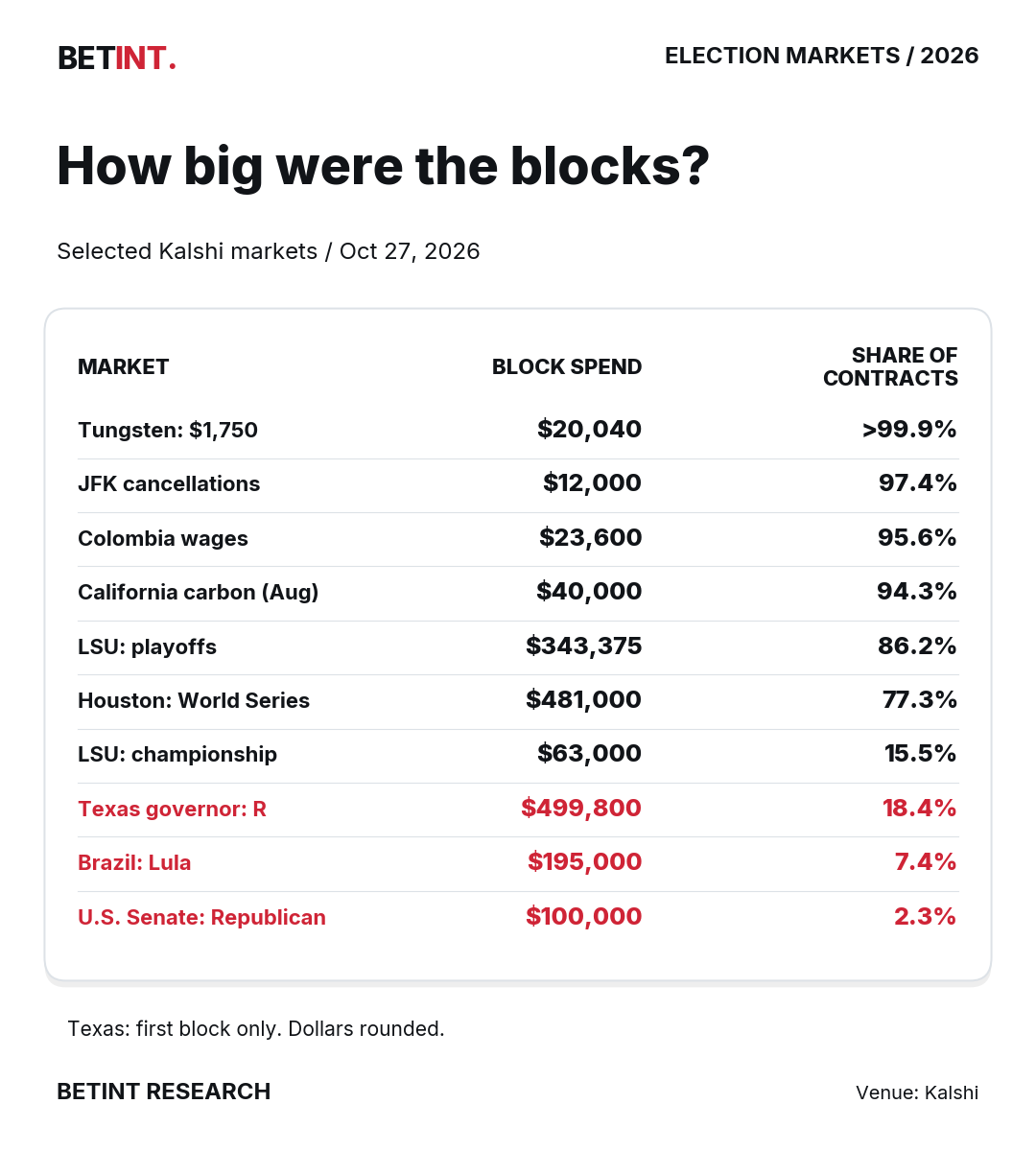
Could there be a hedge hiding somewhere else in their book? Sure, only they know. But from where I sit, these election block buyers look like they’re doing what the rest of us do on election night, which is picking a winner.
Why Kalshi Got the Call
In the races we examined, most of the large-trade dollars went through Kalshi. (On who controls Congress, Polymarket’s international site keeps pace.)
Some of that is brand. Kalshi is everywhere right now, between the ads, the lawsuits and the volume records, and it’s American, regulated and ID-checked.
Polymarket still reads like a crypto site to most Americans, and most Americans still aren’t casually using crypto. Kalshi is easy, and plenty of political junkies (and people who work in politics) have money and opinions.
For institutions it’s even simpler. Kalshi has brokers who set up the trades, a clear rule for who qualifies, and market makers ready to take the other side. A fund can pick up the phone and arrange a position at a price it agrees to.
Where This Goes
Kalshi was worth about $5B a year ago and was valued at $40B this fall, with IPO talk for 2027. In April, Citadel Securities president Jim Esposito told Semafor the midterms would be “a seismic event” for investors’ portfolios and that there’s “a good use case” for hedging them. Asked whether this market will scale, he said, “I think it’s likely.”
None of this is new in sports. Susquehanna became Kalshi’s first institutional market maker back in 2024, and sports is still the bulk of what trades there. Professional firms already know how to price these contracts and take the other side. Now we’re seeing large negotiated trades on elections too.
So here’s where I think this goes.
More institutions are coming, and the tickets are getting bigger. A handful of blocks in one week is now the floor, not the ceiling, and as the brokers and market makers get comfortable, more funds will have a way to place those bets.
They won’t be hedging parties so much as policy. A fund with money exposed to tariffs, taxes, drug pricing or bank rules already has a reason to care who wins. Every candidate’s platform could become a line item on somebody’s risk sheet.
And eventually, they’ll bet on the candidate they fear.
Picture a fund sitting on a big position in oil stocks, staring down a candidate who promises to tax oil profits. How does the fund protect itself against that possibility?
One way is to buy a contract on that candidate winning.
If the candidate wins, the election bet pays out, giving the fund something to offset the damage it fears for its oil stocks. The policy might never pass, and the payout won’t necessarily match the loss. It’s imperfect protection, but you can see the reason for buying it.
Now multiply that across every industry with something to lose, and you get a world where Wall Street money pours into a candidate because it’s scared of them winning. Hell, the most bullish money on a candidate could come from the people who want them to lose.
And even forget hedging for a second. Do we really expect hedge funds to watch this grow without turning their technology and datasets on a whole new crowd of retail traders behaving, honestly, like gamblers?
I think we’re heading toward a world where institutions dominate prediction markets, using them to hedge their own interests and capitalize on their superior technology and datasets. By 2028, I expect us to be openly discussing which investment firms have positions on which candidates on CNBC in a very Stephen A. Smith-like fashion.
We’ll be looking at election odds and trying to understand how much of that price comes from people predicting the result, and how much comes from firms protecting themselves against it.
That doesn’t necessarily make the odds less accurate. If a fund pushes a candidate’s price above what other traders think is fair, those traders have every incentive to sell into it and bring the price back down. More institutional money could actually make these markets better at forecasting elections.
But that doesn’t mean the crowd is getting wiser. It might mean a relatively small number of sophisticated firms, armed with better technology, more capital, and entirely different incentives, are increasingly responsible for setting the prices the rest of us look at.
I agree with the premise of economic hedging. I see the value in being able to protect yourself against a political outcome that could hurt your business, and I think over the next two years we are are going to really test how well these markets can do that. There is a reason to build this, and a reason for institutions to use it.
But I also think the execution could follow a familiar path. A technology that opens participation to ordinary people becomes saturated with institutional money, and eventually the largest financial interests dominate what it becomes. Prediction markets could prove the value of election hedging while becoming another market where the common man’s view carries very little weight.
Professional traders might make the odds more accurate. But a better forecast and a market dominated by ordinary people aren’t the same thing. And that leaves me wondering what happens to the idea that got so many of us interested in the first place. If the odds are increasingly shaped by investment firms buying protection for their portfolios, how much of what we’re watching can we still call the wisdom of the crowd?
Scope and sources: Kalshi, Polymarket, Polymarket US and BETINT’s research. Figures as of Oct 31, 2026, before fees. Bet sizes are money spent; payouts include the original stake. Texas Senate totals cover Sep 15 to Oct 30. The buyers’ identities, motives and any connection between them are unconfirmed. Nothing here alleges anyone broke a rule.