


At 3:54 p.m. ET on none other than Friday the 13th of November, the Federal Aviation Administration ordered a national ground stop following widespread air traffic control radio outages. At the time, officials had not yet identified what caused the disruption.
Under an hour later, Polymarket opened a betting market on whether the outage would be linked to Iran.
Within the hour, traders were wagering on potential causes ranging from cyberattacks and foreign interference to an “AI sandbox escape”—even though federal officials hadn’t suggested any of those scenarios.
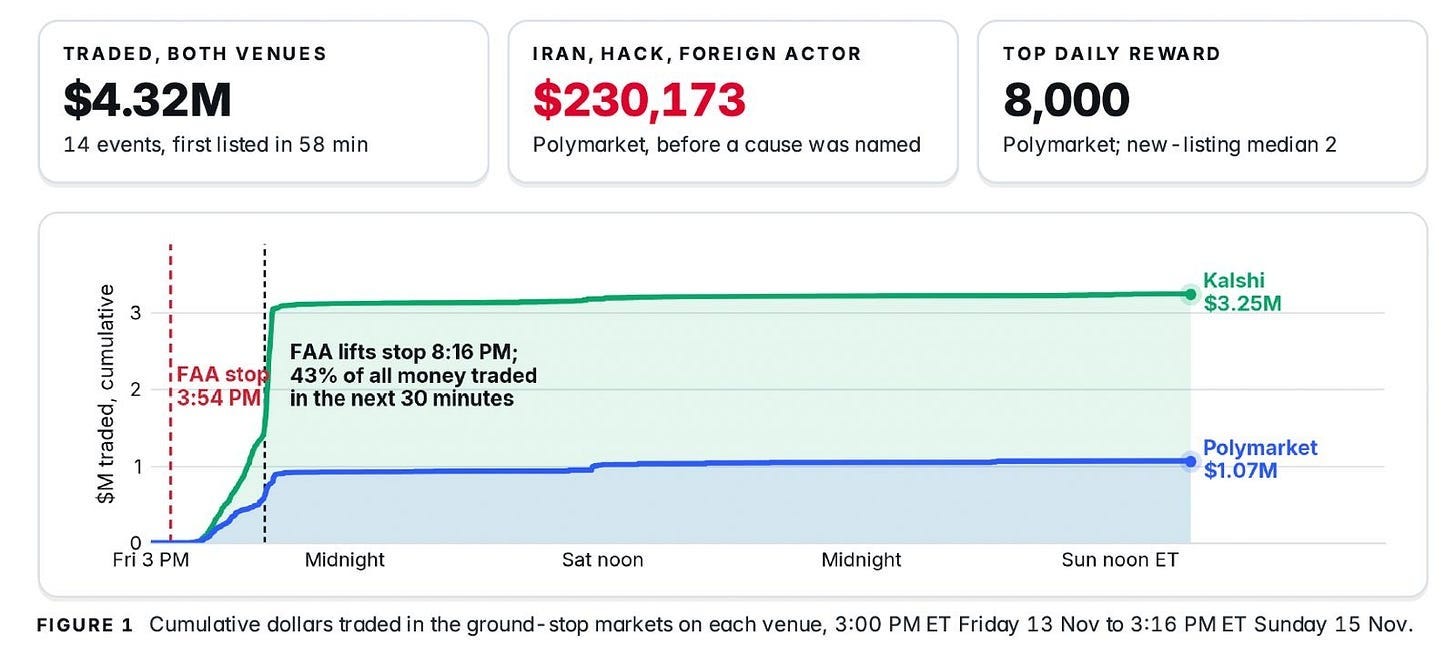
Over the next two days, Polymarket and rival Kalshi processed $4.32 million in volume across 14 event markets covering the outage’s cause, duration, and potential fallout for FAA leadership.
A BETINT review of trading records, market listings, financial incentives, and social media activity reveals how prediction platforms shape which narratives get monetized, where trading capital flows, and how speculative probabilities filter into the broader news cycle during a crisis.
An Emergency Becomes a Market
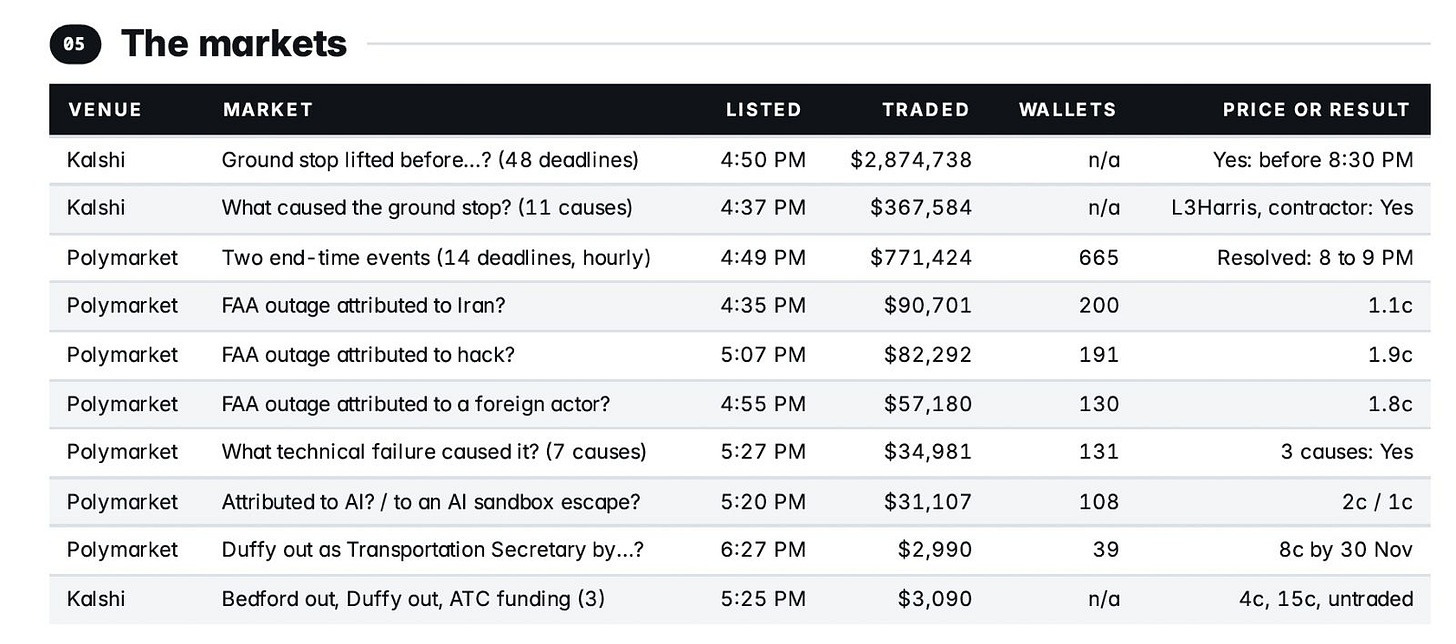
The first public reports of radio issues surfaced on X at 3:37 p.m. Polymarket posted its Iran contract 58 minutes later, while Kalshi launched its cause-related market at 4:37 p.m.
The platforms took different approaches.
Kalshi initially stuck to standard operational explanations such as equipment failure, software bugs, routine maintenance, and human error. Polymarket, by contrast, listed high-speculation contracts on Iran, hacking, and foreign intervention, which together drew $230,173 in volume before official investigations established the facts.
The bulk of activity focused on when flights would resume. Of the $4.32 million traded overall, 48% changed hands while the ground stop was actively in effect.
Another 43% came in the 30 minutes right after the FAA lifted the order at 8:16 p.m., with much of that trading centered on outcomes that had effectively already been decided.
The operational difference between how the two platforms structured their cause markets is notable. Listing an Iran contract doesn’t mean the platform asserts Iranian involvement, but it attaches a real-time price tag to an unverified scenario, allowing market probabilities to spread as news indicators.
Financial Incentives During The Outage
Polymarket actively incentivized trading on specific outcomes during the event.
Throughout Friday’s outage, the platform offered daily liquidity rewards of 2,000 stablecoins each for its Iran, cyberattack, and foreign-actor markets. Certain contracts on when the ground stop would end featured advertised daily rewards as high as 8,000 stablecoins.
These incentive rates were remarkably steep compared to standard offerings on the platform.
Across 2,896 Polymarket listings launched the prior week, the median daily advertised reward was just 2 stablecoins, with a ceiling of 1,000. None hit the 2,000 mark seen during the outage.
By contrast, Polymarket’s own market tracking technical failures offered no liquidity rewards at all.
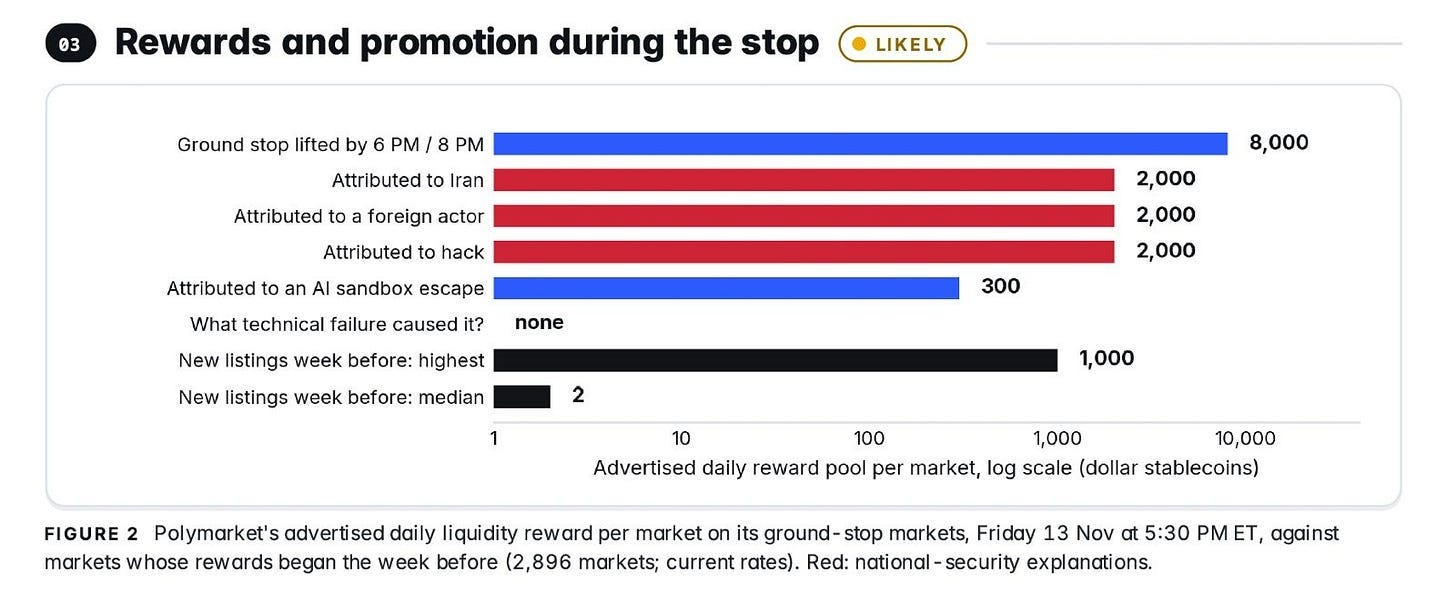
While these advertised figures represent maximum potential daily rates rather than final payouts—and short-lived markets earned only a fraction of those totals—the disparity is clear.
Polymarket steered significantly higher financial incentives toward speculative national security narratives than toward routine technical explanation markets.
When Betting Odds Turn Into Headlines
Beyond hosting the markets, Polymarket actively promoted the disruption across its social media channels.
At 4:02 p.m., before launching its initial contract, the platform published a breaking news alert about the ground stop that pulled in over a million views.

At 5:03 p.m., it promoted the Iran market.


By 5:28 p.m., Polymarket published another “BREAKING” update reporting a 70% chance that the ground stop woul84d clear by midnight.

Kalshi followed a similar playbook on Saturday, broadcasting its own market odds as news updates—including a post claiming a 72% likelihood of a software error.
While real-time market prices reflect trader consensus, they aren’t verified facts or official findings.
When trading platforms package their own contract odds as breaking developments, public audiences reading those headlines on social media can easily mistake speculative betting odds for confirmed reporting.
What Actually Happened
On Saturday, Transportation Secretary Sean Duffy clarified the situation, explaining that contractor L3Harris had been migrating communication lines from copper to fiber when a malfunctioning router flooded the FAA network with traffic.
FAA Administrator Bryan Bedford confirmed the outage was not a cyber incident and showed no signs of foul play, noting that investigators were determining whether installer error or hardware failure caused the bottleneck.
By Sunday afternoon, Polymarket’s contracts for Iran, hacking, and foreign intervention had collapsed to between 1-2%.
BETINT also analyzed sharp price swings around key news disclosures. The price shifts aligned cleanly with public news releases, offering no evidence of insider trading or market manipulation.
These dynamics highlight critical questions for market regulators.
Unverified threat contracts can attract significant trading volume before official facts emerge. Promotional pushes and liquidity subsidies can amplify fringe theories. And when platforms share their own contract odds as breaking developments, those numbers spread rapidly without necessary context.
The FAA ground stop demonstrates how prediction markets can shape public perception during breaking events. As prediction contracts expand into national defense, public health, and vital infrastructure, the interplay between exchange mechanics, commercial incentives, and public information demands ongoing scrutiny.
This article is based on BETINT’s November 16, 2026 intelligence brief, “How an FAA Outage Turned Into a $4.3 Million Betting Event.” The analysis covers Kalshi and Polymarket activity through 3:16 p.m. ET on November 15, using venue market data, reward listings, FAA and DOT statements, and contemporaneous reporting.
