


KEY POINTS
On Oct. 2, a Polymarket trader bet $1.14 million that Indiana won’t pass a data center moratorium. Odds of a ban fell in every state the site covers and haven’t recovered.
In the five hours before the bet, other accounts sent that trader $905,000. Two of them, dromedaryy and ScottyNooo, supplied $750,000
The bet is the smallest part of the story. The accounts behind it have traded more than 1,000 of the same markets and passed each other shares 74 times since March.
Their biggest wins are in US politics and the Iran war resulting in a net total of $3.8M in profit combined.
Late night on Friday, Oct 9th, a Polymarket account called aenews2 put $1.14 million on Indiana saying no to a data center moratorium.
It wasn’t exactly hiding. aenews2 links its profile to the X handle @aenews, it has traded on Polymarket since early 2024, and it ranks among the site’s most profitable politics traders. Just minutes after the order filled, a whale-alert bot posted about the trade to X.
What the alert didn’t show was where the money came from. We followed it, and it led to a group of accounts that fund one another, trade the same markets and settle deals between their own wallets. The data center bet turned out to be the tip of it.
A thin market takes a $1.14 million order
The market asked whether Indiana would enact a moratorium on new data centers by the end of 2027. Before Oct. 2, about $26,000 had traded on it in total.
That number measures trading volume, not money resting on the order book. The market was thin, but it wasn’t empty.
To get traders to quote prices in new markets, Polymarket incentivizes them through liquidity farming rewards: a daily pool, $500 a day on each of these state markets, shared among accounts that keep orders sitting on the book near the current price. The bigger the order, the bigger the cut. An order can earn its share every day without ever being filled.
On Indiana, an account called JambonMogettes had parked a bid to buy 1.25 million “Yes” shares at 26 cents, about $325,000. It was there to collect rewards, not to trade. Nobody had traded against it, because nobody had wanted to trade that much.
aenews2 did. It bought 1.54 million “No” shares at 74 cents and took the entire bid in one go. On Polymarket a “No” buyer at 74 cents is matched with a “Yes” buyer at 26 cents, and the contract creates a fresh pair of shares, so a $1.14 million bet needed only about $400,000 on the other side. JambonMogettes supplied most of it.
With that wall gone, there was little left holding the price up. The market had priced a ban at about 27%. By the next evening it was 9%.
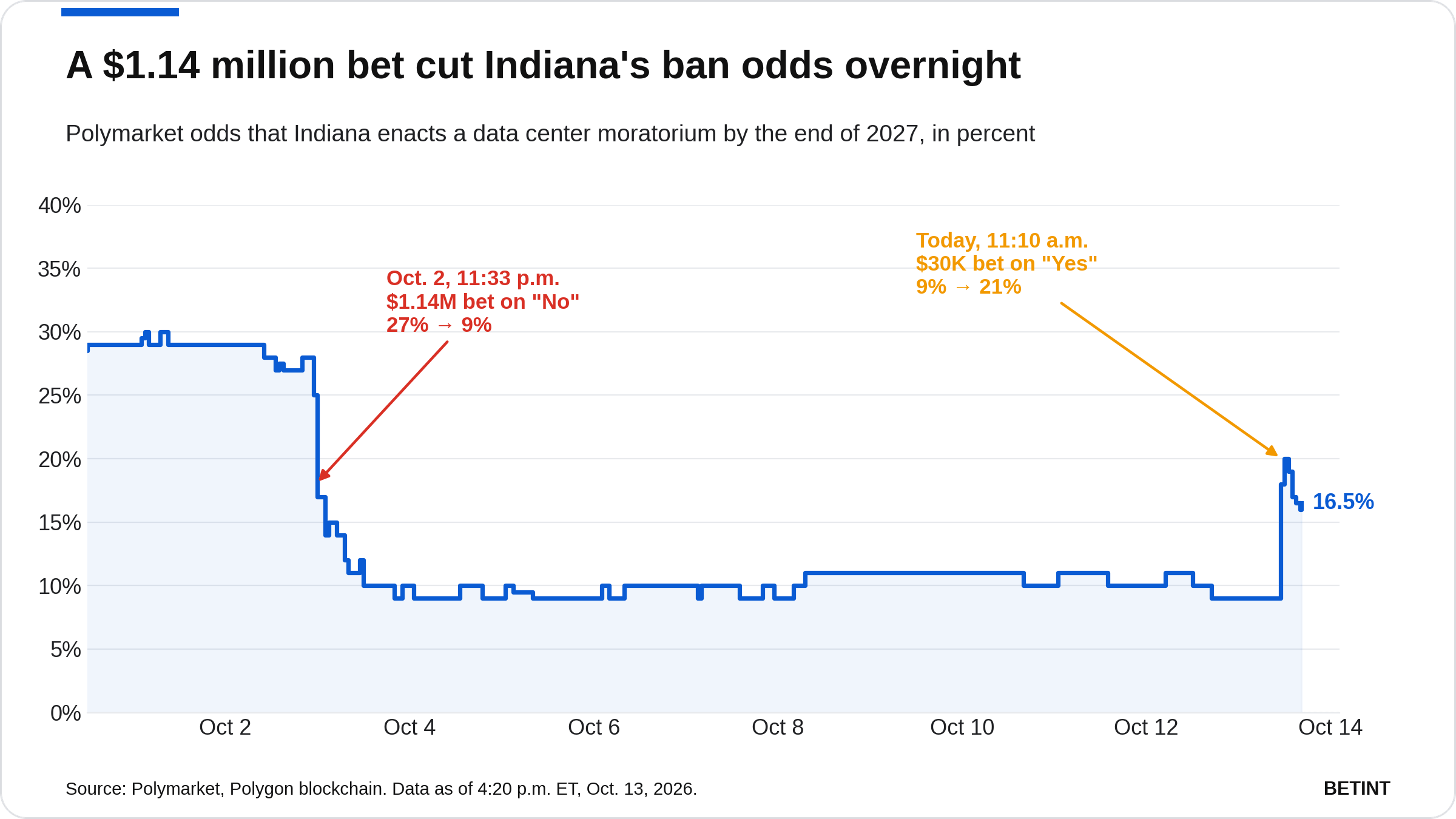
The move spread. Polymarket runs the same question for 6 states across 4 deadlines. The average chance of a ban across those 24 markets fell from 21.5% to 13% overnight. On Tuesday Oct 13th it was 13.9%.
The money arrived first
aenews2 didn’t fund the bet alone. BETINT’s investigation shows $905,000 landing in its account in the five hours before the order, $870,000 of it from other Polymarket accounts. The two biggest senders, ScottyNooo and dromedaryy, put in $750,000 between 10:31 and 11:11 p.m., 22 minutes before the bet.
None of it has been paid back. As of Oct 13th, aenews2 has sent nothing to either account, and nothing to the Coinbase address it normally uses to cash out.
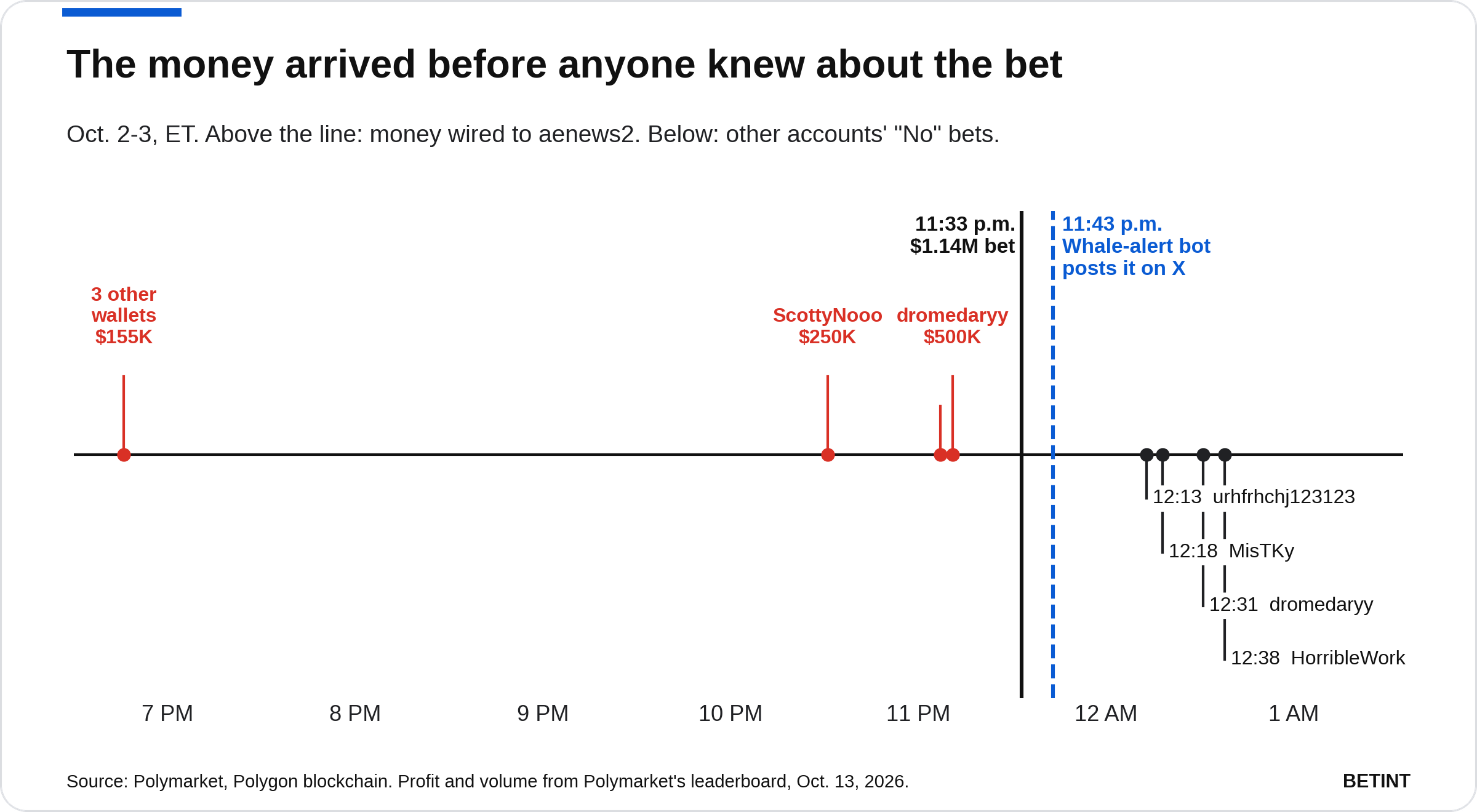
dromedaryy and MisTKy, another account with a history of paying aenews2, placed “No” bets of their own within the hour. Other traders piled in too, but only after a whale-alert bot posted the bet at 11:43 p.m. For accounts with no money tie to aenews2, that public alert seems like the simplest explanation.
Dromedaryy sold its Indiana bet by Oct. 8 for about a 30% gain. aenews2 stayed. It still holds 1.41 million “No” shares, up about $157,000 on paper and roughly 50x the size of its next-largest bet.
So who is aenews2 betting with?
The accounts behind the bet
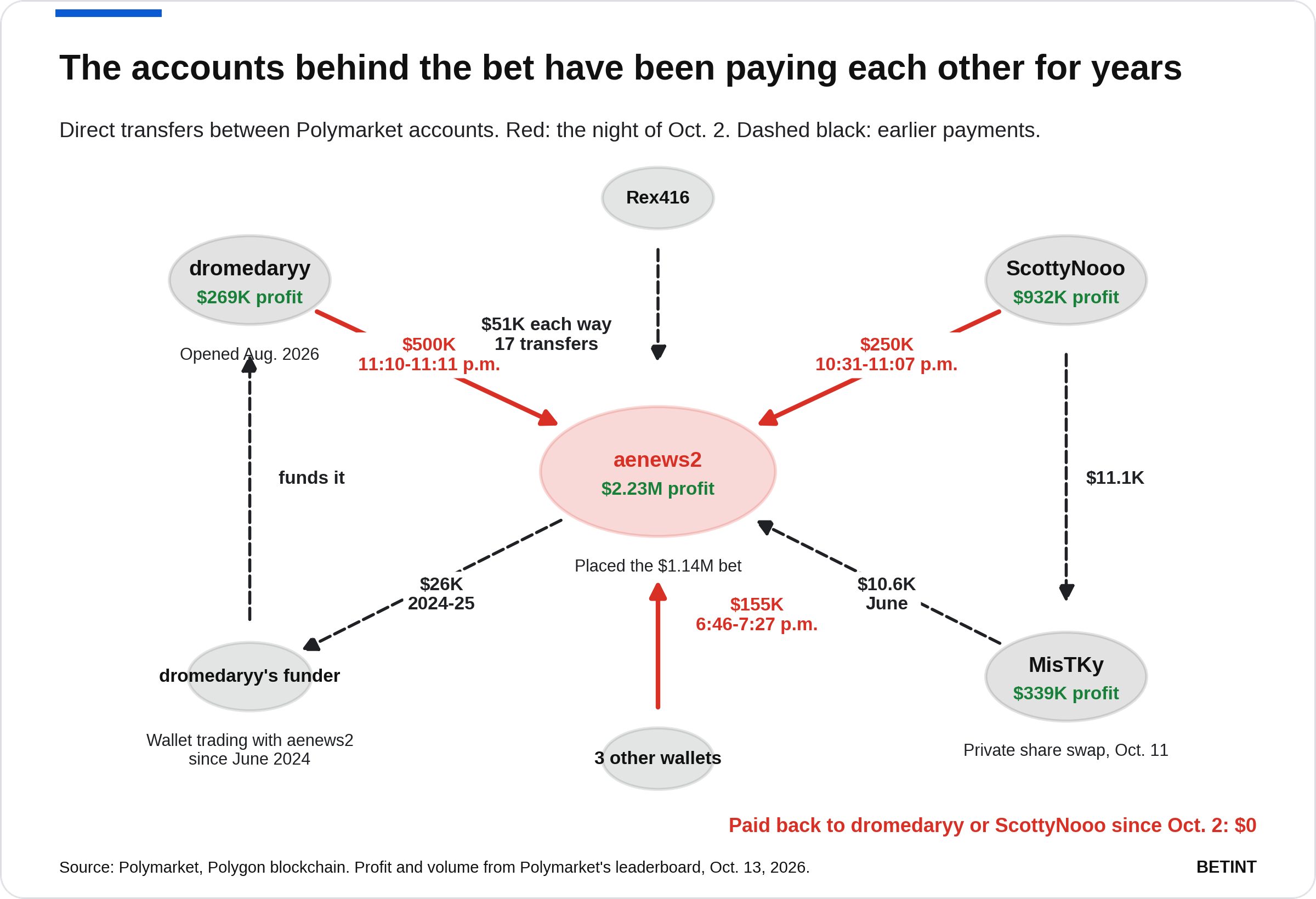
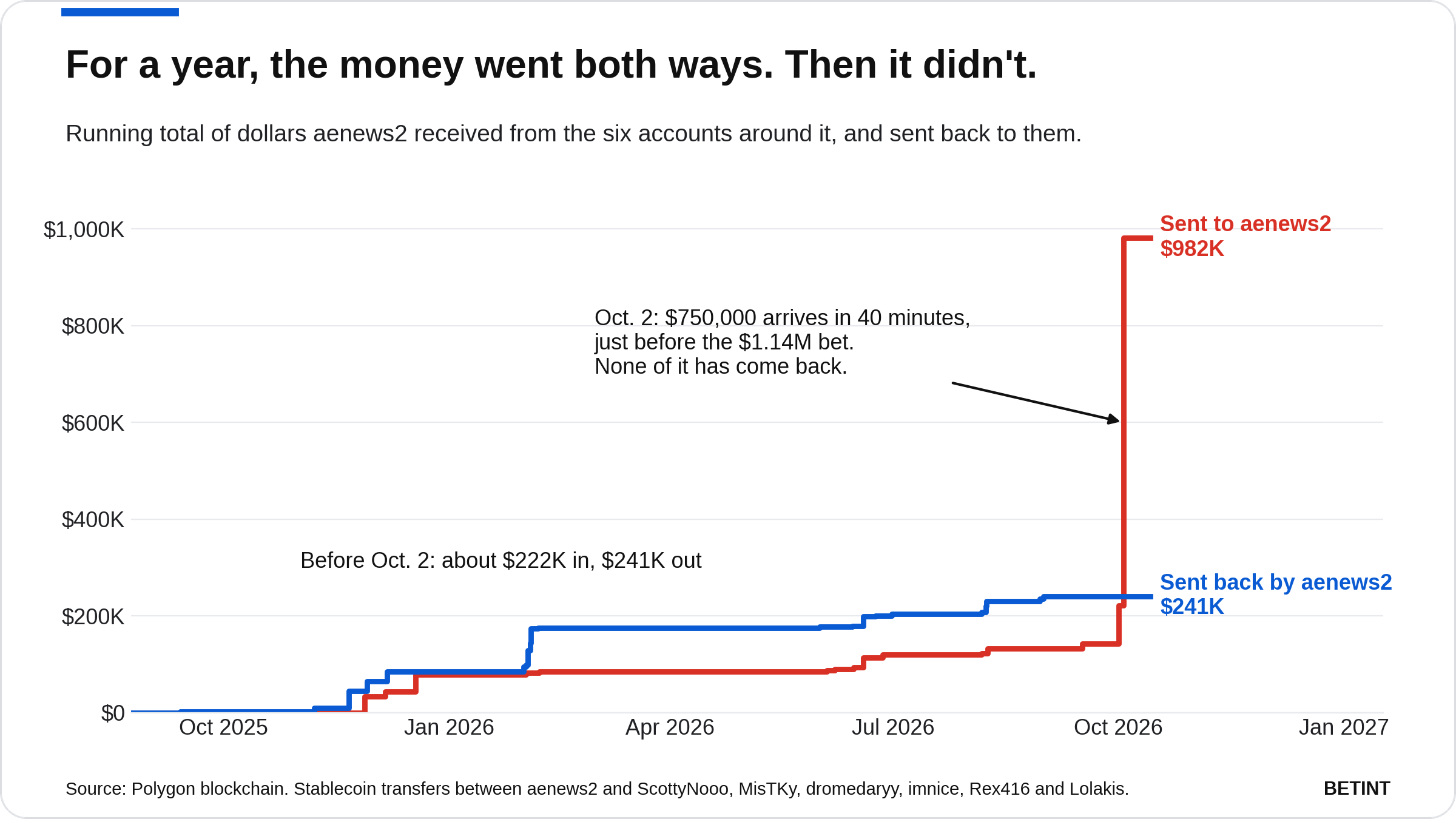
The wires on Oct. 2 weren’t the first money to move between these accounts. We added up every dollar aenews2 has exchanged with six accounts around it: ScottyNooo, MisTKy, dromedaryy, Rex416, imnice and Lolakis.
For 13 months before the bet, the money moved both ways in roughly equal amounts, about $222,000 in and $241,000 out, proving direct levels of cooperation and coordination. Then, in one night, $750,000 came in, more than 3x what aenews2 had received from them in the previous year.
The six are only the closest ring. aenews2 has exchanged money directly with over 1K wallets, and Oct. 2 wasn’t the first time unreturned money arrived just ahead of a big position. On June 16, four accounts sent it $734,000, the day before it started buying into a US-Iran peace deal market. That money hasn’t been paid back either…
Professionals, not newcomers
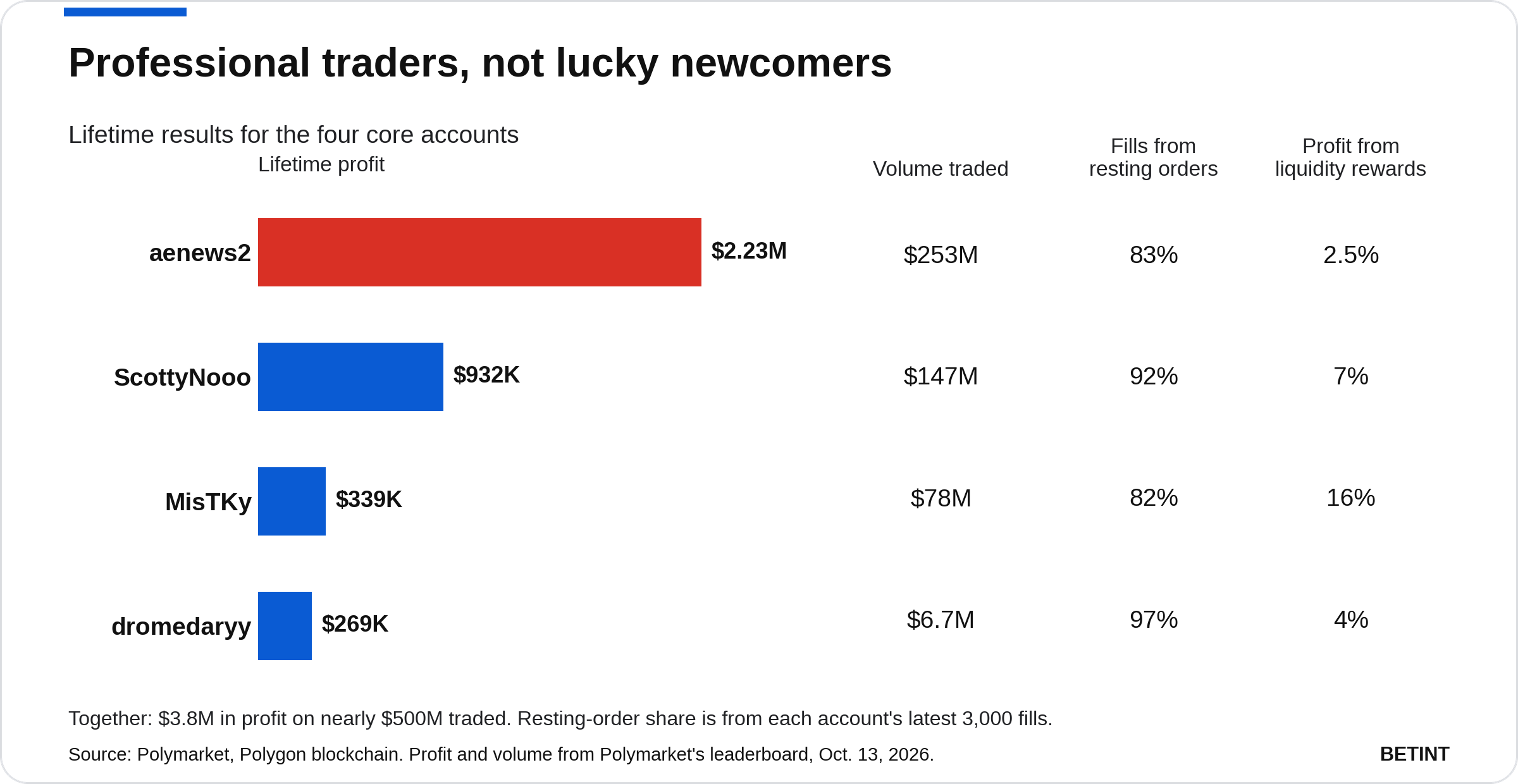
The four accounts at the center are not new to this. Polymarket’s own leaderboard shows aenews2 up $2.23 million over its lifetime, ScottyNooo $932,000, MisTKy $339,000 and dromedaryy $269,000. Together that is $3.8 million in profit on nearly $500 million traded.
Between 82% and 97% of their recent fills came from orders they left resting on the book for others to trade against. Profit runs about .5c to 1 cent per dollar traded. That is more typical of how a market maker works: small, steady margins on very large volume.
They aren’t rewards farmers. These four have collected about $182,000 in liquidity farming rewards, which is a lot, but at their volumes its minimal, only about 5% of their profit.
That is what makes Oct. 2 unusual. A group that normally provides liquidity and waits for others to come to it went the other way, taking $1.14 million in one order.
The same markets, again and again
This group doesn’t just share money. It shares markets.
We pulled every position these accounts have opened. aenews2 and ScottyNooo alone have traded 608 of the same markets, and at least two of the four core accounts have been in more than 1,000 of the same ones.
Because they make markets, they often hold both sides of a contract at some point, so sharing a market doesn’t mean betting the same way. It means they work the same corners of Polymarket at the same time.
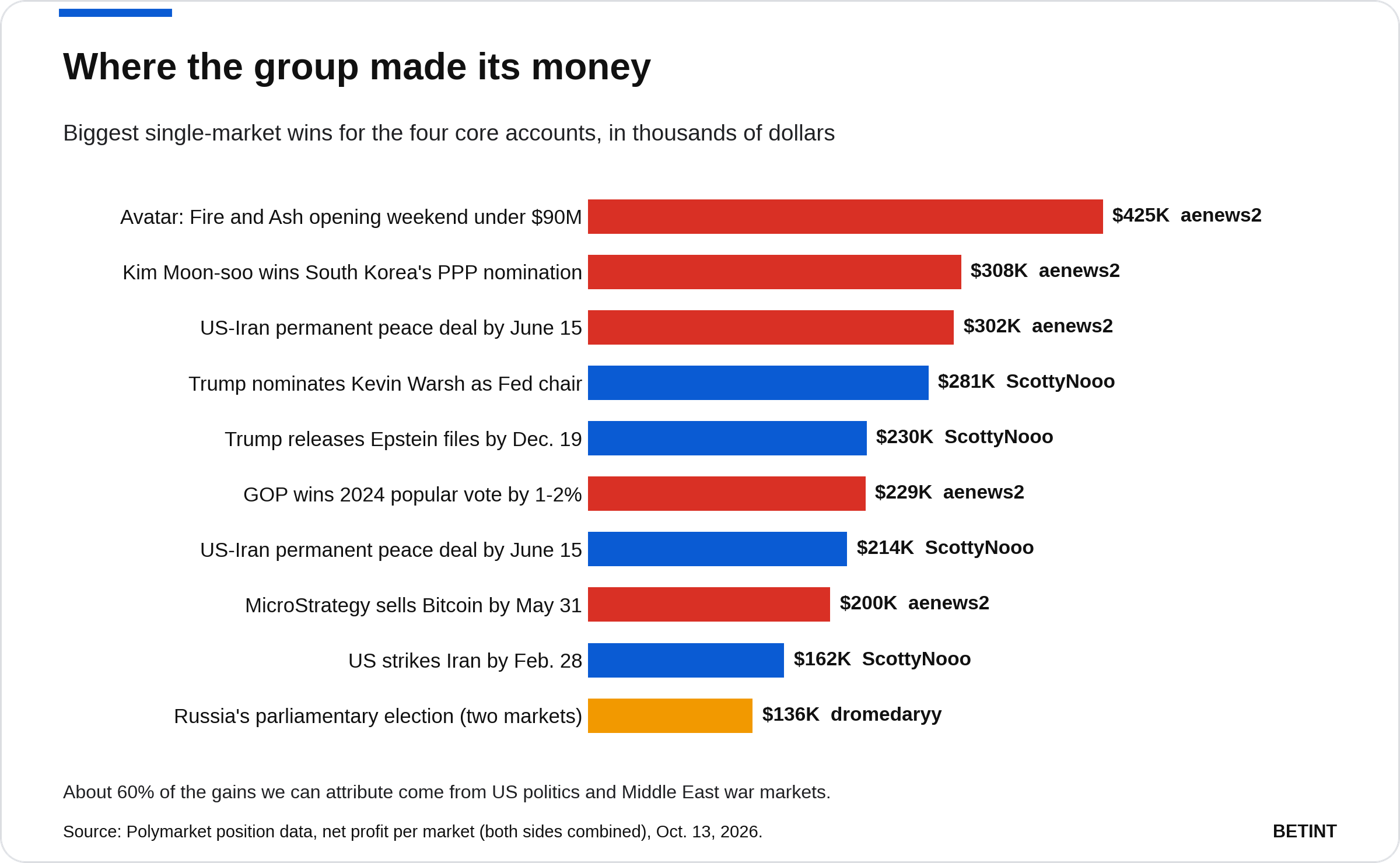
Those corners are mostly politics and war. About 60% of the gains we can attribute to a topic come from US politics and the conflict between the US, Israel and Iran. The single contract where they overlap most profitably is “US x Iran permanent peace deal by June 15,” where aenews2 and ScottyNooo made more than half a million dollars between them.
They lose big too.
ScottyNooo dropped $467,000 on when last year’s government shutdown would end, and aenews2 lost $239,000 on the 2024 popular vote.
This is not a group that always knows the answer. It is a group that trades very large size on the same news.
Passing shares between wallets
Money isn’t the only thing that moves between these accounts. Actual Shares do too.
Quick explainer:
Every Polymarket share is a token on the Polygon blockchain, held in the trader’s own wallet. It can be sent to any other wallet, like a Venmo payment. Two traders can agree on a price, swap shares for dollars and never touch the order book. Those deals don’t appear in Polymarket’s trade feed, its volume figures or its price charts. And because only one side can win, one “Yes” plus one “No” is always worth exactly $1, which the contract pays out on the spot.
Since March, the seven accounts have passed each other shares 74 times, about 217,000 shares in all, or roughly once every three days. About half of the swaps we could match to a payment were settled in cash, wallet to wallet, within 15 minutes. MisTKy sent two-thirds of the shares.
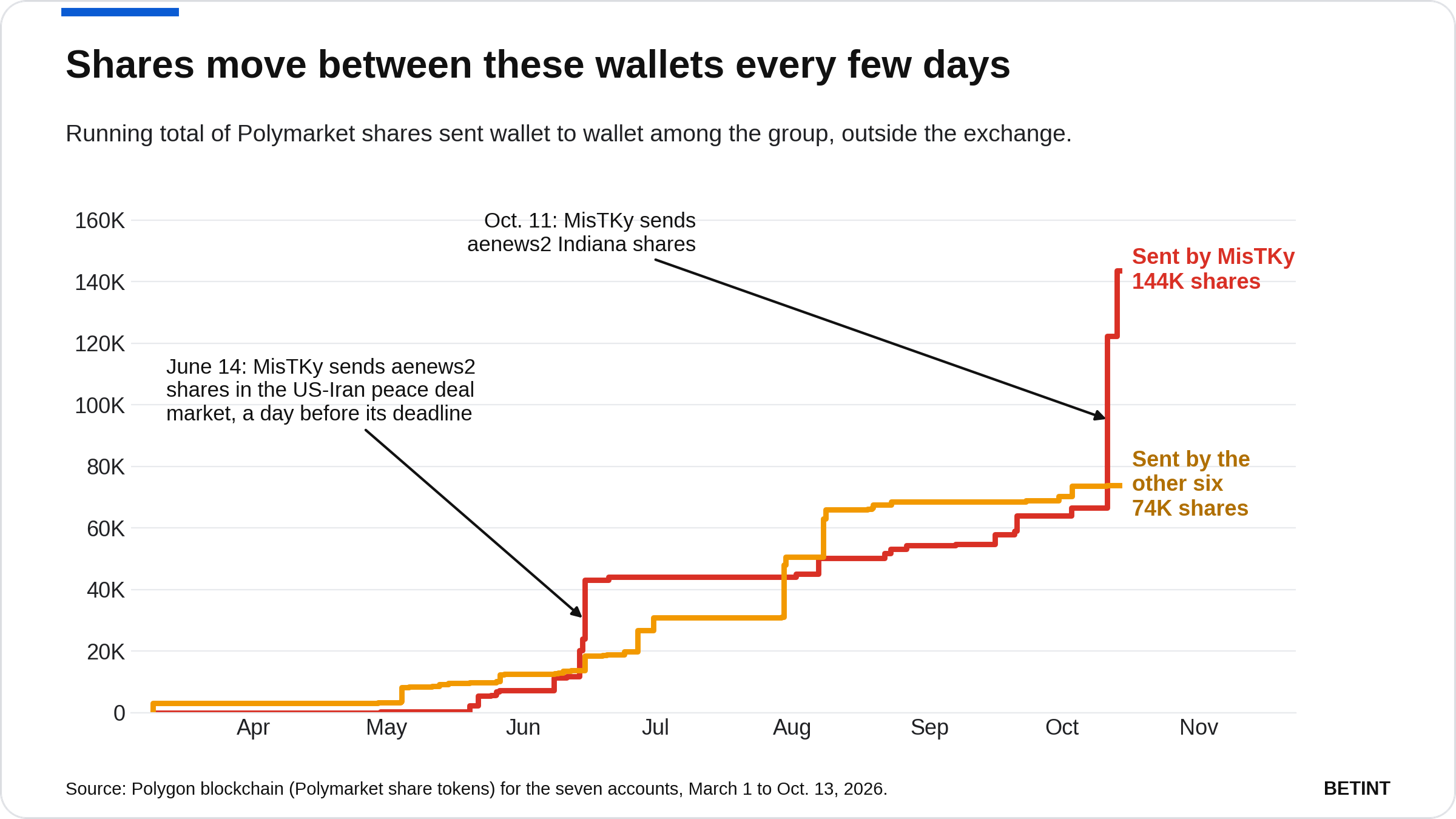
The swaps track the group’s biggest trades. The day before the June 15 peace-deal deadline, MisTKy sent aenews2 a block of “Yes” shares in that market, the contract where aenews2 and ScottyNooo went on to make $516,000.
They show up in Indiana too. aenews2 has cut its data center position only twice, both times through private swaps at $0.10 cents a share and never on the exchange. MisTKy was on the other end of the second one, on Oct. 11. aenews2 paired the shares from both swaps with its own “No” shares and cashed out about $141,000.
The same afternoon, MisTKy sent shares to HorribleWork, the account that bought Texas “No” right after the alert on Oct. 2. HorribleWork had no money tie to aenews2 that night, but it isn’t a stranger to the group.
A private swap needs two parties who agreed to it. 74 private swaps in 7 months indicates a working relationship.
The other side of the trade
The rewards bid aenews2 took on Indiana belonged to JambonMogettes, which runs with a circle of its own. Since May, more than $11 million has moved between JambonMogettes and two linked accounts, UnderperformingForALiving and CryptoScam. UnderperformingForALiving also sold into the Indiana bet.
The two circles have dealt with each other before. MisTKy and UnderperformingForALiving swapped shares privately 3 times in May and June, all in Iran-related markets.
That doesn’t make the Indiana trade a wash trade though. JambonMogettes is down about $121,000 on paper, so someone on that side is losing real money. But the two biggest players in Polymarket’s data center markets, on opposite sides of a single trade, sit one account apart…
What they’re betting on now
The data center bet is aenews2’s largest open position by far. The others are spread across the next set of political markets.
ScottyNooo’s biggest current bet is $185,000 on Flávio Bolsonaro winning Brazil’s presidential election.
MisTKy is short Alexandria Ocasio-Cortez for the 2028 Democratic nomination.
Dromedaryy, the account that wired $500,000 the night of the bet, now has $95,600 on Benjamin Netanyahu not being Israel’s next prime minister.
Indiana’s odds have been tested once since the bet. At 11:01 a.m. Tuesday, a brand-new account was opened, funded within minutes by a second new account, and by 11:13 a.m. it had spent $30,579 on “Yes” and pushed Indiana from 9% to 21%.
We found no news behind it and no link to either group. That afternoon, aenews2 bought another $22,000 of “No.” The contract closed the afternoon at 16.5%. Indiana lawmakers don’t return until January.
Until then, the odds on whether a state bans data centers rest largely on one trade between two groups of linked, professional accounts. For the group that placed it, Indiana was one market out of thousands, and the question we can’t answer from the blockchain is the one that matters most: why a desk that lives on small margins decided this was the bet to make big.
What is established: every trade, transfer, share swap and account-creation time cited here comes from Polymarket’s trade and position data and the Polygon blockchain. Profit and volume figures are Polymarket’s own leaderboard numbers as of Oct. 13. Per-market results combine both sides of each contract. The share of fills from resting orders is measured on each account’s latest 3,000 fills. Topic shares are based on each account’s largest gains and losses, up to 4,000 closed positions per account.
What is not: whether the money and shares sent between these accounts were loans, stakes in a trade or one owner’s funds spread across several accounts; who controls the accounts that moved Indiana on Tuesday. Nothing in this analysis shows that anyone broke a rule or traded on non-public information. Running multiple accounts, transferring money and shares between wallets, and redeeming positions are all permitted on Polymarket.