



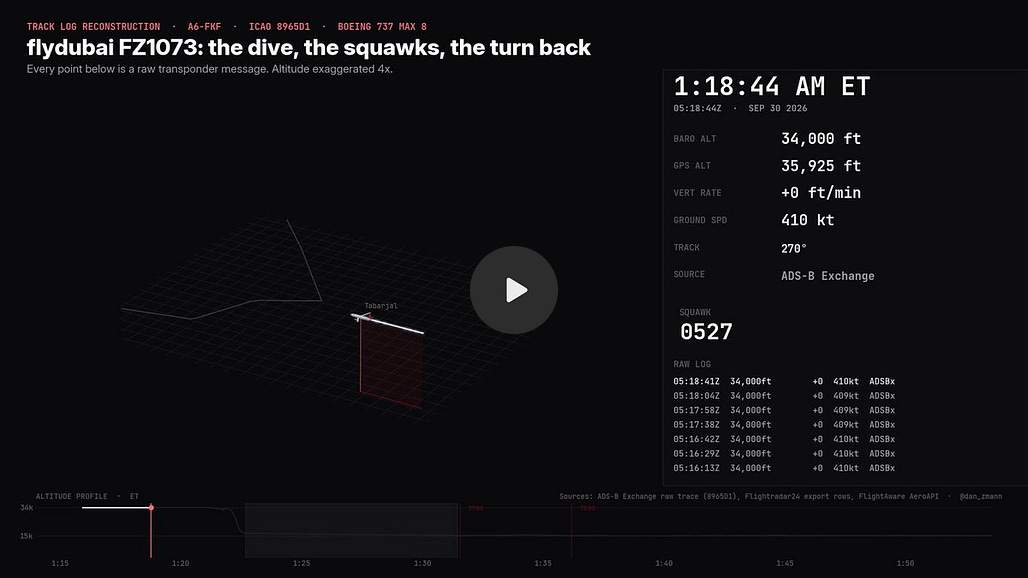

At 1:21 AM Eastern on September 30, a Flydubai Boeing 737 MAX 8 cruising at 34,000 feet over northern Saudi Arabia began to fall. Within a minute it had lost more than 14,000 feet. Fifteen minutes later its transponder was broadcasting 7500, the code for unlawful interference.
For the next 43 minutes, we the public had no idea what was occurring on flight FDB1073.
The first report came at 2:19 AM, from Amit Segal of Israel’s Channel 12, the moment the military censor cleared it:

I was on my couch finishing up some development work when Segal’s tweets popped up on my alerting system. I immediately felt like this could rapidly develop into a major security incident, so I hopped into my work station.
This piece walks through that night the way I reported it it: my posts and Amit’s, in the order they went out, set against what the aircraft itself was broadcasting. All times are Eastern.
2:19 to 2:53 AM: The Live Report
Amit’s feed moved fast. Within two minutes he had the airline and the code.

That post has now been seen more than 670,000 times. Three minutes later I replied under his first report:

Then I opened FlightAware and Flightradar24 side by side. They disagreed. FlightAware showed the flight “completed” on a clean line into Tel Aviv. Flightradar24 showed something else.


The purple line on FlightAware was not the plane. It was a projection: the flight plan, drawn forward from the last known point, with altitude and speed set to zero. The white line was real, and the white line showed a U-turn over the Saudi-Jordan border.
At 2:31 AM Amit laid out the sequence that would define the night:
Then the plane vanished from the apps. At 2:38 AM FlightAware’s app stopped showing the flight at all:

Amit’s tone turned at 2:38 (”For the first time, there are positive signs”), and at 2:45 he reported the plane back on the trackers and in contact with the Saudis. At 2:53 AM:
Seconds later came the post that set the early narrative:
3:11 AM: The first visualization
Amidst the chaos, I wanted to see the whole night on one screen. I pulled the FlightAware track through their API and synced it with the timestamps on Amit’s posts. Every X post ID encodes the exact second it was published, so the timing is exact.
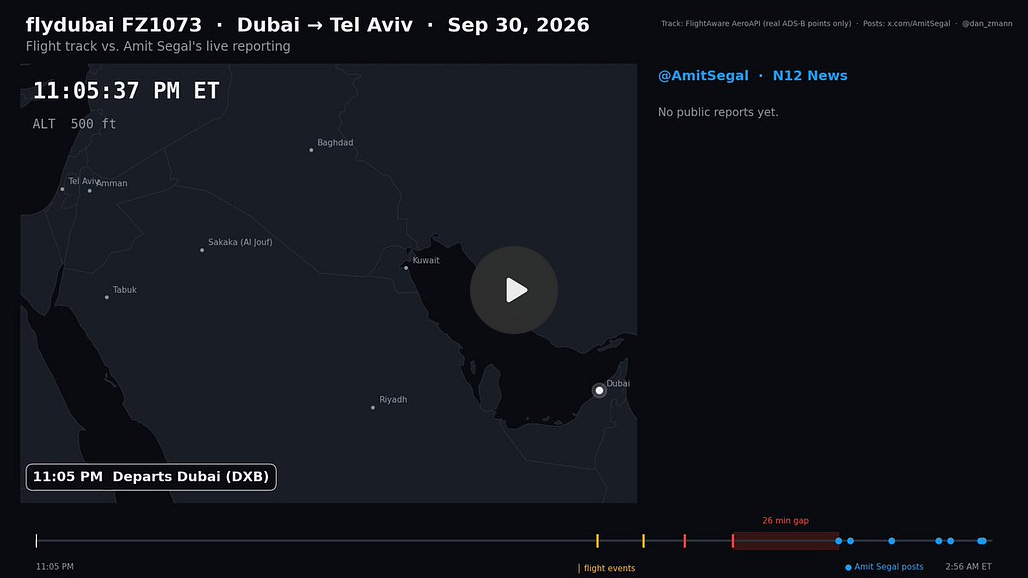

The most striking thing on that timeline was not the turn. It was the red band: 26 minutes between the plane’s last FlightAware signal at 1:53 AM and Amit’s first post. And FlightAware had a bigger hole than that. It recorded nothing between 1:21 and 1:32 AM. Its log jumps from 33,700 feet straight to 15,300.
3:31 to 3:43 AM: The dive
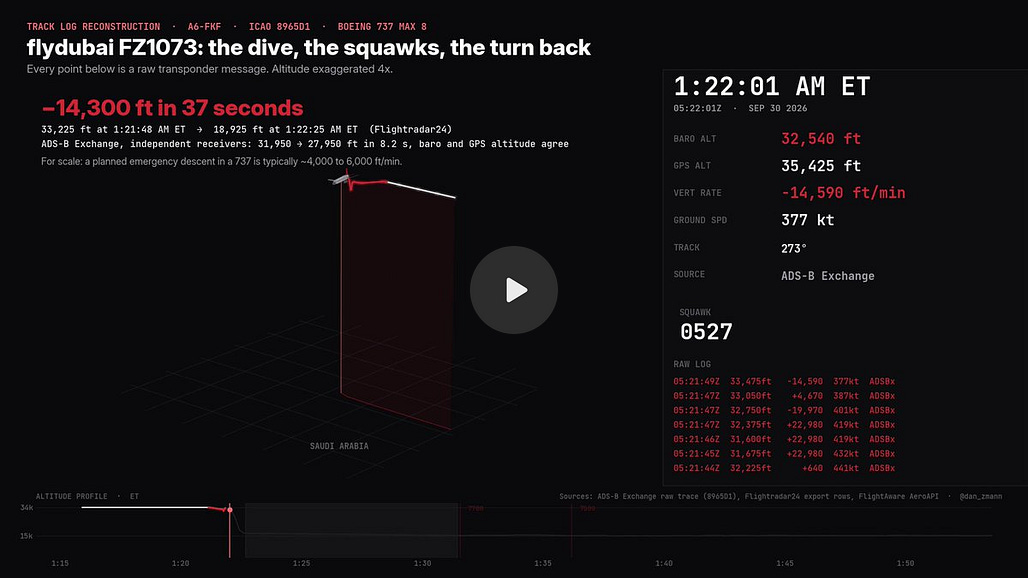
A screenshot from a second tracker filled that hole: 33,225 feet at 1:21:48, then 18,925 feet at 1:22:25. That is 14,300 feet in 37 seconds.
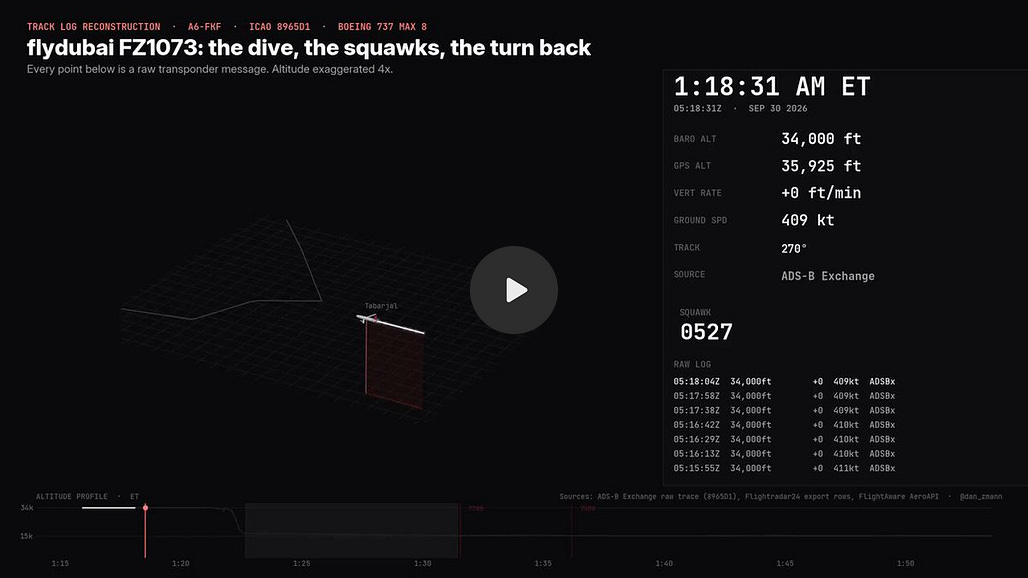
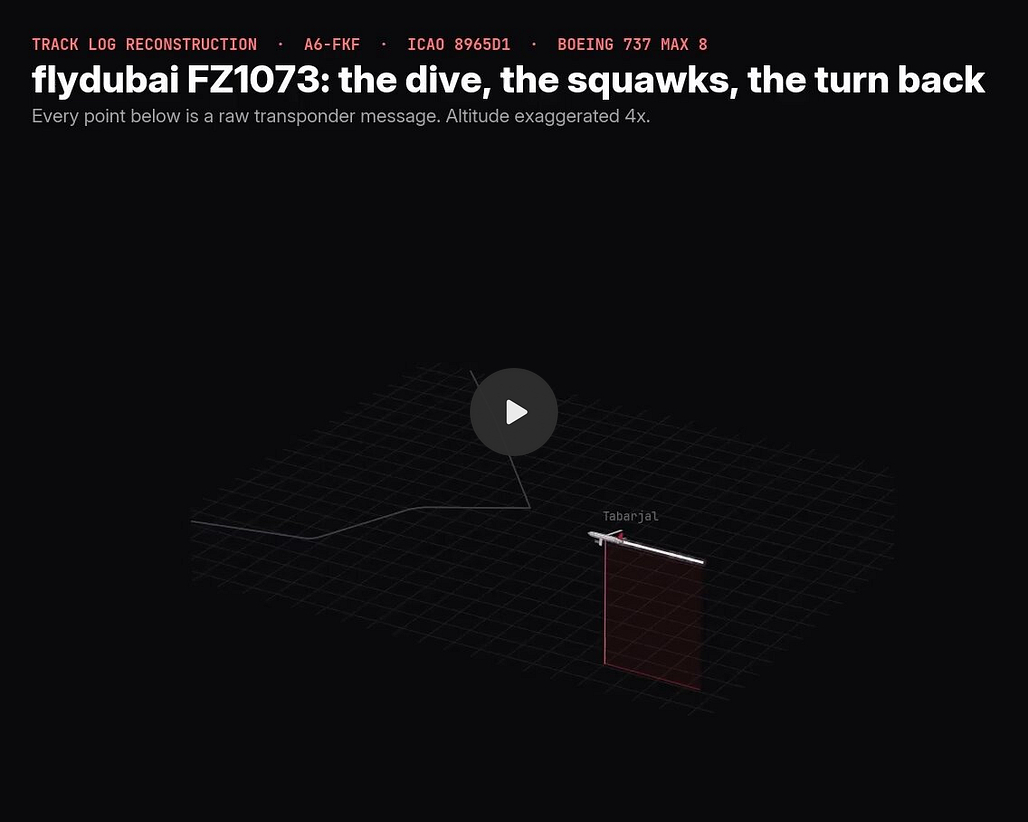
I checked it against the raw transponder logs from two volunteer receiver networks, ADS-B Exchange and adsb.lol. Both caught the start: 31,950 to 27,950 feet in 8.2 seconds, roughly 29,000 feet per minute. Then both lost coverage. So I built a 3D reconstruction and posted it first as a reply under @Faytuks:
Twelve minutes later I put out a main thread. It has now passed 117,000 views:
For scale: a planned emergency descent for a cabin-pressure loss runs about 4,000 to 6,000 feet per minute. This was four to five times that, at the jet’s maximum operating speed, while turning roughly 90 degrees.
The zoomed-in version of the model travelled furthest on its own:
3:45 to 6:57 AM: What happened on board
While the data was being rebuilt, the human story arrived through Amit’s feed. At 3:45 AM, passengers described a stabbing with a pocketknife and “a lot of blood.” At 3:47 AM, investigators were examining whether a pilot had tried to crash the plane.
By 4:27 AM Israel was treating it as a terrorist attack. That is the most-viewed post of the entire night, at 1.59 million views:
I posted my read of the data alongside it:
At 2:28 AM the IRMilitaryMedia account posted a plane emoji; I flagged it at 3:04 and hedged it myself at 3:06 (”or just opportunistic propaganda slop”); at 10:31 AM Amit asked whether a statement from Iran’s security council was “an indirect claim of responsibility.”

At 6:47 AM Amit named the attacker as an Omani pilot. The cabin footage he posted at 6:53 AM has been viewed more than half a million times:

What the data shows
After the thread went out, I added a Flightradar24 API key and pulled their full record for the flight: 708 track points. It changes the picture in three ways.
1. The fall went deeper than 18,925 feet.
Time (ET) Altitude Source / note
1:20:56 34,000 ft Level cruise, heading west
1:21:48 33,225 ft Descending 24,512 ft/min
1:22:05 to 1:22:13 31,950 → 27,950 ft ADS-B Exchange + adsb.lol only
1:22:25 18,925 ft Descending 30,976 ft/min, reported by the aircraft 1:22:36 16,850 ft Groundspeed 598 kt
1:22:40 16,600 ft The bottom 1:23:23 21,725 ft Climbed back 5,100 ft
1:24:18 14,950 ft Fell again, 6,800 ft in 55 s
The real figure is roughly 16,600 feet lost in 52 seconds. The 31,000 ft/min rate is not a calculation. It is the descent rate the plane itself broadcast.
2. It went up and down twice. After the bottom, the plane climbed 5,000 feet, then dropped nearly 7,000 more, all inside about two and a half minutes. By midday we had the explanation. Yaniv, one of the passengers who broke into the cockpit:
A passenger pulling back on the controls of a 737 at nearly 600 knots is an absolutely incredible story often thought only possible in Hollywood. While the data can’t prove who was at the controls when, it fits his account second by second.
3. It landed at Tabuk, Saudi Arabia. Flightradar24’s record reads: diverted, actual destination Tabuk (OETB), landed at 3:09 AM ET. Their last position report is at 2:11 AM, heading straight for Tabuk at 14,925 feet, so the 3:09 landing time may be an estimate rather than a measured touchdown.
The squawk codes. Both raw feeds show 7700 (general emergency) at 1:31 AM, then 7500 (unlawful interference) from 1:36 AM to the last message at 1:53 AM, across more than 100 messages. Flightradar24 has told NBC and the BBC that the aircraft went 7700, then 7500, then back to 7700. Their API data shows a different sequence, so I treat the raw feeds as the record here.
One caveat on the visualizer - In the video, altitude is exaggerated 4x so the fall reads on screen, which also steepens the nose angle. The stretch from 1:22:40 to 1:31:26 has very sparse coverage and is shown dashed.
The market waited for the tweet
No prediction market covered this flight directly. The closest was Polymarket’s “Israeli airspace closed by October 31, 2026?”, trading at 13 cents.
1:36 AM Aircraft broadcasting 7500 on public ADS-B feeds
1:36 to 2:28 AM No trades
2:19 AM Amit Segal’s first post
2:28 AM Buying burst begins, five wallets
2:35 AM Peak at 18.8 cents, up about 45%
2:43 AM Back to 12 cents
The money was small, but the pattern is the point: the hijack code sat on public transponder feeds for 52 minutes before anyone traded on it. The market moved on the tweet, not the data.
That gap between public signal and priced signal is what BETINT exists to watch. In this case, there was no indication of insider trading or market positioning based off this event.
How it ended
At 9:39 AM Israel’s defense minister called it “an attempted jihadist terrorist attack, which was thwarted only thanks to the bravery of several Israeli passengers who broke into the cockpit.”
At 11:37 AM the passengers landed in Israel under a fighter escort:
I am glad I was up and able to jump into action on this and am so grateful that what appears to have been a very near catastrophe avoided by heroic actions of the passengers and crew.
I used my custom AI system built by Classified AI to monitor and reproduce these 3D recreations in real time, the same technology stack that powers BETINT.ai.
Sources
Raw ADS-B traces: ADS-B Exchange and adsb.lol, aircraft A6-FKF (hex 8965D1)
Flightradar24 API: flight summary and 708-point track
FlightAware AeroAPI: flight record and track
Amit Segal (@AmitSegal), Channel 12, live reporting on X
CNN, NYT, NBC, BBC coverage, September 30, 2026
Polymarket trade history, “Israeli airspace closed by October 31, 2026?”