


The weekend before the 2026 midterms, an anonymous Polymarket account put about $294K on a 7-leg parlay betting that Republicans lose all seven Senate seats in play in Alaska, Iowa, Kansas, Maine, Michigan, Ohio and Texas.
If every one of those races breaks the Democrats’ way on Tuesday, user ‘ndb1’ collects $1.24M. A single miss in their projections and that $294K is worth $0.
It’s the biggest parlay bet we’ve seen on Polymarket.
But it wasn’t even the biggest parlay in the markets that week. A day earlier, a Kalshi trader put $493K on Democrats sweeping Congress.
Welcome to the brand new world of parlay election betting.
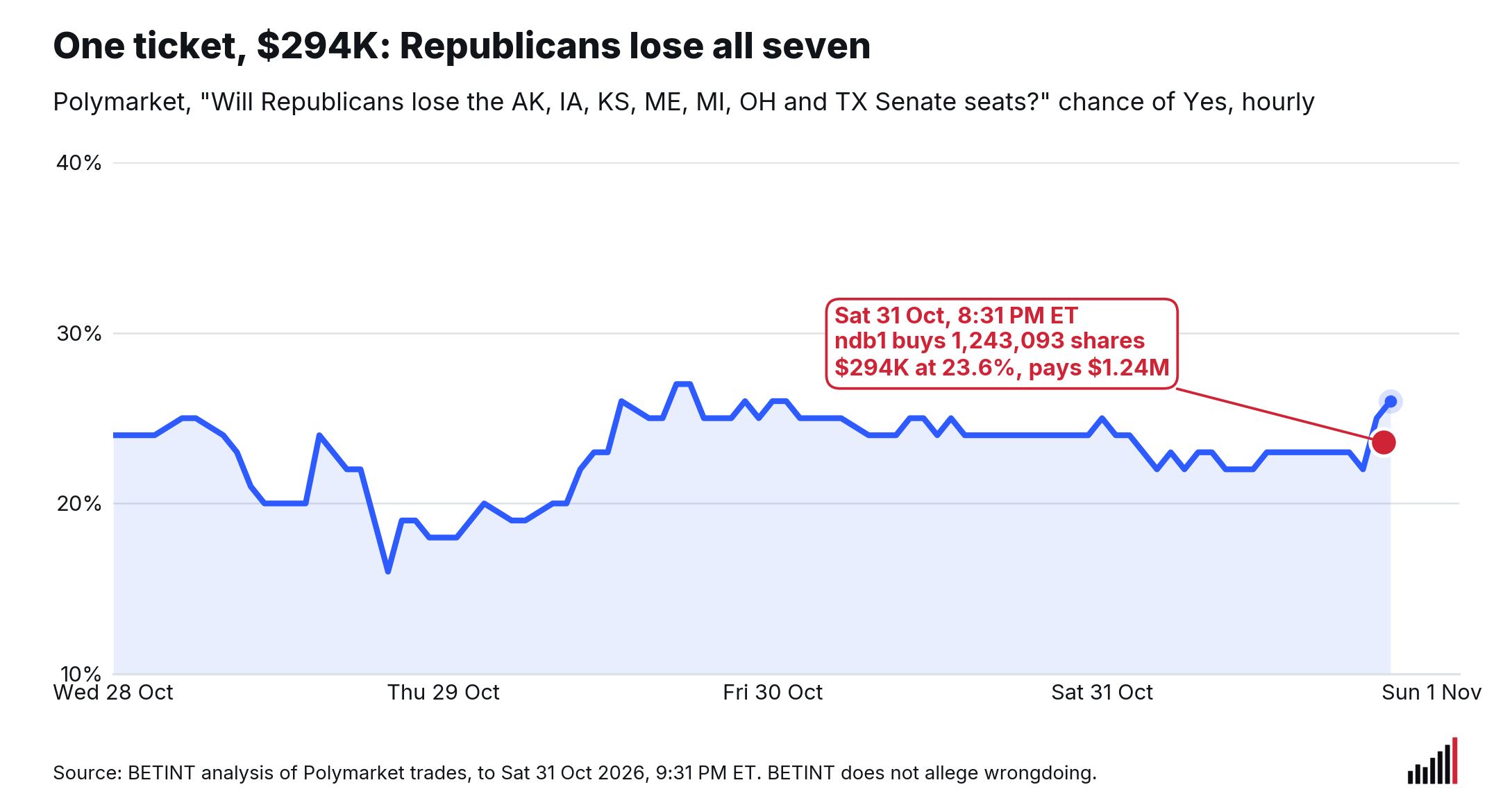
The market ndb1 bought. The red dot is the $294K order.
Our BETINT system flagged the trade within seconds. It was far from the first political parlay that’s come across our desk in the last few weeks. Parlays have long been the darling of the sports betting world, so we went back and counted every political parlay we could find. There were more than 136,000 of them.
(Obviously, by the time you read this there will be more and potentially larger bets placed)
Midterm Parlays by the Numbers
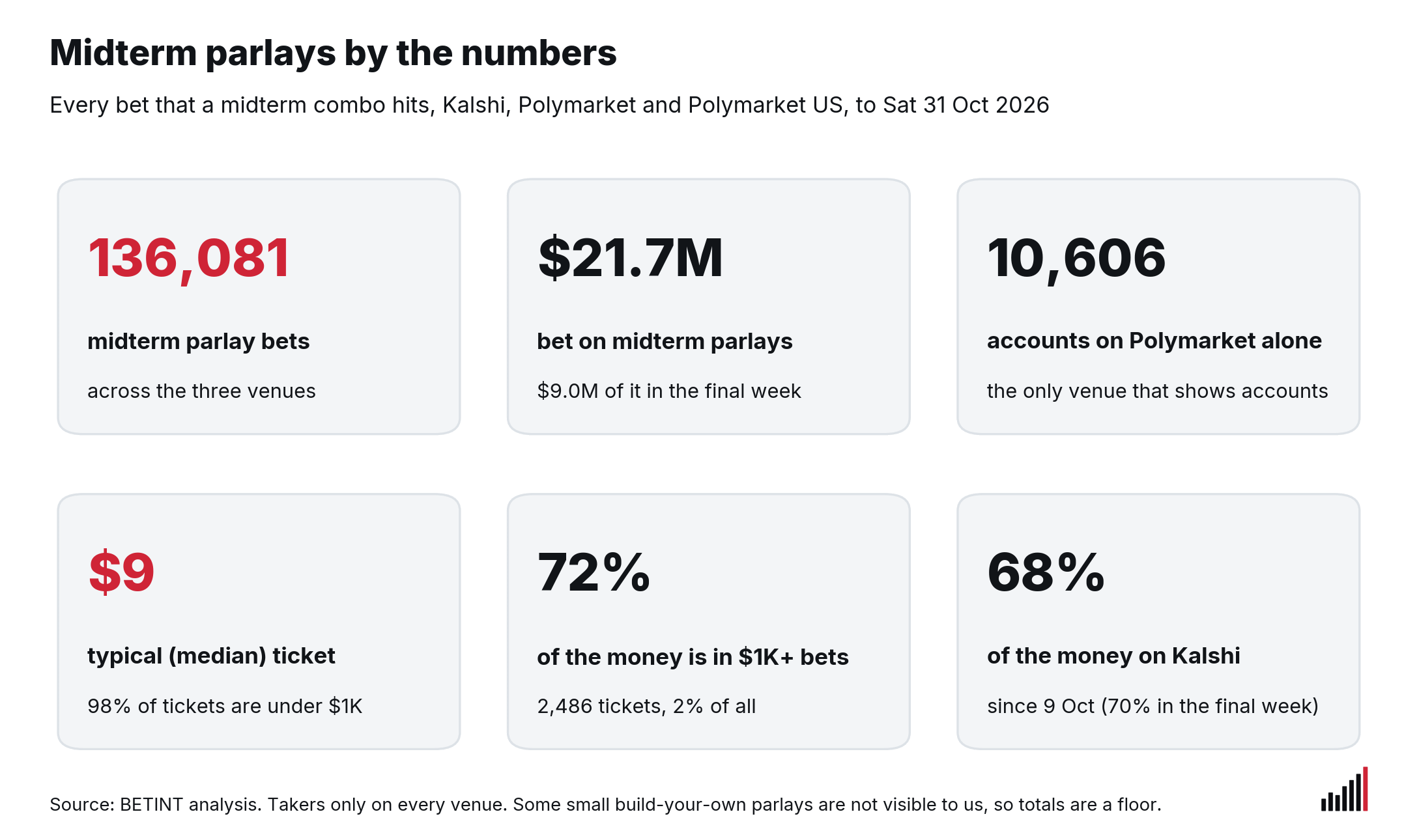
Every bet that a midterm parlay hits, all-time through Saturday 31 October according to BETINT systems.
Every figure here counts bets of any size that a midterm parlay hits, across Kalshi, Polymarket and Polymarket US, through Saturday night.
136,081 bets on midterm parlays, totalling $21.7M.
$9.0M of it came in the final week alone (Monday 26 to Saturday 31 October), more than 40% of all the money. A month earlier, it was about $1.1M a week.
Kalshi took 68% of the money, and 70% in the final week. Polymarket’s international site took 27% and Polymarket US the rest.
At least 10,606 different accounts placed a midterm parlay on Polymarket alone. It’s the only one of the three that shows accounts, so the real number of bettors is higher.
The typical ticket is small. The median is about $9, and 98% of tickets are under $1000.
But the big tickets carry the money. 2,486 bets of $1000 or more, under 2% of tickets, make up 72% of the money.
About 95% of the money went on ready-made combos the venues list themselves.
80% of tickets include control of Congress.
The most-bet single race is the Texas Senate: 21,251 tickets, $2.4M.
Build-your-own parlays are almost all sports. Only about 0.025% of the money in custom combos on Polymarket US in October touched an election, roughly $1 in every $4,000.
Treat these totals as a floor. We see every bet on the venues’ own election combos, but some smaller build-your-own parlays are outside our view.
The Big Bets
Most of the money sits in a small number of very large tickets. Counting only bets of $1,000 or more:
$15.6M across 2,486 tickets, with a total potential payout of $61.3M.
$7.2M of it came in the final week.
Kalshi took 67% of the big-bet money, and 70% in the final week.
The median $1K+ ticket is about $2.5K; the average is about $6.3K, pulled up by a handful of very big bets. 266 tickets were $10K or more, and 10 were $100K or more.
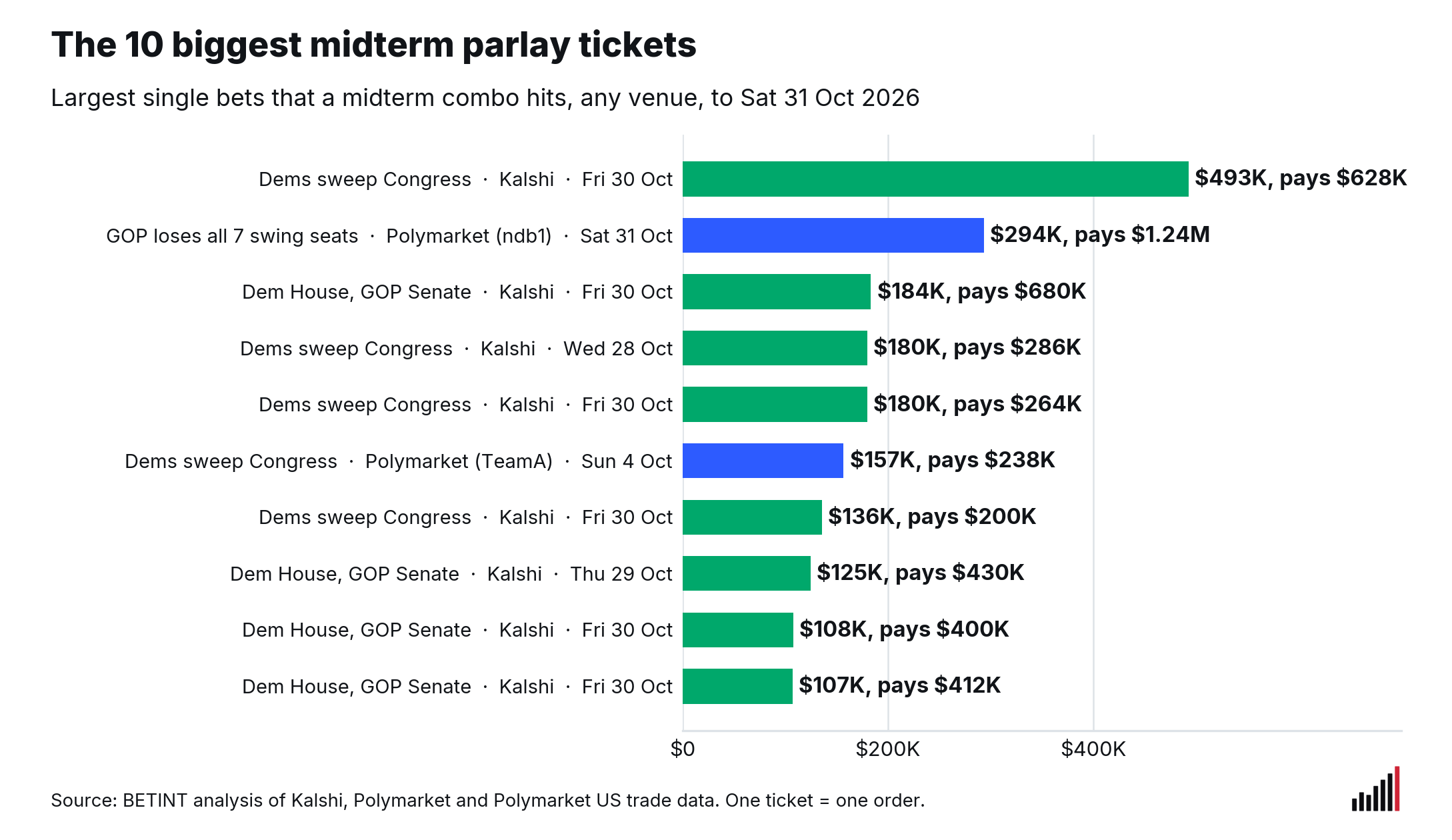
The 10 biggest single midterm parlay tickets on any venue, up until Saturday night (Oct 31st).
$493K on Democrats sweeping Congress, Kalshi, Friday 30 October. Pays $628K.
$294K on Republicans losing all seven swing Senate seats, Polymarket (ndb1), Saturday 31 October. Pays $1.24M.
$184K on a Democratic House and a Republican Senate, Kalshi, Friday 30 October. Pays $680K.
$180K on Democrats sweeping Congress, Kalshi, twice: Wednesday 28 and Friday 30 October.
$157K on Democrats sweeping Congress, Polymarket (TeamA), Sunday 4 October. Pays $238K.
$255K across 48 tickets on one Kalshi split combo (El-Sayed wins Michigan, Ricketts holds Nebraska), all on Saturday 31 October.
Eight of the ten biggest tickets were on Kalshi, and six of them landed on one day, Friday 30 October.
The biggest one moved the market. That $493K ticket went through as 1,228 fills in a single second and pushed the price from 69% to 89%. Seconds later it was back at 69%.
That buyer paid roughly $60K more than the market price to get it all done at once. Somebody really wanted in on this bet.
How Election Parlays Work Now
So what is a parlay? In a parlay, you stack several bets into one ticket, and every leg has to hit for it to pay. Sportsbooks love them because they’re hard for players to win. Players love them because one small ticket can pay out big.
Prediction markets have spent years insisting they’re not sportsbooks. But the parlay found its way in anyway, which I projected would happen last year.
Today both US apps, Kalshi and Polymarket US, let you build your own across any category. Pick a Senate race, add a governor’s race, throw in a college football game, and the whole thing becomes one contract. Both apps, plus Polymarket’s international site, also sell ready-made combos, like a seven-state Senate map or a single bet on who wins both the House and the Senate.
None of this is new to me. At my last company we launched Verse Picks in September 2025, a sweepstakes app built around exactly this: two to eight picks across sports, politics and pop culture on one ticket. A year later, the regulated prediction markets offer the same product.
Where the Money Goes
A month ago, midterm parlays were drawing about $1.1M a week. In the last week of October it surged to $9.0M, across nearly 43,000 bets.
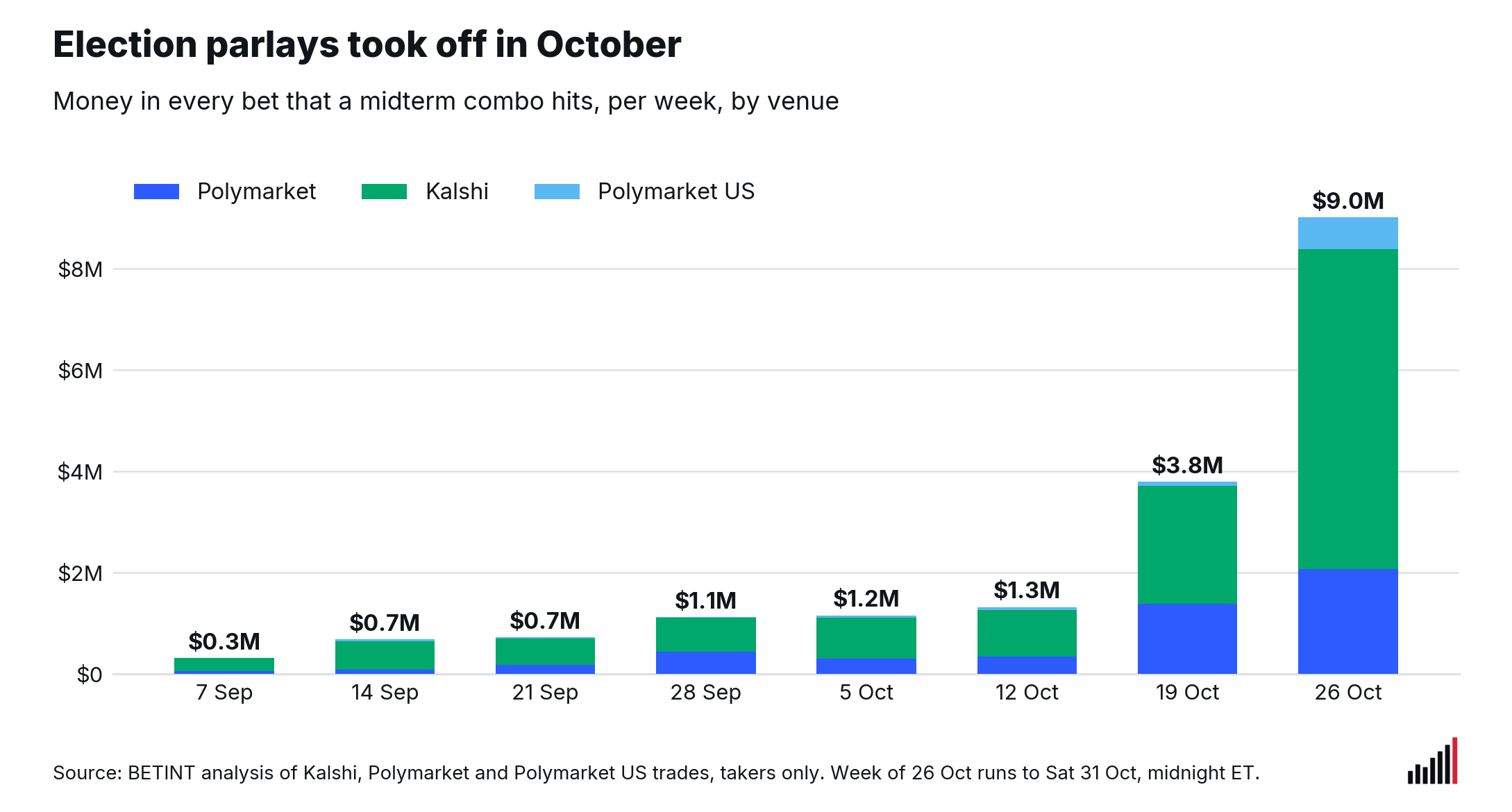
Money bet on midterm parlays each week, every bet of any size. The last bar runs to Saturday night.
Kalshi carries most of it, and most of its money sits in one place: its Balance of Power market, a ready-made two-leg bet on who controls the House and the Senate. Polymarket’s version of the same market carries most of its money too.
The build-your-own boom is real, but it’s mostly still a sports feature. About $420M changed hands in custom combos on Polymarket US in October, and only about $106K of it had a political leg. Kalshi’s custom combos look the same: under 0.1% political in the samples we pulled.
So where’s the election money?
It’s in these ready-made parlay suggestions, where the venue has already stitched the races together for you.
What People Are Parlaying
About 90% of tickets are two-leg bets, and almost all of those are some version of who controls the House and the Senate. Below that, the money follows the Senate map.
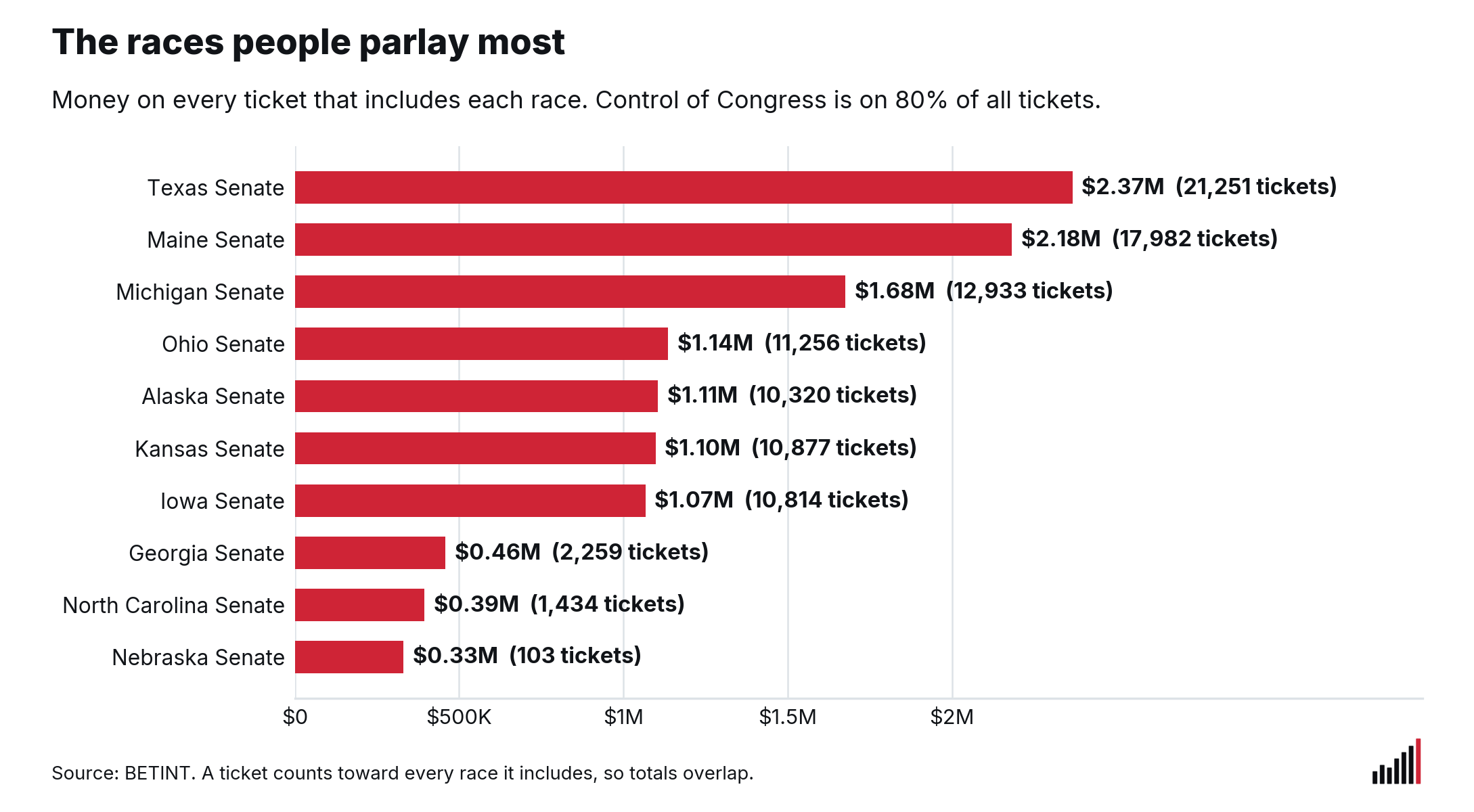
Money on every ticket that includes each race. A ticket counts toward every race it includes.
Texas, Maine and Michigan lead, then the long shots in the seven-state map: Ohio, Alaska, Kansas and Iowa.
Longer tickets are rarer. About 13,000 had three legs or more, around $1.9M in all, and most of that sits on the seven-state map.
Fewer than 1,000 tickets mixed politics with sports. The wildest was a Kalshi 13-legger, Greg Abbott plus 12 college football results, $9K to win about $200K.
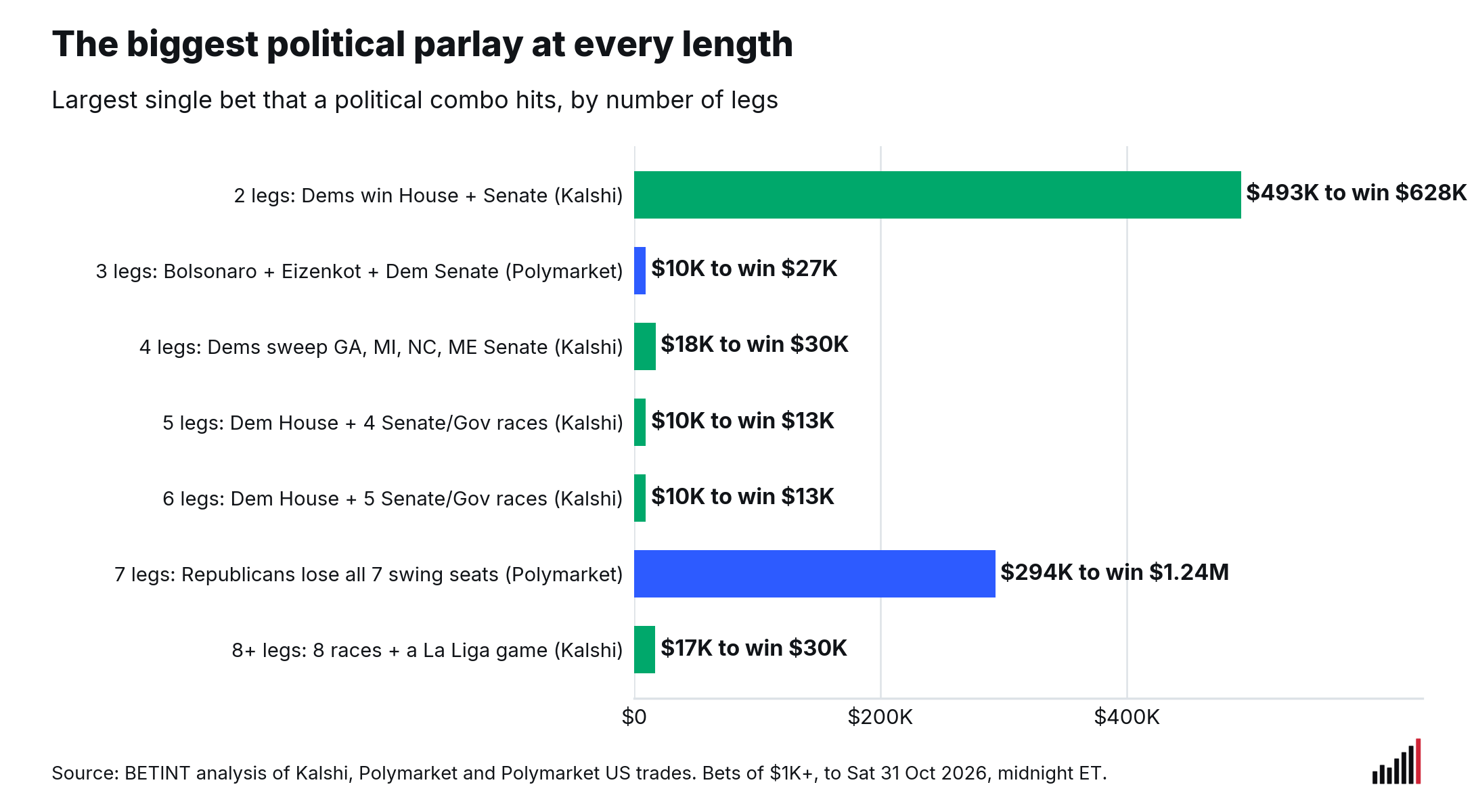
The biggest single ticket at each number of legs: one ticket per length, so most of the top 10 above don’t appear here.
The Trader Behind the Seven-Leg Bet
So who bets $294K on a seven-leg parlay?
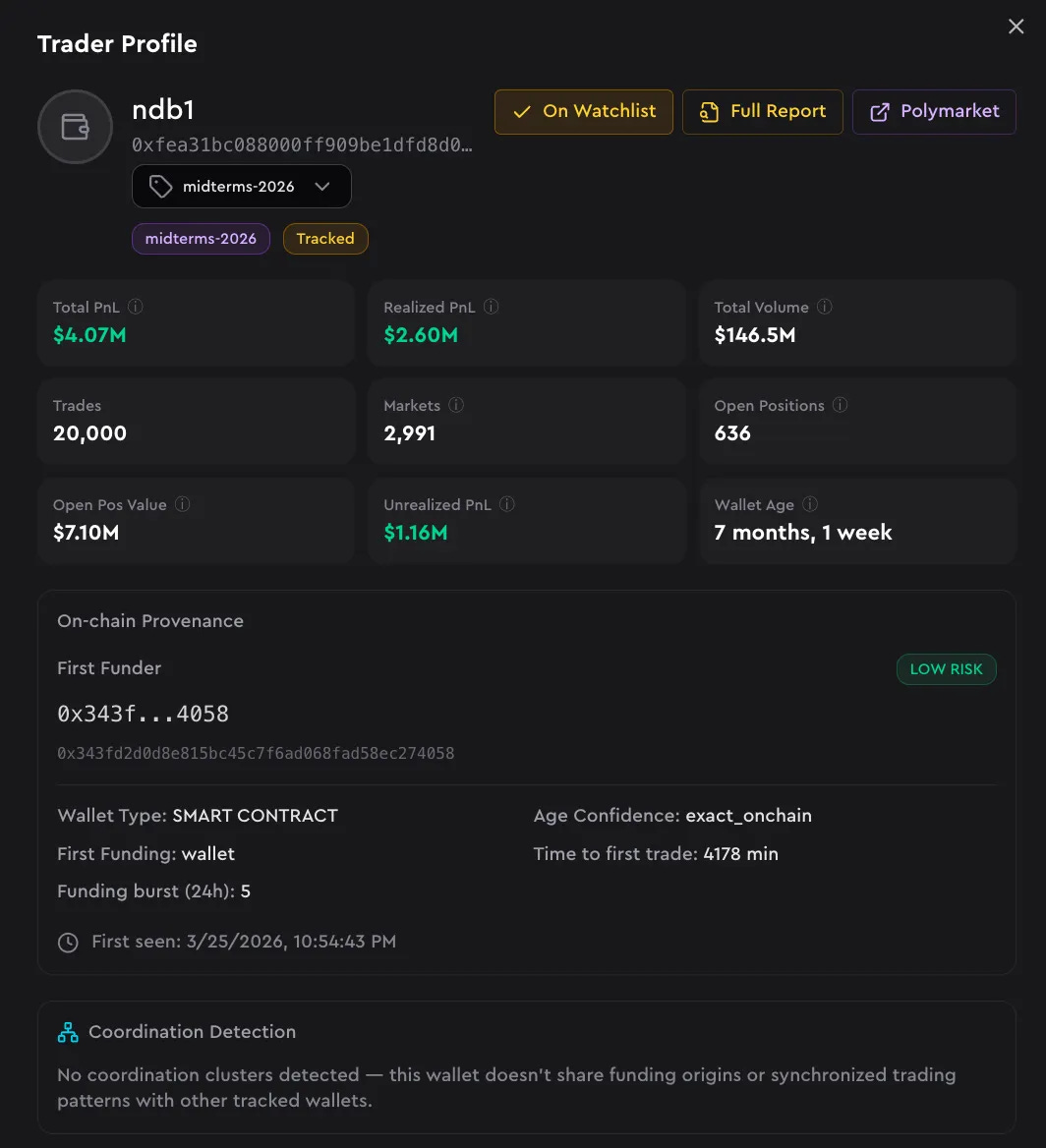
The answer is not some kid chasing a miracle. On Polymarket’s own leaderboard the account is up about $2.8M all time on roughly $146M traded, 54th in profit. They have done all of this in 7 months.
It holds about $5.3M in open positions, and most of it is one view: a Democratic wave. The biggest is $1.1M on Democrats taking both the House and the Senate, with a few Republican positions that work as hedges.
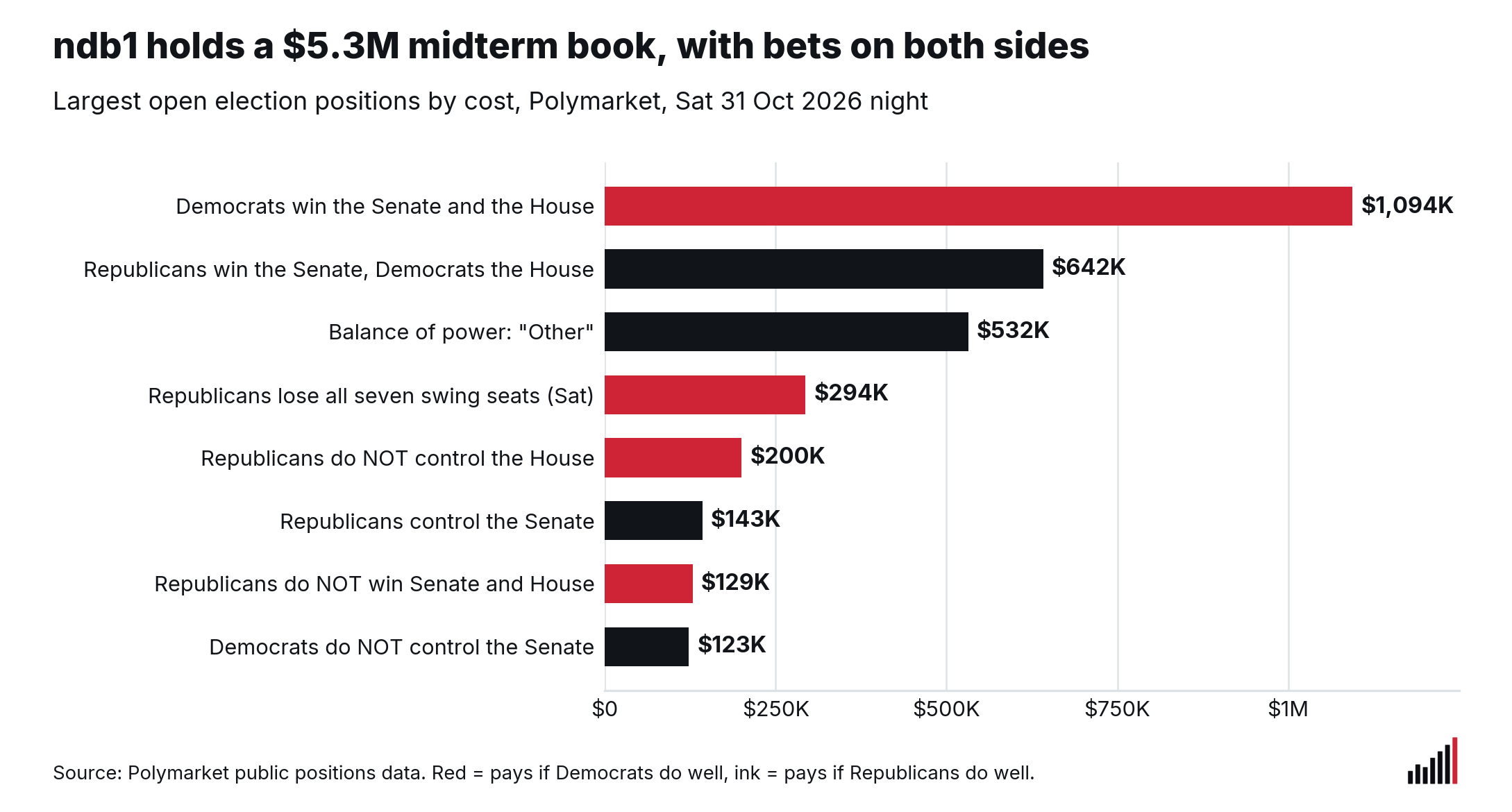
ndb1’s biggest open election positions. Red pays if Democrats do well.
We’d flagged this account before Saturday. On Friday night, BETINT caught it putting $291K against a Republican sweep, trading under its Polymarket pseudonym, Tinted-Consciousness.


If Prediction Markets are Peer-2-Peer, Who Takes the Other Side?
Somebody had to sell ndb1 those shares. Mostly that was an account called BreakTheBank, which spent Saturday evening selling the same contract at about 23% to anyone who wanted it. Earlier in the month, it was also one of the biggest buyers of the Democratic sweep. Buying here, selling there. That’s what a market maker looks like.
Market makers can quote parlay bets in real time through the exchange’s trading systems. My first company now does exactly that for sports parlays, so I am very familiar with the mechanics. After a year of successfully operating sports parlays, Kalshi has scaled their RFQ (Request for Quote) system to be able to handle parlays on just about any combination and category.
And the pricing is the part worth paying attention to. A single race has a price you can sanity-check against the polls. A seven-state map is a lot harder, because the legs move together (if Democrats are having a great night in Ohio, they’re probably having a good one in Iowa too), and whoever quotes the parlay has to price that.
The house usually prices it better than the customer does, but political parlay betting is moving very fast and nobody I’ve met is quite confident in their ability to price political parlays just yet.
What This All Means
I feel comfortable saying that by the 2028 presidential race, if the current regulatory treatment of prediction markets holds, more money will move through election parlays than through a lot of the single-race markets they’re built from.
On Wednesday we find out whether ndb1 hits for $1.24M. We’re tracking every one of these tickets through Election Day, and we’ll tell you who cashed.
But regardless of how these parlays pay out, the new reality of hypergamblification, which we wrote about a year ago, has finally arrived.
A bettor may now spend some of their hard earned cash wagering on 10 leg state rep win margin parlays instead of (or in addition to) their 5 leg Monday Night Football parlays.
Will that lead to a more engaged political audience? Perhaps. Will it create a deeply integrated association between politics and habitual sports gambling? We will find out.
For reporters: If you’re covering the midterms and want the full ticket list, the venue breakdown or access to BETINT’s research preview of the Midterm Hub, reach out at dan@betint.ai.
BETINT doesn’t allege anyone broke a rule in this article. What we counted: every bet of any size that a midterm parlay pays, on Kalshi, Polymarket and Polymarket US, through Saturday 31 October 2026, midnight ET. Dollar figures are stakes before fees. All figures are BETINT’s own analysis. ndb1’s figures are from Polymarket’s public profile data.