


A conference company bought a 250-to-1 contract on half of JFK shutting down for one day.
A single trade on 27 July tripped BETINT alerting: 3,000,000 contracts on a Kalshi market we had never seen trade, bought for $12,000.
We were several hours into analyzing the activity when Fortune published at 11:24 PM and answered the one question the Kalshi data cannot: who.
The buyer is the prediction-markets conference company NEXTPredict, hedging its own summit. The seller is Susquehanna, underwriting the $3,000,000. Kalshi does not publish counterparties on block trades, so that reporting is the only source for it.
The rest we could check ourselves, against the Kalshi system, the full order book, and the CFTC certification behind the product. Several things there do not match the public account, and they all run in the same direction.
Let’s start with the timeline, because it reframes the controversy this contract has been carrying since it was first announced.
Kalshi filed the product with the CFTC on 14 July, with four clauses of exclusions already in it: sabotage, drones, lasers, bomb hoaxes, cyberattack, and any security-ordered closure.
Just days later, objection to the contracts landed in public. The sentiment was largely “a $3,000,000 payout for shutting down an airport is a bounty on shutting down an airport”. Kalshi put the airport contracts on ice.
The bounty was already drafted out of the certified contract, days before anyone complained.
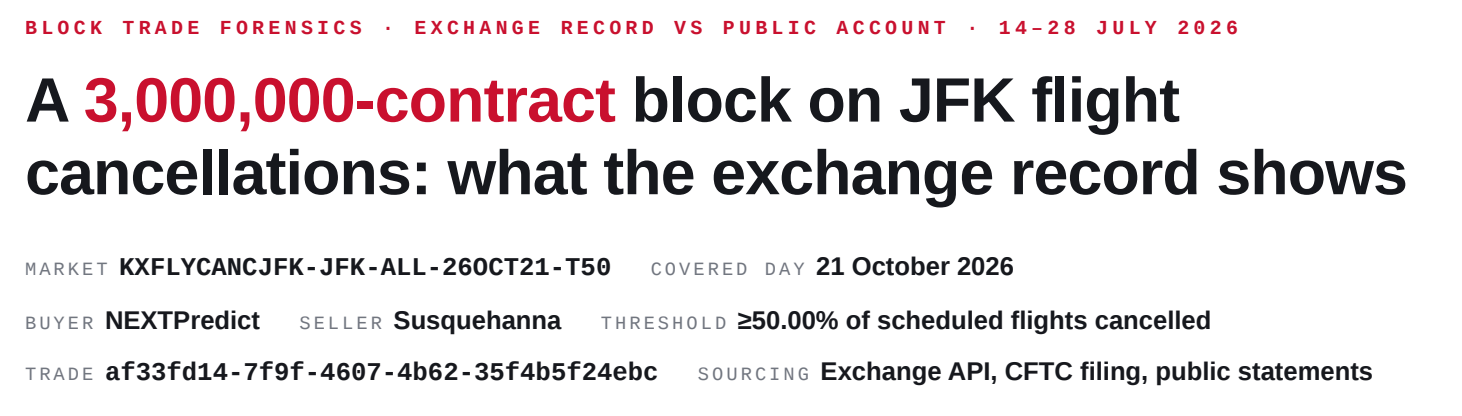
From BETINT Brief BI-2026-0728-JFK, issued 28 July 2026.
The trade
On 27 July at 16:14:32 ET, a single block bought 3,000,000 YES contracts at $0.0040 on the market “Will at least 50% of scheduled passenger and cargo flights at JFK be cancelled October 21, 2026?”
Premium $12,000. Maximum payout $3,000,000. A payoff ratio of 250 to 1.
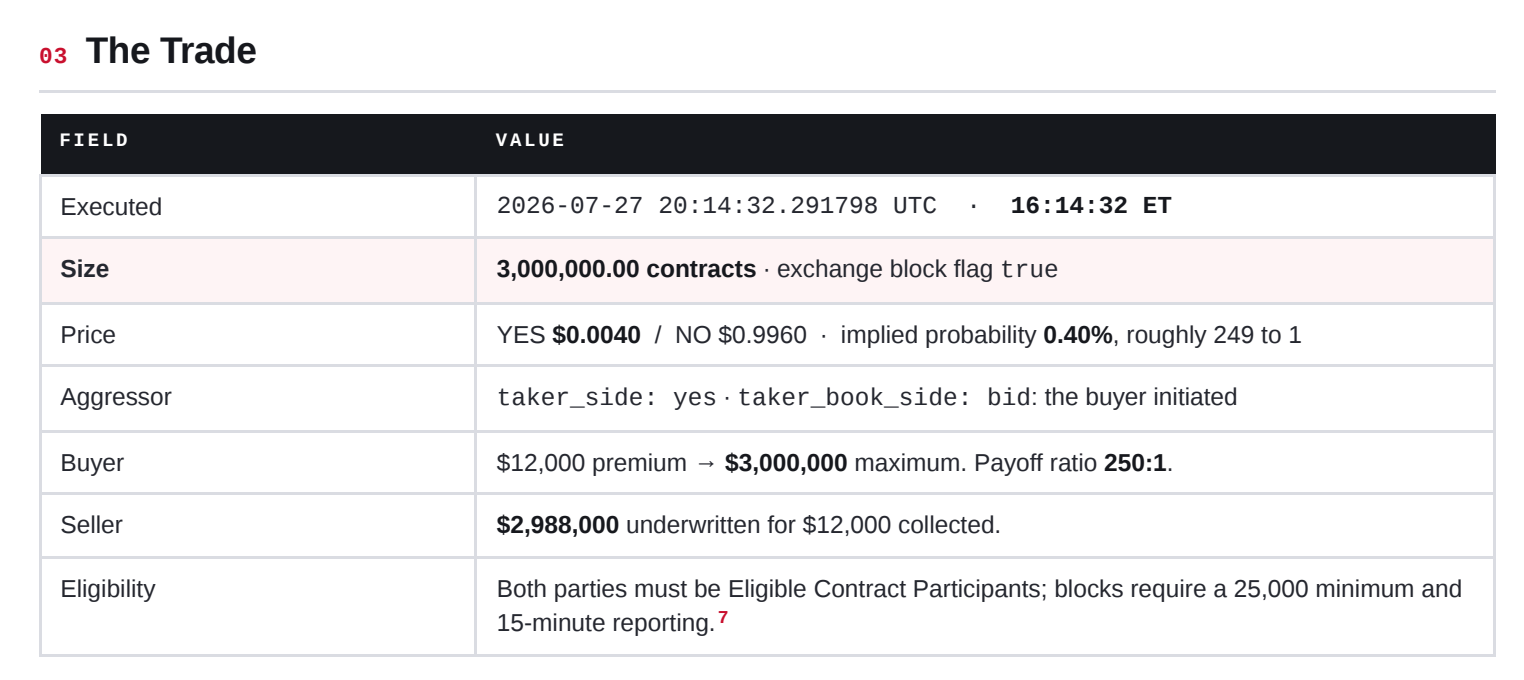
It was never really a market
The contract listed on 15 July and traded nothing for twelve days. But that is not a market shrugging at a product nobody wanted.
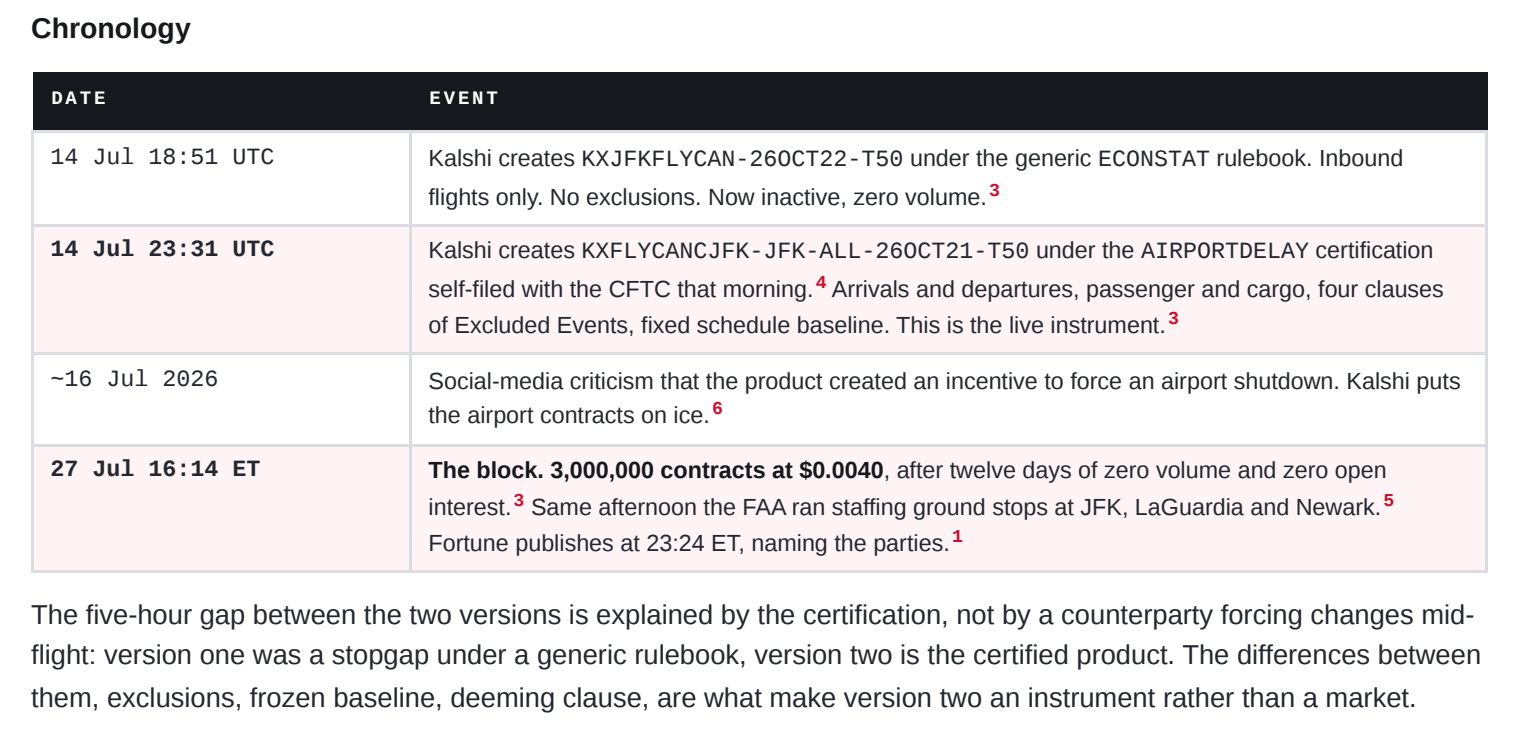
As best we can tell, Kalshi created it quietly, seemingly at NEXTPredict’s request, and did not announce it. Access was limited to roughly 1,000 institutional accounts. Block trades require a 25,000-contract minimum, which rules out the retail-sized flow that normally builds volume in a new listing.
One maker quoted it, 6 cents bid against 13 to 14 offered, for a few hours on the morning of 15 July, then pulled. After 14:00 UTC that day there are no candles at all until the block. Not just no trades. No quotes.
At the hour of execution, the book was 0.00 bid against 0.99 offered. A 3,000,000-lot could not have been filled on the public order book at any price.
So it was not a market that failed to attract interest. It was an instrument, built to order, that happened to be listed on an exchange. The single transaction in its history is the reason it exists.
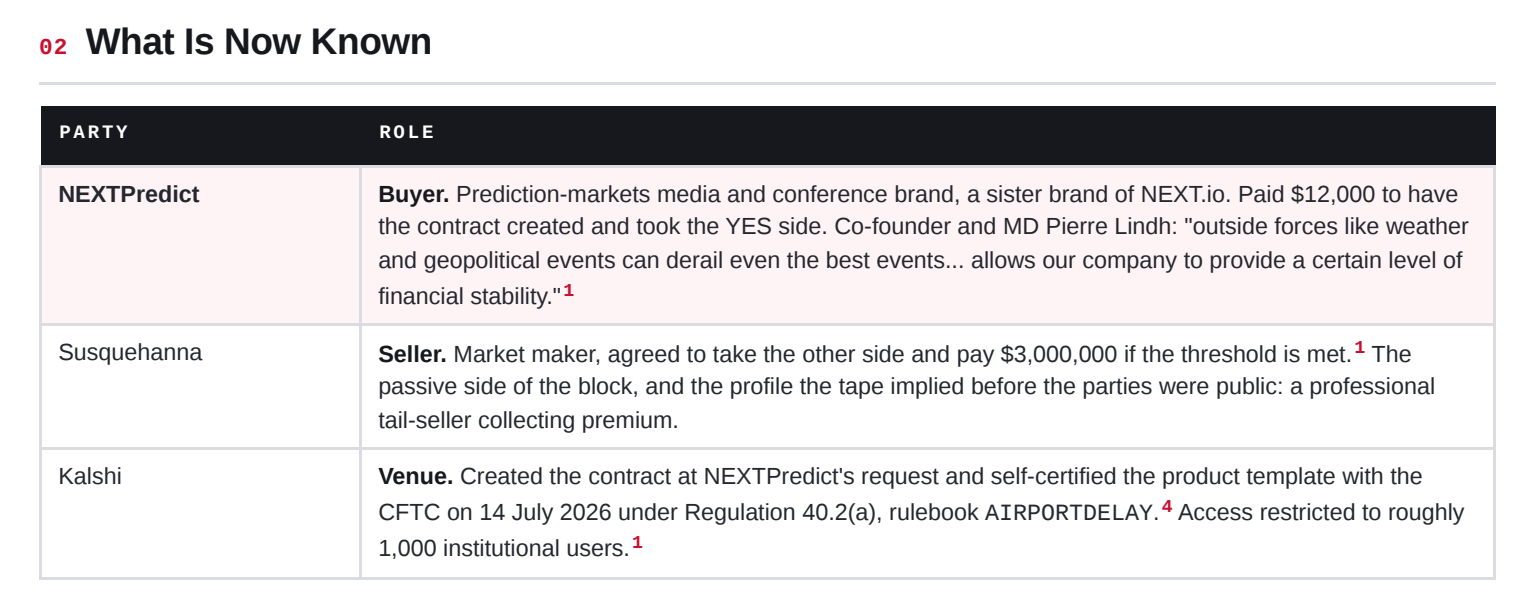
The parties, per Fortune’s reporting and NEXTPredict’s own statement.
Susquehanna is taking the professional tail-seller side here: collect $12,000, underwrite $2,988,000. Kalshi is the venue, and self-certified the product template with the CFTC on 14 July under Regulation 40.2(a), rulebook AIRPORTDELAY.
The shape of that was legible before the names were. A block flag, an empty book, and one resting take-profit order is a hedger buying cover from a professional, not two traders disagreeing about JFK. The names confirmed the structure rather than changing it.
Where the reporting and the filing come apart is on what the contract does, and both gaps make it sound safer and broader than it is.
An excluded event does not refund your money
Fortune records a Kalshi spokesperson saying the excluded events would result in the exchange refunding bets.
The filing says something else.
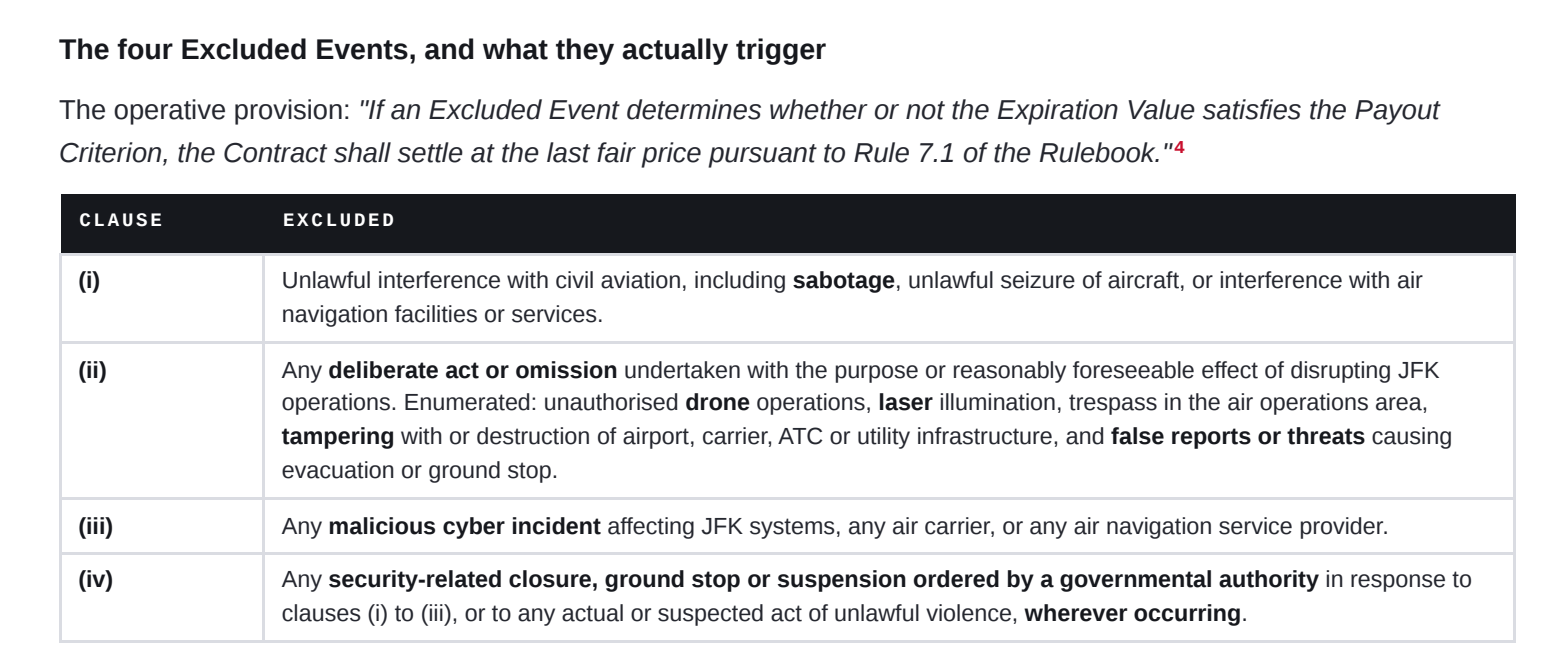
The operative text: “If an Excluded Event determines whether or not the Expiration Value satisfies the Payout Criterion, the Contract shall settle at the last fair price pursuant to Rule 7.1 of the Rulebook.”
Not a refund or a zero, but a mark-out at the last fair price.
That distinction is the entire answer to the moral hazard objection, and it is a better answer than voiding would have been.
An attacker cannot manufacture the $3,000,000, because the event that would cause the cancellations is the same event that stops the payout. And Rule 7.1 lets Kalshi reach back to the last traded price before the circumstances became known or reasonably anticipated, which kills the obvious workaround: buy it cheap, run the price up, then trigger the event and collect at the inflated mark. The reach-back defeats that trade specifically.
Add the access restriction, roughly 1,000 KYC’d institutional accounts with clearing members recorded on every block report, and the practical gap closes. The July objection was aimed at a mechanism the document had already foreclosed.
The rest of it reads like reinsurance, because it is
Once you see the exclusion set, the drafting register gives the game away. Excluded Event. Schedule baseline. Fixed scheduled-flight total. Corrections and revisions. Reinstated flights. That is not exchange language. That is underwriting language.
The four clauses track AVN48B, the War, Hijacking and Other Perils Exclusion Clause carried by essentially every aviation insurance policy in the world. With one deliberate deletion.
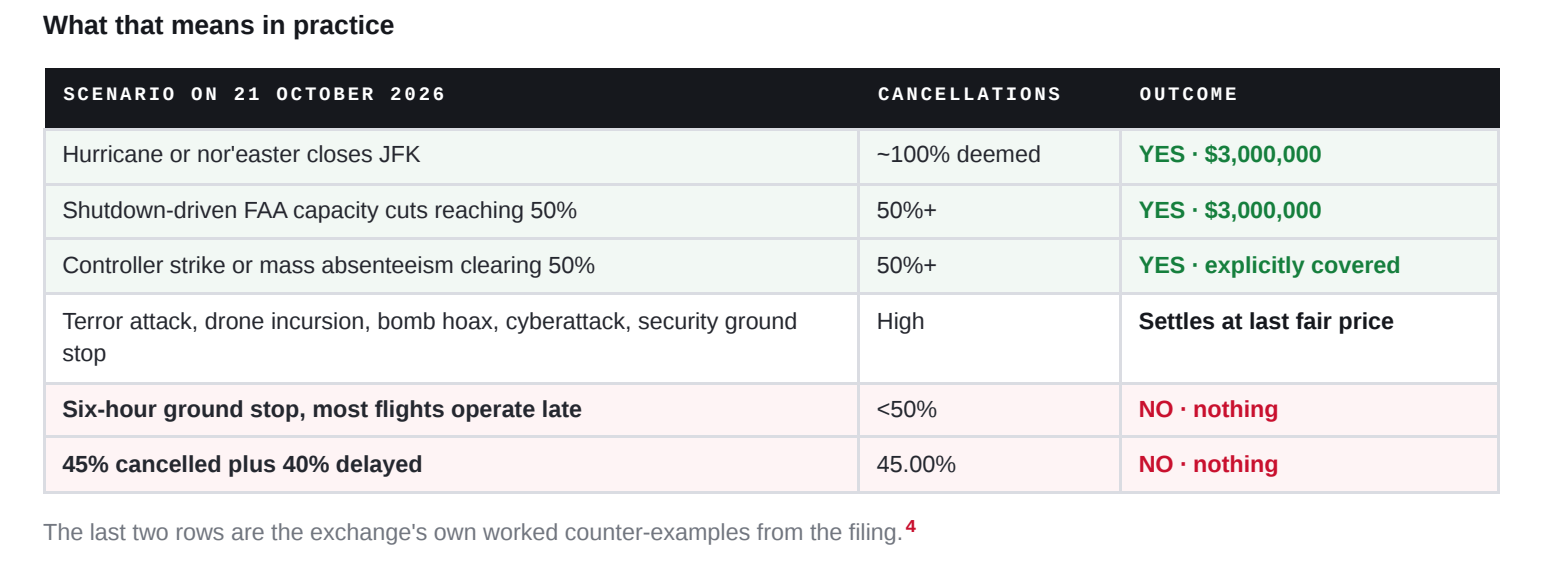
The strikes and labour-disturbances limb is gone. And the filing closes the ambiguity directly: “cancellations arising from any cause, including weather, air traffic control action, staffing, mechanical issues, or strikes, are counted identically.”
That matters more than it looks. A controller sickout is the single most plausible non-weather path to a mass cancellation day, and it would otherwise read as a “deliberate act or omission” under exclusion clause (ii). The operative text forecloses the argument. Labour action is a covered peril.
So: a parametric insurance policy, drafted in reinsurance language, listed on a regulated exchange, and sold to a company hedging its own event.
That is the story, and it is a more interesting one than the argument the product picked up in July.
Which leaves the question the coverage skips.
Is it actually a good hedge?
On the exchange’s own terms, the cover is far narrower than the risk it is described as addressing.
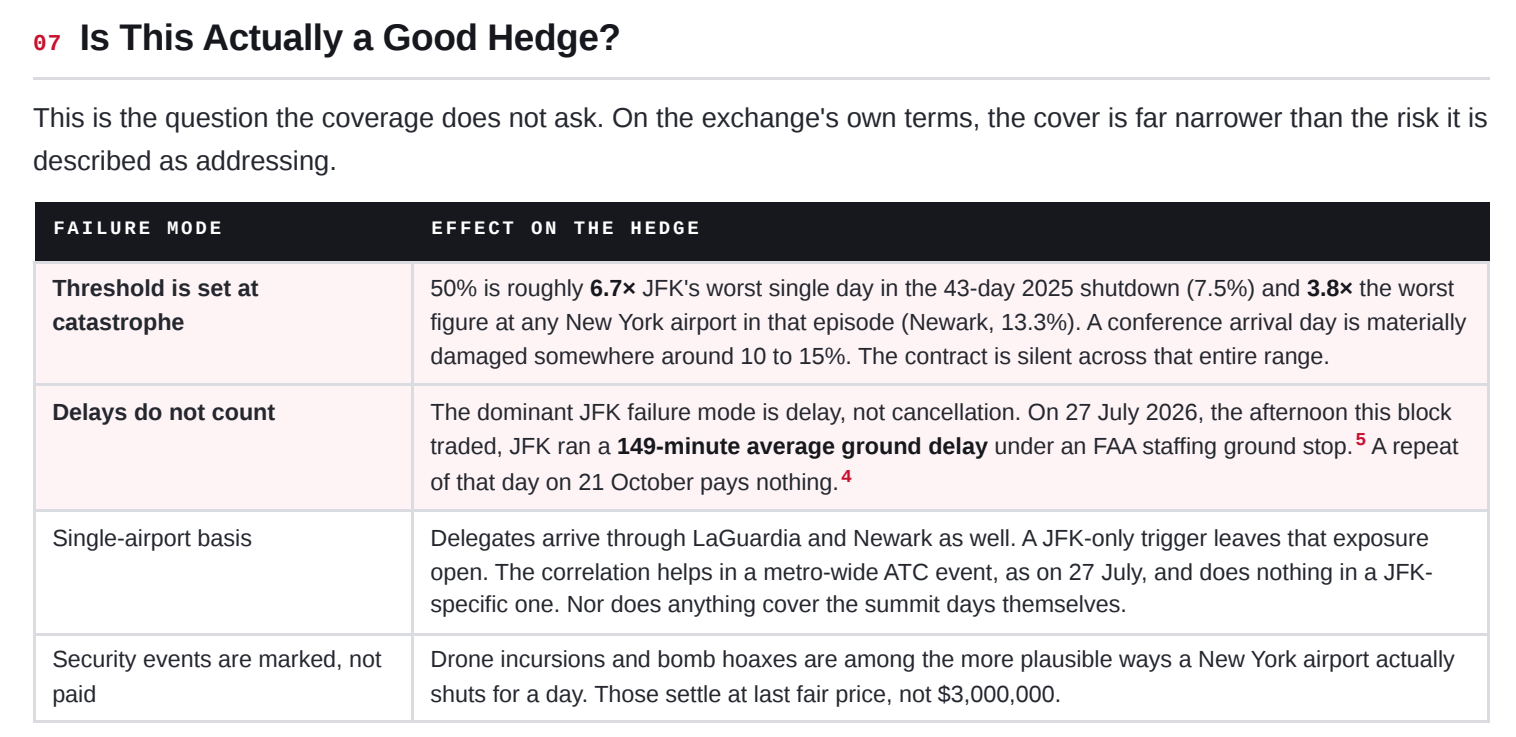
The threshold is set at catastrophe. Fifty percent is roughly 6.7 times JFK’s worst single day during the 43-day federal shutdown that ended in November 2025, when 20% to 40% of controllers were absent nationally and the FAA cut scheduled operations by emergency order. JFK’s peak in that entire episode was 7.5%.
The worst figure at any New York airport was Newark at 13.3%. A conference arrival day is materially damaged somewhere around 10% to 15%, and the contract is silent across that whole range.
Delays do not count at all. Only cancellations, as classified by FlightAware at expiration. Diversions and gate returns that ultimately depart do not count, regardless of length.
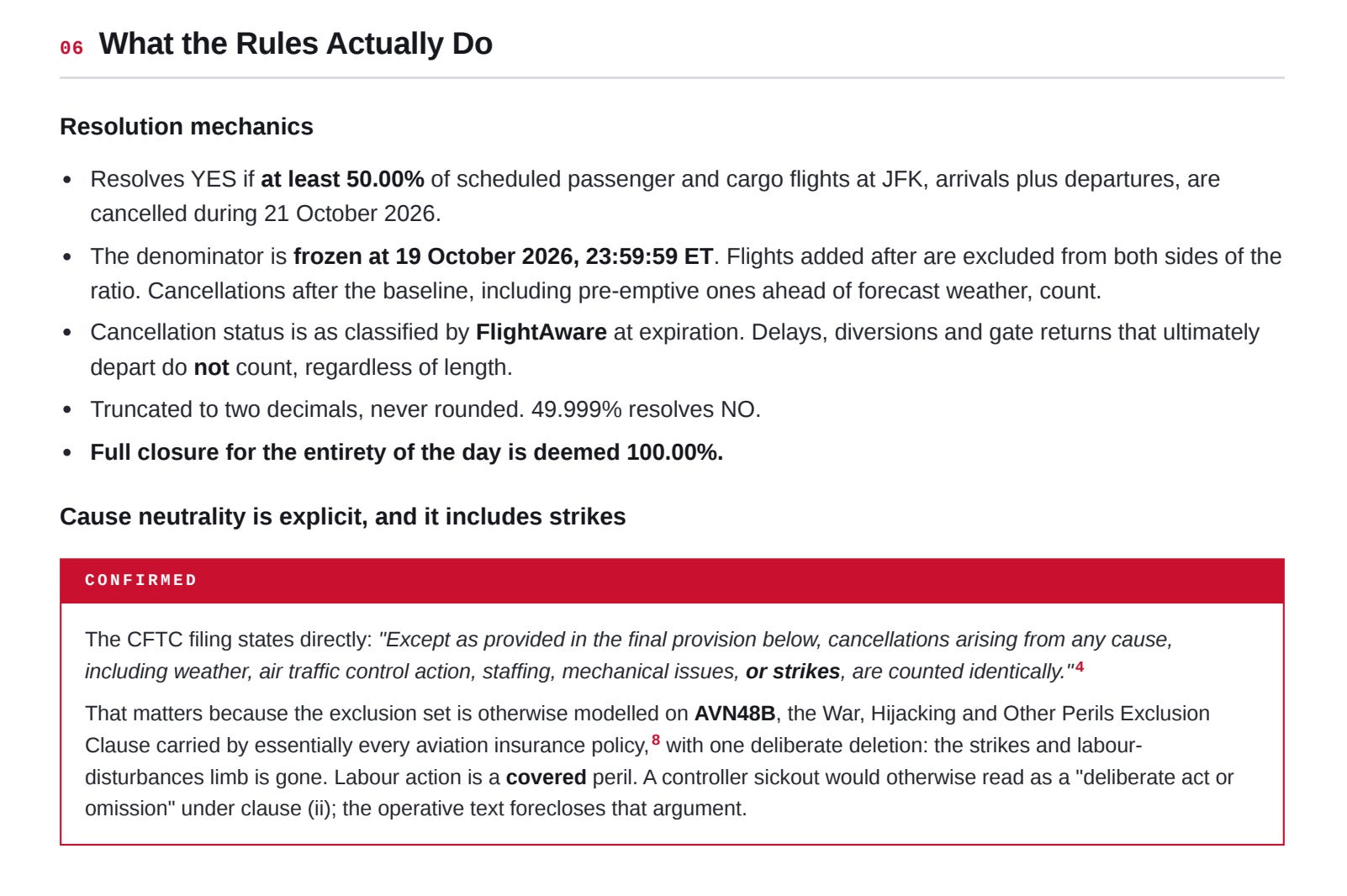
That is not our reading of a grey area. The exchange’s own certification uses a six-hour ground stop where flights operate late as a worked example of an outcome that pays nothing.
Here is where that bites. On 27 July 2026, the same afternoon this block traded, the FAA ran staffing-driven ground stops at JFK, LaGuardia and Newark simultaneously. JFK carried the worst delays in the region: a 149-minute average ground delay.
That exact day, repeated on 21 October, would wreck a conference arrival flow and pay zero.
Two more gaps worth naming. The contract covers one day, 21 October, the inbound travel day. The summit itself runs 22 and 23 October, and disruption during the event is unhedged, as are departures on the 23rd. And it is a single-airport trigger, while delegates arrive through LaGuardia and Newark too. The correlation helps in a metro-wide ATC event like 27 July, and does nothing in a JFK-specific one.
What $12,000 bought
We put independent fair value on this contract at roughly 0.2% to 0.5%.

They paid 0.40%. Susquehanna has not obviously overcharged, and NEXTPredict has not obviously overpaid. The instrument is honestly priced. It simply pays in a very narrow and very extreme corner of the risk it is described as covering.
To get there you need a tropical system or a severe extratropical storm closing the airport, which under the deeming clause resolves at 100%. Hurricane Sandy made landfall on 29 October 2012, closed JFK for roughly a day and a half, and cancelled more than 20,000 flights. That is eight days later on the calendar than the covered day, inside the same late-season Atlantic window. It is the cleanest covered path there is, and it is still a fraction of one percent.
So for $12,000, NEXTPredict has bought a genuine, correctly priced far-tail contract, and a Fortune article about its own conference. Fortune itself raises the question of whether this is replicable risk management or, in large part, a marketing effort. On the numbers, the risk transfer is real but slight. The narrative value is large and certain.
Both are true at once, and there is nothing improper about that.
Why this matters beyond one contract
Kalshi says it is in talks with companies in freight and energy about similar airport-specific cancellation contracts. That converts a one-off into a product thesis, and it is the part of this story with the longest tail.
A regulated exchange is being used as a parametric insurance venue. The AIRPORTDELAY certification is an airport-and-period generic template. Any hub, any window, listed on request.
The bespoke-listing channel is the interesting surface. A counterparty can commission a contract, have a market maker take the other side, and hold cover without a broker, an underwriting cycle, or a claims process. Settlement is mechanical against a third-party data feed.
The regulatory line is still moving. The CFTC has been unusually active on this venue in 2026: insider-trading enforcement in April, a rare emergency-rule stay on 14 July, dedicated prediction-market rulemaking since June, and reporting this week that the Commission is pressing exchanges to abandon broad contract templates. AIRPORTDELAY is exactly the kind of broad template that guidance addresses. Those two trajectories are on a collision course.
Threshold design is where the value sits. If these contracts are going to function as risk transfer rather than lottery tickets, the strikes have to come down into the range where disruption actually hurts. A 10% or 20% JFK cancellation contract would be a real hedge, and would price in the single-digit cents.
That is the product to watch for.
What we are watching
A few things would settle the open questions here.
Whether a 22 or 23 October contract gets listed, which would close the gap over the conference days and confirm the travel-day reading was deliberate. Whether lower-threshold airport contracts appear, which is the difference between risk transfer and a lottery ticket. Whether the template shows up at other hubs with freight and energy counterparties, which tests the product-line thesis the exchange has stated out loud.
And on the tape itself: the buyer’s only visible instruction is a resting offer to sell all 3,000,000 YES at $0.95, an exact size match and a good-till-cancelled take-profit. Any movement in that order is the only statement of intent the hedger has made.
Below it sit unfilled bids: 116,666 contracts at $0.003 and 175,000 at $0.002. Someone is still trying to accumulate this thing at a third of a cent, as of 2:41AM ET today.
The gap worth reading for
Prediction markets are now being used to transfer real corporate risk, priced by real market makers, on templates that can be replicated at every major airport in the country. That is a genuinely new thing, and it arrived without much ceremony.
It also means the odds line is no longer the only interesting number. The interesting number is the distance between what an instrument is described as doing and what its filed terms say it does. On this contract that distance is two reported details and one threshold, and all three point the same way.
This piece draws on BETINT brief BI-2026-0728-JFK, a nine-page internal report on the block, the certification and the base rates. It is not published.
Sources. Kalshi REST v2, pulled 28 July 2026: full rules text, the 28-trade tape with block flags, full-depth order book, hourly candles from listing, and the superseded 14 July version of the contract. KalshiEX LLC, CFTC Regulation 40.2(a) notification, AIRPORTDELAY rulebook, filed 14 July 2026. Fortune, 27 July and 16 July. FAA emergency order and per-airport cancellation data from the 2025 shutdown. NEXTPredict’s summit page.
BETINT produces this level of coverage on the markets that move your business, your sector, and your stakeholders. To point it at the markets that affect you, reach out at bettingintelligence.ai or contact dan@betint.ai.